Follow Us on Google
By Steve Agbota
Water hyacinth, an invasive water plant, is considered a nuisance in Nigeria’s waterways because they impede the movement of boats when the engine gets entangled with them.
However, maritime experts say the plants are not a nuisance but economic gold if there is political will to harness their potential.
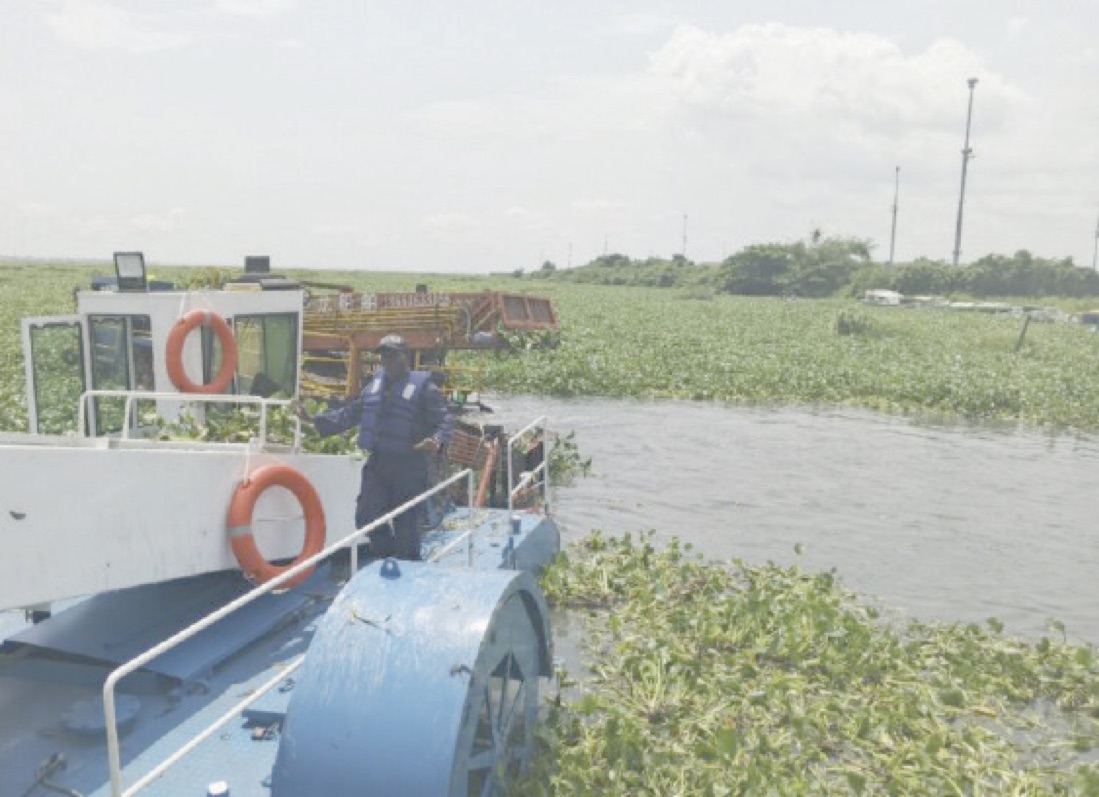
They note that once the plants are transformed into a valuable economic resource, they can boost job creation, income generation and local production. Every year, the Federal Government spends millions of naira through its maritime agencies, particularly the National Inland Waterways Authority (NIWA), to clear the pervasive aquatic weed known as water hyacinth (*Eichhornia crassipes*). The weed’s rapid proliferation presents an annual challenge to navigation and economic activities across Nigeria’s inland waterways network.
Daily Sun learnt that water hyacinth, an invasive species native to South America, has become a persistent feature of tropical and subtropical water bodies globally, including Nigeria’s inland waterways and adjoining creeks. Its dense mats disrupt oxygen levels, block sunlight, impede fishing, and, most critically for a city like Lagos, severely obstruct maritime transport.
To tackle this menace, the government intensifies efforts by allocating huge resources to remove the weed and protect lives and aquatic ecosystems. For instance, NIWA made significant budgetary allocations for waterway maintenance in recent years, including N434 million in 2022 and N280 million in 2023 for the removal of water hyacinth and floating debris across Nigeria’s six geopolitical zones. In its 2025 budget, the agency has earmarked N850 million for the removal of wrecks, clearing of water hyacinth, floating debris, and other materials from the nation’s inland waterways. An additional N550 million has been set aside for mechanical and manual clearing within the same scope.
However, experts say that water hyacinth also presents an economic opportunity, as it can be converted into valuable finished products. The plant has potential applications in phytoremediation, paper production, organic fertilizer, biogas, human food, fiber, and animal fodder. A recent breakthrough technology also enables the conversion of water hyacinth into a renewable energy source, with one kilogram of hyacinth costing significantly less than gas energy.
Stakeholders insist that Nigeria needs political will to transform these aquatic weeds into tools for sustainability and profit through innovative solutions such as biochar production, Black Soldier Fly Larvae (BSFL) cultivation, and frass processing. Meanwhile, reports indicate that both NIWA and the Lagos State Ministry of Waterfront Infrastructure Development have deployed machinery and task forces to areas such as Pakodo Jetty in Ikorodu, undertaking joint efforts to clear waterways and ensure safe navigation.
Speaking during a recent monitoring visit to the Ipakodo terminal, Ikorodu, the Lagos Area Manager of NIWA, Sarat Braimah, described the clearance exercise as a critical safety intervention rather than a routine cleanup.
“Water hyacinth, a fast-spreading aquatic weed native to the Amazon Basin in South America, entered Nigerian waters through ballast water discharged from ships in the 1980s. It now reappears seasonally between July and December, choking waterways, obstructing boats, and impacting fisheries and local livelihoods,” she said.
“We are monitoring its movement as it spreads, and our teams move with it,” Braimah added, hinting at ongoing research and collaboration to turn the challenge into an opportunity. “Research is ongoing to establish a centre that will help us convert this menace into useful products.”
Speaking to Daily Sun, maritime tourism expert, Frank Meke, emphasised that Nigeria needs political willpower to convert these weeds into economic opportunity.
“Basically, one of the problems in our country is not the absence of policies or direction, but the willingness to implement them. Nigeria has the capacity to address these issues. For instance, Lagos is already planning to convert street waste into useful products. Companies are recycling plastic bottles and other materials, generating economic value. This same principle can apply to water hyacinth,” Meke said.
“Once there is political will, these weeds can be transformed into fertilizer, animal feed, or other valuable products. The challenge is the willingness to turn policy into action. Until that happens, private sector efforts may lag because of funding constraints,” he added.
Meke noted that water hyacinth has both advantages and limitations. It grows seasonally, typically from October to December, meaning businesses focused solely on its use must adapt to periods of abundance and scarcity. However, the volume of hyacinth that appears is often sufficient for enterprises to process it into fertilizer, animal feed, or other products even during the off-season.
He explained that the plant’s proliferation is driven by nutrient-rich waters, often caused by effluents from surrounding industries and runoff from communities. “The government needs to monitor what companies are discharging into the water and regulate it. During certain times of the year, especially around Christmas, increased production leads to more effluents, which encourage hyacinth growth. Research is needed to identify causes and mitigate them,” he said.
“Ultimately, removal is necessary—not just because it blocks boats or makes the water look dirty, but because it depletes oxygen, impacting aquatic life. The government must either prevent excessive growth or find ways to convert the plant into wealth. Awareness, subsidies for equipment, and innovative processing can help. Our water bodies are polluted with effluents and waste, which exacerbate hyacinth growth. Only the government can tackle this holistically,” Meke concluded.