Follow Us on Google
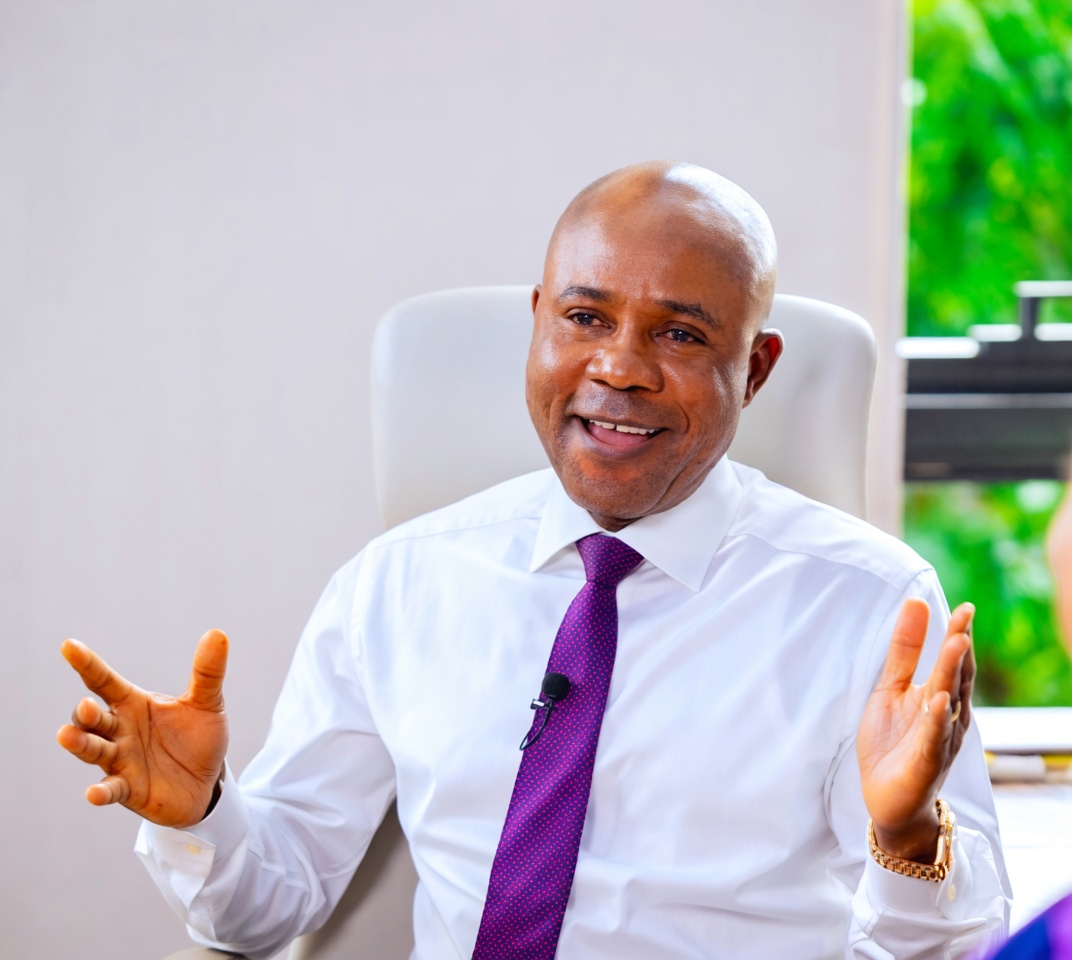
From Romanus Ugwu, Enugu
Enugu State Governor, Dr. Peter Mbah, could rightly be described as Mr. Project, having distinguished himself in the areas of infrastructure, security, education, agriculture and technological development.
Speaking in Enugu during an interactive session with Renewed Hope Media team, he said that his developmental strides would not have been possible without the support of the President Bola Tinubu-led government.
He listed his landmark achievements in the areas of building AI-enabled Smart Schools and ICT-equipped Command Security Centre to comprehensively monitor the entire state, including the forests within the state.
What are your motives in building the international hospital in your state?
It would be nice to just make some general reference to illustrate our vision. When we were campaigning for this office, we set out a blueprint for what Enugu could become under our watch.
That blueprint was predicated on three factors. One was to grow the economy exponentially, from $4.4 billion to $30 billion in eight years.
The second was to eradicate poverty. We inherited the poverty headcount of 58 per cent and we are committed to bringing that number to zero in eight years.
The third was to make Enugu the number one destination for tourism, living, business and investment. If you take the first item there, exponential growth, meaning growing the economy from $4.4 billion to $30 billion.
If you look at the capital, it is about 27 per cent confirmed annual growth rate. If you look at the trend and the pattern of growth over the years, it doesn’t quite reflect what we are projecting.
Therefore, you will see why some sceptics, naysayers, wouldn’t give us a chance, because it wasn’t really what we projected. If you look at the historical perspective, you wouldn’t be able to make sense of what we were talking about.
But we realised that we needed to do things differently. And we pointed out that this is going to be an era of constant disruptive innovation, things that were going to disrupt the status quo. The important thing was that the growth is going to be government-enabled but private sector driven.
What that means is that we needed to put the fundamentals in place for this private capital to flow towards the direction.
If I should address the question of our intervention in the medical sector, which is not isolated project, they are all connecting these dots and mutually reinforcing.
What we did was to look at those key drivers, and those things that can attract the private sector. We identified the biggest elephant in the room which is the security challenges. When we came in, we had the sit-at-home thing where people were told the days of the week they have to sit at home and days of the week to go to work.
That was not acceptable to us. We had to put in place security measures, working with the security agencies, investing hugely in technology, bringing that so-called sit-at-home to an end, and making sure that we provide a safe environment for this private capital investment to flow.
The other things are the services, again making sure that things like healthcare is top priority. If you are bringing in an investor who would be worried, two things, one is security, the next thing is where to seek medical attention if they are sick.
If you look at our manifesto, our objective has been to capture some of the markets of the medical tourism, the market size of about $2 billion.
Our plan was that if we can do something very attractive to capture just 10 per cent of that market, we are talking about $200 million, which is huge.
To actualise that we resolved to build a world class hospital, bring in top-notch professionals, ensure that the place is run very well and that way we can capture some of that market size. That is essentially what we have done.
What you saw in international hospitals is a facility that is going to provide the opportunity to carry out Spect scan and health scan as there are few locations to do that and that is like advanced Oncology centre to carry out all diagnosis, therapeutics, and carry out the treatment as well. So, this is just talking about the medical sector.
What was the motivation to invest in tourism through the airline and upgrade of the Akanu Ibiam International Airport?
Again, it is part of connecting the dots and growing the economy as well. Our target is to bring in three million visitors to Enugu. If you look at our manifesto, it speaks about bringing in that number, and doing the calculation, three million visitors means that we have to ensure that at least 100 aircrafts are landing in Enugu Airport every day, to get close to that number.
We are talking about an airport that takes, as at the time we came in, maybe four or five aircrafts landing in Enugu. It was just not possible and we just didn’t have the facility to take more. We felt that we need to have our skin in the game, we want to first create the pull factors.
We are developing four massive tourism sites, comprising the longest zipline in Africa, spanning 300 metres, which takes off from the Pine Forest all the way to the cave. We are also doing a cable car of 5.6 kilometres, which takes the highest point in the state, 580 metres above sea level. It is a massive cross of hope.
It takes one from there to the monastery, for those interested in religious tourism, the highest point of the cross to another 70 metres to the part where one has the chapel to commune directly with God.
These things have been carefully created to act as pull factors to bring people there. And if you have to do that, we also have to start thinking about access and how people will be able to access the states.
We had to set up our own airline, and we now operate regular flights. We have close to 20 flights coming into Enugu on a daily basis now.
But that is really not our target, our target is to move that number to 100, however we have to also pull the passengers, and bring in the diaspora, attract foreign travellers, and even the investors that also want to have direct flights from their state or location to the location of investment.
We got involved with an investor who is interested, because the federal government won’t want to concession to the states, that’s the rule. We worked with the investor to ensure a successful concession of Akanu Ibiam International Airport and ensure that it becomes operational.
Any time we have the opportunity to give credit to Mr President, we do because it took his intervention, standing behind this deal for the success to be recorded. This is the first airport in history that has been successfully concessioned, and very soon it will be fully operational.
I thank Mr President for the support to my state. The entire South East, I must say, is grateful that this has happened, because very soon we are going to have a functional international airport from the South East, so that the people of the zone can travel down to here. Our target is that by December this year, they will be able to get a direct flight from Enugu to the US, and from Enugu to the UK, and to China. That is our objective of making sure we achieve our target of bringing three million people to Enugu annually.
Other News
Security is a core ingredient of development because without security, development won’t happen. It reflected in the investment in the command and control centre, how did you achieve that?
We believe that if we don’t get the security aspect right, it will be impossible to attract the level of investments we expect to happen here. What we have essentially done is to invest hugely in technology to at least have a clear line of sight of what is happening in the States, to also monitor the gateways into the state.
We were able to identify the official gateways, and we have about nine gateways and we were able to have a clear line of sight of visitors coming into the States, and those leaving the States.
Our objective again is to nip crime in the bud, because this sector is one area that if, in a spectrum of 10, you do nine well, and commit an error in one, it gets magnified and diminishes everything done in the nine.
We always have to be extremely vigilant, and that is why we have to invest in those digital equipment and tools that can help us to be that vigilant to nip crime in the bud, but also when there is a breach we will also have the ability to act swiftly.
That is why we have set up the Distress Response Squad (DRS) with an AI-enabled cameras.
Our DRS vehicles all have AI-embedded both the static and mobile cameras. That means that as the policemen are driving or remaining static, they know what is happening within two kilometres radius through the monitors they have in the vehicles.
Our DRS men have body camera. From the Command and Control Centre we are also viewing what they are doing so that we are able to monitor their performance. The helmets of those on night duties also have cameras so that we are able to monitor them remotely.
We are also working very closely with the security agencies in a collaborative relationships, the army, the DSS, police, Civil Defence and I must commend them because we may have all these fantastic tools, but if we don’t have the personnel, the motivated workforce to use them, we will also be running into problems.
After making huge investments in Smart Schools, how are you bridging the technological gap between the teachers, students, and how do intend to sustain the investments if resource dwindles?
Starting with the sustainability aspect, what we have done in the last three budget cycles, was to dedicate 33 per cent of our total budget to education. That is not sustainable, because we are carrying the heavy limits, the capex that we are not going to continue going into the future.
We imagine that the recurrent or the operating costs won’t be as high, because in the last two and half years, we have been able to do more than 7000 classrooms. As at today, we have built 267 Smart Learning Schools. We have started equipping them with all the features of a typical smart school like robotics centre, AI, ICT, 3D Printer. But most importantly, we have to push on something which for us is the number one risk factor.
That is how do we ensure that we get the right teachers and the tutorial staff? That has always been identified as the major risk factor. What we did was to built what we refer to as (CELI), Centre for Experiential Learning and Innovation.
Finally, what we also did was to interrogate the current pedagogy. We have also modified that and moved away from the route system of learning to an experiential learning system. That is teaching by practice, where we get the kids to constitute themselves as a team and begin to involve them in what they are learning.
Beyond seeing them on the e-learning platform, we also do practical stuff. We have locations, for example, where we teach the kids how to create a filtration system that enables them to know how to clean the water they produced. We try to get the kids to learn by practising which will make them to see themselves as problem solvers rather than just coming to normalise or repeat what the teacher said.
We are now taking the teachers through that pipeline, the centre where these teachers are all taught to be able to teach at a Smart School. First of all, we conducted a civility exercise, where we were able to pick teachers that would be trainable, trained and get them to teach, that is not something you relapse on.
It is a continuous thing, we are going to continue training them to increase the number of teachers with skills to teach AI, skills to teach robotics, mechatronics and all the evolving 21st century skills that these kids need.
We are also picking them from age three, we have 12 years of free and mandatory education, from age three, there is the early child learning that is free, and we have the nursery, quick family 1, quick family 2, then basic 1 to basic 9. We stopped the common entrance. From basic 6 to basic 7, there is one more guideline, just pass the examination, that basic 9 is mandatory and free from the early child learning.
We believe that once we are able to move away from this heavy lift, the operating costs will be manageable and if we don’t do this, how can we possibly eradicate poverty in the long run.
The idea is that if we sustain our investment in education, we are able to save a lot of money to spend on security tomorrow, because if we don’t get these kids skilfully equipped, they will take to criminality and misadventure tomorrow. We might as well spend that money to be training them.
How has Mr President’s policies and reforms impacted on the good work you are doing?
It would have been impossible to say the least that we would have done things at this scale indeed, without some of the bold and courageous policies of Mr President. First of all, what the policies of Mr President has done for the sub-nationals is largely to free up resources to them.
The President has been very intentional in terms of how this $1 trillion economy is to be achieved. He believes strongly that this is not going to come from top to bottom up, but from the peripheral. In order to achieve that he has to strengthen the full intent of responsibility and also intent of acting, providing them with the finance.
If you just cast your mind back, and even having a conversation with my predecessor, he would remember what he went through. Sometimes he struggled to pay salaries when he comes back from FAAC, or maybe after the payment of salaries, nothing will be left for keeps.
What we are seeing today, at the scale, is only possible because we now have more funds coming from the federation. Of course, a lot of support from the centre to the sub-nationals, and for us, it is to make good use of that opportunity, essentially all we are doing.
Whether you want to look at things from the removal of the subsidies, the unification of foreign exchange, the reform in the tax sector, they are quite a whole lot of great initiatives. Now we are also having a look at the NELFUND policy.
This is something that we are excited about, because typically the list of scholarships we get, the applications we get, are almost unimaginable. But today we encourage them to assess NELFUND, and that freeze off funds for us to do other things. The impact is invaluable.
We saw the tractor assembling plant, can you tell us how the investment will be beneficial to Enugu people?
For us, agriculture is not just food security, it is also a major business and we are looking at agriculture beyond food security. What we have done is to announce a programme tagged construction of over 260 farm estates and the idea is to have a well-fenced location with the size of a typical farm estate that will house smallholder farmers to graduate from subsistence to mechanised farming.
We brought in agronomists and agric extension workers to training them and we also have storage and aggregation centres. For a typical Local Government Area (LGA) with an average of 15 words, out of the 260 wards and when we talk about them, we have 260 wards in education, healthcare, ect. Our model of development is all inclusive. We are making sure that no part of the state is left behind.
We are also doing so in the farm estate where we have a database of our farmers totaling over 18,000 smallholder farmers in Enugu. What we do is to put them in the housing estate and provide them with the machinery and equipment like the assembled tractors to go into mechanised farming and scale up production.
And because we are now producing at large scale, we are also building processing plants. Beyond the aggregation Centres, we also have the Agro Transformational Centres (ATC) we are doing in conjunction with the Federal Government, which also connects with the Airport facilitate in process..