Follow Us on Google
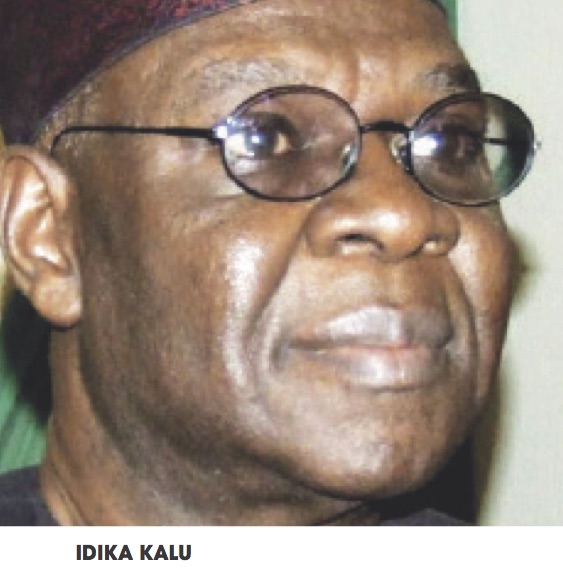
A former Minister of Finance, Dr. Kalu Idika Kalu, has explained why economic theories and policies that have worked wonders in other parts of the world and transformed countries have never worked in Nigeria.
Dr Kalu, who turned 84 on October 14, shared his memorable days in this interview with Saturday Sun.
While noting that many Nigerians said that after secondary school at Kings Collage, Lagos, he got seven university scholarships.
In an interview with VINCENT KALU, the four times minister, who was.
You were 84 on October 14. How has the journey been so far?
A lot of people say age is just a number. It is actually how you feel that is more important than the number. I’m lucky that at my age, I’m still very active, physically, intellectually. I move around; I don’t have identifiable infirmities. Of course, age is catching up on everybody. By the time you are over 70, you begin to experience some things. Generally, I have been quite healthy. Some may just want to flatter me, and they say you are just over 50.
As a professional economist, I may not feel as I would have liked to feel if my experience in the international arena was fully replicated in my own country, which is what I had hoped when I left the World Bank in 1980 to come back home. But that has not dented my interest, my enthusiasm, my push to have us realise the kind of potential we should have.
The journey has been interesting. I got what I may modestly call good training. I was very lucky as I didn’t have to sweat to get further training as I was always running into scholarships after my studies. There has not been any problem getting busy. In fact, it has been remarkable. The journey so far may be considered what you can call an ‘ideal situation.’ I got married and no sweat, and we have three males and two females, and we are still waiting for further extension of the immediate family from their own families. In all, I give thanks to God in every split second of the day; God has been merciful, so kind, so gracious, so protective, so guiding; everywhere I have been from my home in Ohafia, Abia State, all the way to Taiwan, Korea, Japan, China, I have been everywhere, and all the years in America, and there have not been any major problems.
Indeed, you look younger than 84. Your mother recently passed on at 100. Do you have longevity genes in your family?
It is obvious. In fact, one of my uncles was 108 years and he was saying, ‘do you think that I’m going to break all records?’ My grandmother is still holding the record. We haven’t gone back to check records. My grandmother was born in the 19th Century and traversed to the 21st Century. She was 116, and then my mother was just few days short of 100. So, when people talk to me, I tell them that I’m just starting. My aunty (my mother’s younger sister) is approaching 100, and I just lost an uncle who was in his 90s.
The longevity gene is particularly on my mother’s side. From my father’s side, I know some uncles who lived long, but my father, probably because he was in the Second World War and also in the civil service, he didn’t quite lived as long. But definitely, he lived about 80, well above the Nigerian average.
Within this period, what have been your memorable moments?
I was born in Ohafia. It was expressly designed that I would be born there when my mother came home, otherwise, I could have been born in Zaria. I can’t recall my baby years in Zaria, but I speak Hausa. Then, we travelled with one of my aunties to Fiditi, Oyo. She was the one who was telling me that we lived in Ibadan, we lived in Oyo.
Even at Ohafia, I was very intrigued with a lot of our customs. I remember once I came home and I was told that I have not shot my first bird (which every boy has to do as a mark of bravery, courage, and marksmanship) and the notion of, ‘don’t worry, we will arrange it for you’. My uncle and others arranged the bird I was going to shoot. Of course, everybody knew that I didn’t shoot the bird, but it was part of the arrangement. You know that kind of thing impresses one and all traditional things; erecting small batchers in the village square and doing some cooking. I remember all the traditional games we used to play and it is a shame that we have discontinued some of them. I have been raising it at Ohafia School of Thought that we should go back to reorganise all these traditional game. I remember the songs we used to sing at (Otaa Akara age) kindergarten. My teacher then became my father in law. All the songs they taught us and the excitement of remembering them off hand and jumping around the whole place.
Then, coming to Lagos, we stayed briefly with one of my uncles, Chief A. O. Ukwa, after my father came back whether from Burma or Ethiopia. By then my mother was in the village and it was my stepmother that I grew up with. We moved to Ebutta Meta. We used to play football in the space in from of our house. Gen Ike Nwachukwu (Retd) and his brothers lived very close to our house and they would come and play football with us. We mixed up- Yoruba, people from the present South-South and others.
It was said that, strangely enough, that I ran into the street and ran back home and started speaking Yoruba fluently, and people were wondering how I picked it up. That was another memorable period.
You are growing up happily and starting school at Ladilak Institute, Yaba. The Agbaje family started it. I don’t know if the Agbaje who once was running for Lagos State governorship was a member of that family. There was also Colony Pokus School that was established by Chief Oyename, my father’s friend. Doyin Okupe’s family also went to that school. From there, I went to St Jude. I think this is memorable. My father was using this to test me. I was always coming tops, so he thought he could give me more challenge. Before I went to St Jude, he also took me to Baptist Academy, but I came late, and so was not admitted, and I later ended up at St Jude. The challenge I had was being pushed tougher and tougher, but the interest I had was that Ladilak and Colony Pokus were not doing well in sports, so, I was looking forward to be in a school that was top in sports. So, when I went to St Jude, I said finally I have arrived where we would be challenging the likes of St Paul and some of the other big schools in Lagos in the Empire Games. In St Jude, I was enrolled in the Boys Brigade and I was part of the school band. We were secretly going to Bobby Benson before the entrance result to secondary school came out. Can you imagine being a band boy with Bobby Benson?
The next memorable time was passing the entrance exam into Kings College. It was after I passed that entrance examination that my father took me very seriously. I had two other mates who also passed and their results were sent to their school and everyone was expecting that I would be one of those who would pass because in the exam that was just concluded (First School) I was the best among the schools in that area. So, I was in tears going home seeing that two of my mates have their results. Then a bicycle hit me at Adekunle side. As I got to our house and I was getting up the stairs and I saw an envelope from Kings Collage, Lagos. I didn’t remember that I submitted my house address and that was why my result didn’t come to the school. Even though I was beaten by rain and a bicycle had jammed me, I immediately rushed out to meet Olonede of the Tejuosho family, who was my bosom friend, and also to Babajide Babafemi somewhere near Oyigbo, even when my family was calling me to come and eat, but I told them I was coming. I had to go there to inform them that I have got my result before I returned home to eat.
As a primary school pupil, my father would take me to Glover Hall. I would be listening to great speakers, some of them were from America; and others like Nnamdi Azikiwe, Herbert Macaulay, Bode Thomas, Mbonu Ojike. I got to know a lot of those top politicians – the NCNC and Action Group people. What interested me was listening to famous leaders and speakers from all over the world. You can see how that also impressed upon me as a young fellow the idea of a public service. These were great politicians, administrators and leaders of men. Let me not go forward because Kings College was a totally different level all together.
How did you get into the World Bank?
You know this thing about predestination. By the way you get to certain places, you invariably have the impression that you are destined to be there. I rushed through my university studies in America. I got six scholarships. I had one to go to the London School of Economics. I had one for Italy. I had another for Ghana. I had two for Nigeria, but I said that I wanted to go to America. I ended up in the United States, and finished my first degree in three years. My colleagues and I were the first set who came in under the African-American Scholarship Programme of American Universities. The first set of Nigeria-America Scholarship Programme, which was the set ahead of us, did so well, and that was why it was extended to include other African countries. There were about seven of us from Kings Collage alone in that set. Some went to Stanford, Harvard, Yale, etc. Everybody expected that I would be in those ‘top schools’. After you go to America, you will know that we exaggerate this thing about a few top schools. When you come to specialty, you realise that there are scores and scores of schools that are good as any other in particular disciplines – engineering, economics, agriculture, etc.
I was in first form, but some of my mates were placed in sophomore because we already have Higher School Certificate and I did very well. So, I was complaining all the time. It took my first performance in that year for them to call me that I have good reason for complaining. After they had taken full account of what I had studied – My HSC or Advanced Level, and by the time they graded me, I now ended up a year ahead. I caught up with my friends who had started in the second year. In the third year, I took my first degree and the year after I took my masters degree. The following year, I went for my PhD – that should be middle of 1966. I finished everything in four and a half years – Bachelor’s, Master’s and PhD exams. I was given an offer at the Enugu campus of the University of Nigeria, as a research fellow and lecturer. Many great men like Prof Eni Njoku, Dr. Kalu Ezera were concerned that I had completed my PhD exams, but I had not completed my dissertation which was why I came home. I was here when the civil war broke out, and Dr Sylvester Ugo became the governor of Central Bank of Biafra, and so I was virtually overseeing EDI, and Ifegwu Eke who was my colleague became the Commissioner for Information.
The research work I came to do was truncated. After the war, they graduated those who should have graduated since 1967. The alumni of my university found out that I was still alive, and extended scholarship. Again you talk about destiny. In all the rubble in my house at Enugu, I still found my passport under the rubble and it had not expired. If it had expired, I don’t know what would have happened considering the scrutiny we were subjected to at that time; it would have delayed my going. My passport was ready; I got this scholarship and I sold the car that I drove through the war. It was my second car. The first had its engine knocked. I bought the second car from a UK departing staff at the university. So, I sold the car and I had enough money to pay my fare and my wife and I decided to get married because she was going back to the University of Ibadan to finish her medical clinical studies and I was going back to finish my dissertation.
I went back to the university. At one point I almost gave up because I said I have the knowledge, and must I have PhD? All of a sudden by inspiration, I started a different dissertation, which I’m now preparing to publish.
As fortune would have it, there were MIT, Harvard fellows in Nigeria, who came back at the time when I was still working on my masters in 1965. One of them came to recruit for the World Bank at my university. They usually came there, because the institution has a very strong department of Economics. I learnt he was in campus and I went to see him with some of my preliminary results. He looked at them and said, ‘eh, you should be at the World Bank.’ I said I didn’t know and that my wife was in UCH Ibadan and we were already expecting our first baby. I was sent an invitation for an interview and the most senior economist said, ‘we are assigning you to the Korea Division, comprising China, Korea, Hong Kong and Japan. That was how I got to the World Bank.
What did you do there?
I went on my first mission without going to defend my PhD. My professor was so much impressed with what I was able to come up with – massive work on trade, structure of industries and economic growth in Nigeria covering the period 1950 to 1970. Some of the studies of trade went back to early 1900. The guy was so impressed and what he saw that I did was related to what he has done when he was in Nigeria. That is the story of how I got to the World Bank. I never applied, I never wrote any exam. When I went for the interview, I could have ended up in Latin America, in Mediterranean or South Asia – India, Siri lanka etc, but the most senior economist just felt that he wanted me to go to Korea as they were preparing a mission to Korea. I was busy writing reports on processes of growth in Korea, Taiwan, and Hong Kong that I never showed up in my university during graduation.
You were among the team that put the Asian Tigers on the path of growth and development. There was Austerity measure, Green Revolution, SAP and others. Why is it that economic theories that had worked in other climes have not worked in Nigeria?
Your description is only broadly accurate. In details, it is not true. Some things have worked. Nigeria was always being cited as one of the fasted growing economies, when we had high agricultural production – cotton, sorghum, beniseed and many others in the North, and in the South, we had cocoa, palm oil, palm kernel, rubber, etc. We were growing very fast. We used them to build a lot of schools, institutions. This is where the theory of comparative advantage comes in; using what you have to grow your economy, wealth and labour force. It is a fallacy to say that those economic theories don’t work in Nigeria.
The major problem that we have had are institutions, leadership, expectations – what economist called, ‘demonstration effect’, where you copy other people’s consumption pattern. You copy them so much that you forget that you should consume what you produce. Even other countries still have that demonstration effect, but it seems that ours has lasted so long and while it lasted, we didn’t take care to sustain some of those things that could have put us ahead, like quality of education, competitive education system; we introduced all these quotas, cut of points, allocations outside of competitiveness when we didn’t have to, and we are still doing it today. What we needed to do was build the proper institutions, allocate teachers, allocate libraries, allocate facilities everywhere, but expect everybody to be competitive on the same basis.
Then politics came in, and with the politics came a proliferation of institutions. With the demonstration effect, we started abandoning public transportation for private transportation. You can systematically chat how we veered off from where these theories would have applied; Nigeria would have been industrialised by the 70s. When I was in Korea, we were looking on Nigeria as one of those that could be emerging as one of the Asian Tigers. The Asian Tigers connotes the rapid rate of growth, the rapid rate of moving away from poor intensive plywood, textiles leather goods etc and moving into capital intensive, technological intensive. Korea, in the mid 70s where I worked on it, has its export increased by 64 per cent in one year; it doubled in one year. They finished their modern steel mill; they have shipyard, and these companies – Samsung, Daewoo, etc were moving very fast. Some of them were advised to now go abroad to vend their skills. When the oil prices shot up with the Arab crisis in 1973/74, these countries were earning more foreign exchange than the oil producers who were making more money out of the big jump in terms of trade with the quadrupling of the oil price.
I know many people have said it, especially some of our leaders, that there is no theory that works here. The theories worked here, but we counter minded those theories by creating the conditions that responded to all these demonstration effect in our consumption pattern. We are no longer living steadily the way we were in the early 60s after independence. By early 70s, we had such lofty size in our consumption, but we could not match it with our production. That is where the theories started diverging from practice.
You were talking about our consumption pattern. The National Assembly recently spent about N160 million to buy Toyota SUV for each of its members. Couldn’t they have patronised local auto manufacturers?
I’m going to come back to this question. You earlier mentioned SAP. Let me respond to it. In the mid 70s, when the oil price shot up, Korea, Taiwan, Hong Kong and China, don’t have oil. They were advised to restructure their economy and move up higher in competition as the only way they can compete against Indonesia, Malaysia and Thailand and all the others that had the raw materials.
That was the essence of the SAP, the structural change, but we never understood it. You can call SAP by any name, it was just about how to restructure your economy in the face of new prices, new technology, changes in the market, etc. We pooh-poohed the notion, we thought it was going to force us to restructure the consumption pattern. When you restructure, if you are losing, the exchange has to adjust until you build up again, and it can go up, it does not have to go down, but you have to restructure. But we messed it up and we are still messing it up to a large extent.
The issue of demonstration effect affected our abilities to have realistic policies that would have enabled us to restructure. We had the raw materials, we had skilled people, but we have to make sure that the prices remain reflective of the relative cost and benefits. You don’t pad up your exchange rate and people are importing champagnes and other things they considered to be cheap because you didn’t allow your exchange rate to adjust to what the market relationship were. I don’t know what it could take to get this through our whole system. That is still our problem. That is one of the reasons we say theories didn’t apply. The theories applied yesterday, today and will still apply tomorrow.
Which one do we talk about? We set up steel rolling mills, we set up Ajaokuta, set up aluminium smelting plant, newsprint mills and other mills; we set up automobile plants, etc, but we couldn’t discipline ourselves to produce them and stay with them, but we stated importing because we overrated our exchange rate and how much naira was compared to the relevant other currencies.
Peugeot plant by the time I came back to Nigeria was supposed to be about 30 per cent import substitution, but now it has gone down. When you talked about automobile plants, I haven’t got the production function of Innoson and others. In fact, you have to start with your basic skills, basic materials. It is not assembly; assembly is a very shallow automotive if it is only assembly. We have to make sure that we produce the parts; we have to make sure that we are competitive in producing the parts. Then you can sustain it.
As Minister of Transport, we were to build a modern railway, fast wide gauge from Lagos all the way joining the old railways stations that the World Bank financed so many years ago. It would have opened up the whole of the northern area right down to Sambisa. I have talked about it before on how that would have affected the whole social contest, and maybe Boko Haram and the others that we would have avoided. We were also to build one from Lagos to Calabar towards the southern states- wide gauge. The KMW of Germany with their long term financing, ten years, 30 years repayment was ready to fund it, but we didn’t implement. This was when we started the mass transit programme, and that would have been a solid base for the mass transit programme. As a minister, we were supposed to also expand the water ways; the use of water ways not just Lagos to Apapa, but all the ports would have been developed – Port Harcourt, Calabar, Koko, Warri, etc. This is the theory, but we didn’t take it because we were just jumping, thinking of our wealth.
When we were getting independence, we started thinking of building a mono rail, when you didn’t even have a wide gauge, you didn’t even have public transportation, but you wanted to build a mono rail. You should have made sure that you expanded the railways all over the shorter routes. They said the transporters were lobbying against it. It’s not so because the transporters would even have expanded their business because there would be more volume of trade, more volume of haulage for agricultural goods, petroleum products, passengers, etc, aside from opening up the entire country, which already gives a sense of social mobilisation, more social intercourse and relationship among the peoples of Nigeria. You can’t underestimate what we lost by not sticking to the rules; sticking to the theory. It is not that the theory didn’t apply, but we didn’t stick to the theory. This is what the World Bank was talking about; that was the whole essence. We had a big mission to Korea in 1976 to help to step the competition that was going to swallow them up because oil prices went up, and they don’t have oil. What did they do? They had to restructure to get into petrochemicals, into steel production; they had to go into ship building. Nigeria is ordering ships from Korea, a country that was at the same level with us. I went to a ship yard in Korea; they told me that they were building seven ships for Nigeria. They went into high-tech; you know where Samsung stands today and other companies like LG. These are small companies then. We had better initial conditions in terms of economies of scale, in terms of the size of our economy, in terms of labour component, the market. We were ahead. All we have to do is to speak to the people not to be buying Toyota Land Cruiser for every Dick and Harry in local governments, states and federal level. This is the time for us to get back to the basis, what we can afford. This is the time to get back to building up our health sector, our education sector, creating level playing field from the southern cities to the northernmost point of this country, the same standard but give them equal service, they would perform. Somehow, we have to discipline ourselves to get back to those good days.
The naira is tumbling against the dollar. What should be done to arrest this slide?
First of all, let me shock you. I know when I say it people don’t believe it; they would say KIK has come again. If we have been staying with the rules; discipline, the naira could be less than ten to one dollar today. If we look at some of the currencies when we were in the World Bank system, some of the countries were still 20 or 30, may be. But with our resources, we have no business even getting close to that. It is not the World Bank or the IMF that caused our problems. I was so disappointed when a friend who should know better was saying that somebody out there is telling us to devalue our currency. It is no so. It is our performance. It is our structure of production, structure of trade, structure of resource allocation, pattern of expenditure that is sinking the naira. Nobody is using naira out there; nobody is interested whether you naira is one or 100 or 1,000 not. It is a function of our policies at home. The sooner our people at any level whether the presidency, National Assembly, state Assembly or what, understand this, the better. It is not in our stars out there, it is in us right here. If you don’t have to devalue it, the market, the private sector would do it for you. That is what happens in our villages. When there is scarcity, the price will go up. You don’t need a trumpet from the city, London, New York to change the price. If you have blight in corn or vegetables or tomatoes, nobody would tell you that things are rough because it is that price adjustment that gives the impetus for those who now want to take advantage then; they save more, invest more and produce more, and the price starts to come down. That is what has been happening from prehistoric times till now. IMF and World Bank were just created as institutions after World War 11. This is what Adams Smith and other great pioneers talked about. It is in the nature of the system.
When I was making comments on the removal of subsidies, I said, like I did during the Jonathan period that we should not have allowed it to come up the way it did, where corruption came in. The depreciation of the exchange rate was bad enough. When the exchange rate is depreciating that means that imports are getting more and more expensive in domestic currency, but if you are adjusting your domestic prices so that the differential doesn’t continue, the subsidy will remain very small. That was what we were saying in the 80s, 90s and it is what we are still saying now. So the fault is in us, not in our stars. It is not in the economic theories, it is how we are getting to understand and implement our policies that are the problem.