Follow Us on Google

Obinna Odogwu, Abakaliki
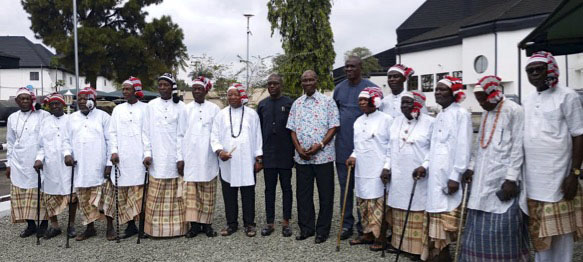
The traditional ruler of Amagu Ikwo, Eze Dominic Alo, the Erimogwudu III of Amagu Ikwo in Ikwo Local Government Area of Ebonyi State, has attributed ego and sensitive nature of land to why communal clashes are rampant in the state. He also spoke on the relationship between government and the traditional institution in and other issues.
How has it been ruling your people for almost three decades now?
I became the traditional ruler in 1991 and it has been wonderful ruling my people. I ascended the throne like David. I was so young and inexperienced. I think I was able to cope because of the great support by my people.
In Ikwo, I have learned people in my community, Amagu community. It is the largest, populous community in Ikwo LG. I am going ahead, succeeding because they are cooperating with me. They are giving me the necessary cooperation that I want from them to rule our people.
Ruling people means that you take decisions over their welfare, and when there are problems, you do everything possible to resolve it among them. That is what my own leadership is all about within my community. And I am moving on, successfully.
How are your festivals being celebrated?
We have several festivals. Within this time now, we are entering New Year as far as our tradition is concerned. We have what we call Oriecha celebration. And that Oriecha means a feast that is celebrated within the farming period.
After it we have another one we call Ori ji. This is comes when the new yam must have been harvested and you want to celebrate it with the people in the village. We also have Nnefioha. It actually precedes Ori ji.
That is when we celebrate it in Ikwo in grand style when every son and daughter of Ikwo must return. We assemble at our ancestral home, Ili Noyo, and celebrate the nnefioha festival. And in Ezza, they used to call it Okeaku and then in Izzi, I think they call it Ojiji. In fact, it doesn’t even end there.
After that Ori ji, there is what we call Ajimma. This means feast of all souls; the departed ones, the ancestral fathers who have died. There is also Ajaereke. That one is just ceremonial feast, which everybody returns and the best cloth you have, you put it on.
In fact, people used to be very happy during Ajaereke feast. It is a very widely celebrated feast in my community. Ajaereke is celebrated within April/May period, especially the beginning of April. Those are the ones that are very special.
Why has it been difficult making peace between Ikwo and their Izzi brothers?
It is just a crisis that is within two separate communities. In Ikwo, it is Enyibichiri community although it has stretched up to another community we call Echi-Alike and Noyo and in Izzi, it is just Enyigba. It is not all the Izzi.
It is not all Izzi that are against Ikwo and it is not all Ikwo that are against Izzi. It is just few people that have common boundaries. We had done much when this thing started. Some people waded into it and tried to resolve the matter but it didn’t stop.
At a stage, a committee was set up by the state government and I was the Chairman. We tried to resolve it to an extent that we said that a traditional oath should be taken to find out who actually is the owner of the land because it was a land dispute. It was not quite acceptable to the state government because as government, they did not want to rely on traditional oath.
They were looking for a pure, clear, clean decision over the ownership of the land; who owns where. I cannot now say that I know why it has not ended because like I said, the state government waded into it and they have been trying to resolve it.
At a certain stage, the state government called the two communities: Enyigba and Enyibichiri, and in fact, bought two horses and dashed them as a token of love for peace to return between the two brothers.
In Abakaliki, the three patrilineal groups in Abakaliki: Ezza, Ikwo, and Izzi; they are from one father. And Ezza is the oldest followed by Ikwo and then followed by Izzi. While Izzi and Ikwo came from one mother, Ezza came from another mother but from the same Ekumenyi as their ancestral father. It is from here that we have all these other relations that form Ishielu; the old Ishielu Local Government.
Part of Ezza lives in Ishielu. I am talking about old Ishielu not now that you have Ohaukwu and Ishielu and other areas there. So, it could be that some people have interest there. I am coming down to your question. You asked if there was any reason why the trouble has not ended. I don’t know.
This is because I was given enough cooperation when we were trying the matter; when I was the chairman of the settlement committee. I don’t know; I cannot say this is the person that is responsible for it or these set of people are responsible for it. I don’t know.
Ebonyi State appears to be fighting with all its neighbours over some pieces of land. Why is it so; and can’t the traditional institutions in the concerned states proffer solution to these crises?
It is not that the traditional institutions cannot find solution to these. The traditional institution is doing very much on both sides. But the fact is that when people develop interest, there is no way you can press them down.
They would say even if you are a traditional leader and you are feeding yourself; you cannot feed me; that someone is trying to deprive me of my land and that is where I feed from; it is my source of income and livelihood.
Sometimes you need to be very careful going into an issue when you know that people have interest over it. I know they say that some people have interest because they get something from it but rarely, I don’t hold such belief that much. It is true. There is some truth about it but I don’t really stick to that myself.
I just know that it is very difficult to talk about land and ask someone ‘leave this place for this one or to the other one.’ This is because they would ask ‘where will I farm or feed from.’
In Ikwo, we have problems with Cross River State almost along the riverine areas. Amagu Ikwo where I come from, we have problem with the Adadama of Abi Local Government Area of Cross River State. Then, Inyimagu, Oferekpe, Oferekpe Inyimagu they have problems with Isiogobibiko of Cross River.
In Izzi, they also have problems with Cross River people on the other side and of course, still in Ishielu; old Ishielu which is now Ohaukwu, I think they have problems with the Agila people. So, all those areas are land problems.
Major problems we have are land problems. And it is not easy for you to say ‘you leave this one to that one. And again, you know, one would like to protect his personal ego. I was deprived or I was snatched off my own. People would not want to hear that. If you are a leader like I am, if you tell somebody to leave it to the other man, let him own it; you have committed something that you will not be forgiven. That is why we prefer to talk cordially.
How would you describe the relationship between the traditional institution and the state government?
It has been very cordial. It has never been this good since 1991 that I became a traditional ruler. The chief executive of the state, Chief David Nweze Umahi, is a wonderful human being. He recognizes the traditional institution. He has placed them on a very good pedestal. They are all happy. Anyone dying now is just dying because of illness or the call of God.
But before now, we were dying so carelessly. Nobody was taking care of us. And after sometime, many things would be put on your head. We were by then being wrongly accused. Sometimes you would be dragged to the police or court. But such things are not in existence again. We have very great cordial relationship with the state government under the leadership of His Excellency Umahi. He is a wonderful man and loves the traditional rulers.
In fact, if it was possible, he could have included them in his executive council so that they will always talk something about traditional institution. He is doing very well and we are very happy with him.
Individuals were dragging traditional rulers to court for flimsy reasons but now, if they do it, the state government will ask questions; it will ask the person what did the traditional ruler do. Such a person that dragged the traditional ruler to court will be queried and it will be investigated and most often, you discover that the traditional ruler has done nothing wrong.