Follow Us on Google
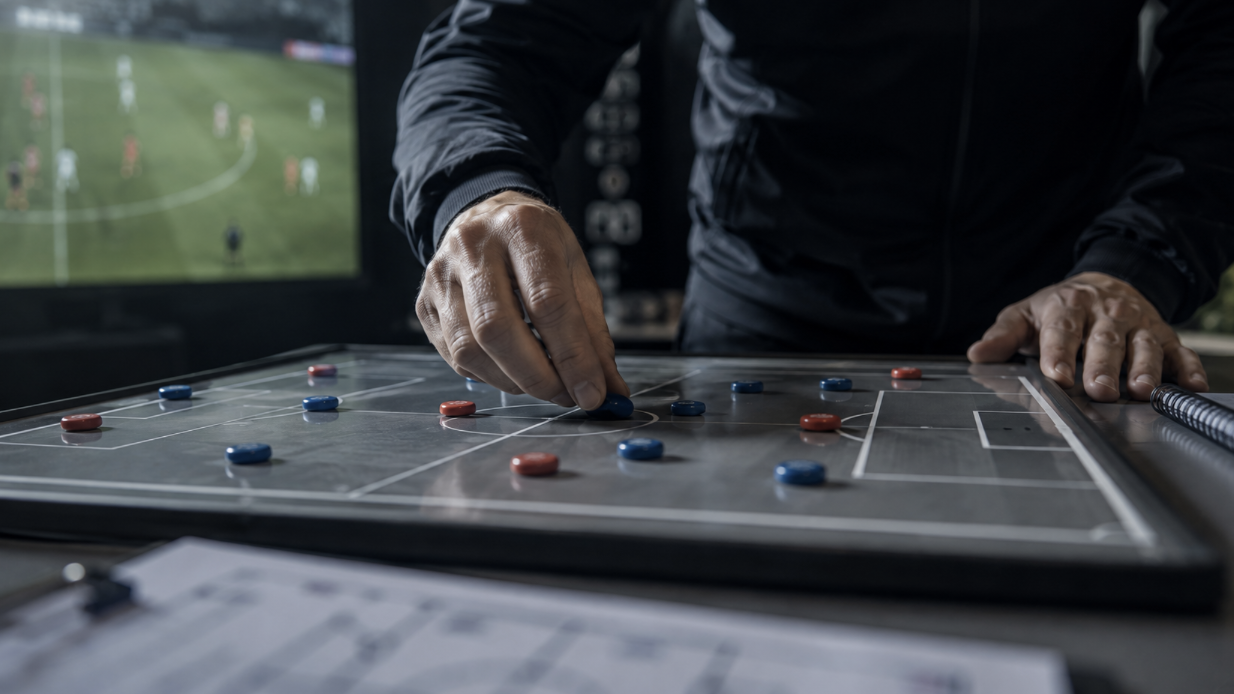
The tactical argument of 2026-27 will not be about discovering a formation nobody has seen before. Last season left more useful clues: Arsenal protected attacks with two holding midfielders, PSV used its goalkeeper to escape Bayern’s man-marking, and Andoni Iraola turned pressure into a route toward goal rather than an exercise in running. UEFA’s technical work also kept returning to central compactness, positional rotations and runs beyond the defensive line. The field feels smaller because teams have become better at closing it.
Arsenal Put the Second Six Back to Work
Mikel Arteta used a 4-2-3-1 in 13 of Arsenal’s first 37 Premier League matches, a clear departure from the automatic 4-3-3 of earlier seasons. Martin Zubimendi could sit beside Declan Rice when a fullback advanced, leaving Arsenal with two players positioned to collect clearances or stop the first counterattack. The benefit appeared after possession was lost: distances between midfield and the center backs stayed short enough for Arsenal to attack the second ball instead of retreating 30 yards. Expect more title contenders to sacrifice one advanced midfielder when control matters more than another body between the lines.
The Goalkeeper Has Become the Unmarked Man
PSV showed the logic against Bayern on Champions League Matchday 8 in January. Ismael Saibari dropped toward Matěj Kovář during buildup, and UEFA’s analysis noted how PSV used its goalkeeper as the extra player against Bayern’s man-to-man press. Once opponents match every outfield player, the goalkeeper becomes the free passing option almost by definition. The position therefore demands two different forms of courage: receiving the ball under pressure inside the box and defending the 30 or 40 yards behind a high defensive line when possession breaks down.
Iraola Wants Liverpool to Attack the Mistake
Liverpool’s appointment of Iraola brings one of the Premier League’s clearest pressing identities to Anfield. Across his three seasons at Bournemouth, his team led the league with 147 shots following possessions won in the attacking third, while its average forward progression of 1.95 meters per second was the fastest in the division over that period. His press is designed to make the next pass uncomfortable, then move toward goal before the opponent rebuilds its shape. That is more precise than simply pressing harder; one player jumps, another removes the escape pass, and the midfield closes the receiver before his first touch settles.
Not Every Pattern Deserves Belief
Football rewards repeatable signals: a backward pass can trigger a press, and a fullback stepping inside changes the next passing lane. Casino draws operate on a different logic because previous results do not make a particular number due in the following round. During a session built around Keno Live (Arabic: كينومباشر), the cleaner approach is to treat each new draw on its own terms and decide the stake before it begins. Live presentation can make the sequence easier to follow, but a fixed bankroll prevents a short run of results from being mistaken for a predictive pattern.
Corners Now Have Their Own Attacking Grammar
Arsenal finished the 2025-26 Premier League season with 24 goals from set pieces, the most in the division, and 18 of those came from corners alone. What stood out was how often they struck first: 14 of those corner goals made it 1-0, shifting games early rather than just padding scores late on. UEFA’s breakdown of their 4-0 Champions League win over Atlético Madrid highlighted the fine margins. Gabriel Martinelli screened his marker, others pulled defenders toward the near post, and Gabriel was left unmarked at the back post to finish. Nicolas Jover’s routines now feel less like set pieces in the traditional sense and more like rehearsed attacking moves, built on decoys, coordinated runs and a clearly planned final action.
Five Seconds Will Force Quicker Decisions
IFAB’s 2026-27 law changes create a small but awkward problem for teams that like to slow the game down. If the referee feels a throw-in or goal kick is being deliberately delayed, they can now start a visible five-second countdown. If the restart still doesn’t happen in time, possession switches to the opposition for a throw-in, or a delayed goal kick becomes a corner. That means teams need their restart patterns ready before the referee even begins the count, especially when they’re trying to protect a narrow lead. Fullbacks need their next two movements already planned. And goalkeepers lose that old habit of drifting around the six-yard box to buy a few extra seconds to reset everyone.