Follow Us on Google
Aviation stakeholders rose from the AeroWest Summit held on Wednesday and Thursday, with a unanimous declaration that weak policies, high taxes and border closures are stunting Africa’s growth.
The conference provided a robust platform to chart best ways to improve Africa’s aviation and tourism sector and the consensus was on the need for a drastic change.
All the speakers took turns to identify an urgent crisis, which is West Africa’s failure to monetize its enormous tourism potential through air connectivity and whether its leaders had the will to make it happen.
The Chief Commercial Officer of United Nigeria Airlines, Adedayo Olawuyi, who was among the panelists said aviation charges and taxes are strangling the industry, but the real problem is the mismatch between the profit that airlines make and the cost of operations.
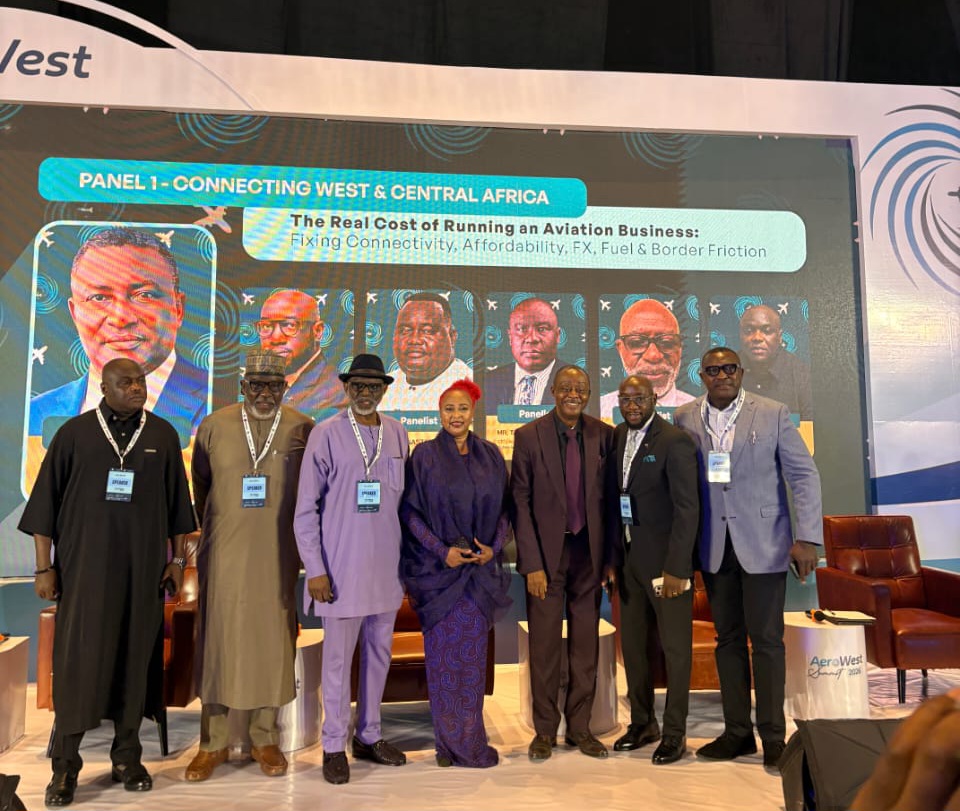
“How many of you would take a loan of 30 per cent to invest in a business that gives you less than five percent profit? That is a pressing issue for airlines in Africa, specifically in Nigeria,” he said.
He explained that airlines sell tickets in naira to passengers, but their largest expenses which includes aircraft acquisition, fuel, crew training, maintenance must be paid in foreign currency, predominantly US dollars. He said these force carriers to absorb massive losses simply to stay operational. When fuel prices spike as they did when costs climbed from N900 per litre in December 2025 to N3,000 naira in 2026, those losses multiplied.
Olawuyi talked about the absence of maintenance and repair facilities in the region which forces airlines to send aircraft abroad for servicing, draining foreign exchange reserves. He then called for reduced aviation charges and taxes.
Former President Olusegun Obasanjo who was the special guest of honour at the event asked what West Africa actually has to offer the world and if Africans know about it.
He said West Africa possesses world-class cultural assets, natural attractions, and creative energy but that these potentials are not threatened by external forces, but by negligence and ignorance.
He lamented how communities are destroying their own tourism assets without even recognizing their value. He spoke on how tourists went to a community in Ogun State to witness how Adire cloth is traditionally made but were chased away from the family compounds where artisans still practice the craft. In his words, the very authenticity that might attract global visitors is being guarded against.
Other News
“We cannot have it all if we do not know what we have. We also need to train people for tourism. Not only do we have tourist attractions, we also need to train people for how to receive, how to react, how to attract, how to welcome, and how to make them feel welcome,” Obasanjo said.
The Chief Executive of Jet Afrique Aviation, Theodore Chikelu, said West and Central Africa, a region of more than 500 million people, carries less than three percent of global aviation traffic.
More startling, he said, is that the region hosts 60 percent of all high-volume, trade and people movement yet lacks the connectivity infrastructure to serve this demand. Of more than 400 city-pairs across West and Central Africa, less than 30 percent are served by direct flights and this gap in connectivity is the greatest constraint on economic development in the region.
He noted that West and Central Africa boasts of UNESCO World Heritage sites, beaches, festivals, and thriving business hubs, yet a tourist landing in Ghana still struggles to reach Abidjan, Cotonou, or Douala without returning to Europe or the Middle East. He said many of the region’s airports lack proper maintenance facilities, efficient passenger handling systems, or reliable power and digital infrastructure. A visitor cannot fly from one West African capital to another without uncertainty.
High operating costs also compound the problem. Jet fuel, taxes, and aircraft leasing remain 25 to 30 percent above global averages in the region. Airlines operating thin routes and those with limited passenger demand face impossible choices. An aircraft like a Boeing 737, which requires high passenger volumes to remain profitable, cannot viably operate on markets where demand might support only 40 or 50 seats per departure.
He said tourism contributes an estimated $18 billion directly to the region’s gross domestic product and sustains millions of jobs and if West and Central Africa could double its aviation and tourism activity by 2030, the region could unlock approximately $45 billion in additional GDP and create two million jobs. This requires the implementation of the African Continental Free Trade Area’s aviation provisions as a seamless West and Central African airspace could cut flight times by up to 12 percent, reducing fuel consumption. Also, unified visa policies could remove the bureaucracy that discourages travel. Harmonized taxes and charges would eliminate the regulatory arbitrage that punishes carriers and passengers.
In his presentation, the Chief Executive Officer of Wakanow, Adebayo Adedeji, said if just five percent of Lagos’s 20 million residents took weekend trips to Benin, the economic multiplier effect would be enormous, yet, this remains largely unrealised because the costs exceed the benefit.
“The cost of going to Sierra Leone is higher than the cost of going to London. How can Ghana, the same distance from Abuja, cost five times as much to fly to?” he asked. He said if the cost of flights to Ghana reduces, demand would surge. Nigerians would visit more frequently, spend more money, and establish businesses across the border. Someone might live in Nigeria but work in Ghana weekly. Cross-border commerce, tourism and economic activity would expand exponentially.
But the problem, he said, is policy. Visa restrictions for instance, treat fellow Africans as security threats rather than customers. Tax regimes punish carriers for operating routes that should be profitable. He said what is important is the political willingness to think about profitability because money follows where return is.
Lagos State’s Secretary, Bimbo Salu-Hundeyin, while speaking, said the state has emerged as one of Africa’s leading destinations for business, entertainment, culture, and tourism, while the Barbados High Commissioner top Nigeria, Juliette Bynoe-Sutherland, said businesses need to trust that regulatory environments will remain stable, that money can move efficiently between countries, that visa processes will not become weapons of protectionism, and that promises made will be kept.