Follow Us on Google
From Adesuwa Tsan, Abuja
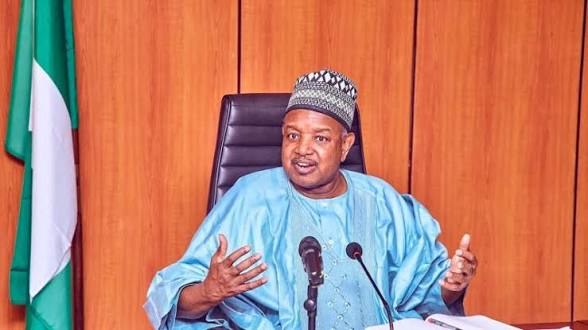
Minister of Budget and Economic Planning, Abubakar Atiku Bagudu, and President of the Senate, Godswill Akpabio, have challenged the media to deepen scrutiny of the national budget while ensuring that allegations of unlawful insertions are thoroughly verified before being presented as facts.
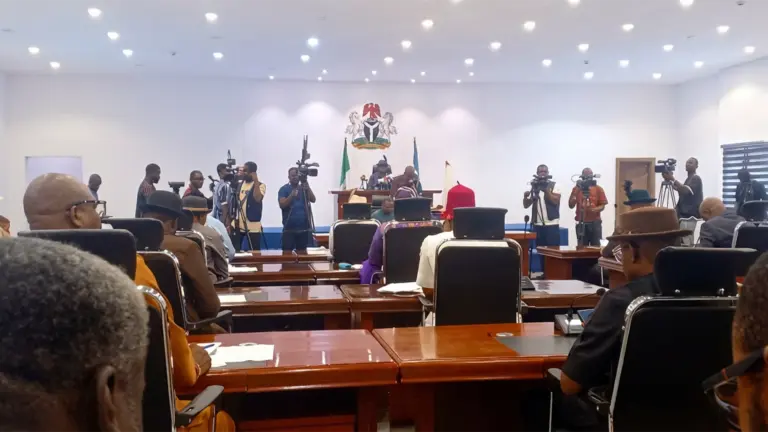
The duo spoke on Monday at the 2026 Capacity-Building Workshop of the Senate Press Corps in Abuja, with the theme, “Leveraging Legislative Oversight and Media Collaboration to Safeguard the National Budget from Unlawful Insertions.”
In his address, Bagudu called for a broader national conversation on the size of Nigeria’s budget and how more resources could be mobilised to fund development.
He noted that Nigeria’s limited fiscal space, relative to its population and development needs, required Nigerians to confront difficult questions about revenue mobilisation and the scale of public investment needed to achieve the country’s development aspirations.
According to him, the ambition of building a $1 trillion economy under the Federal Government’s development agenda would require a rethink of the country’s approach to funding development.
“Should we continue with a budget that leaves our populace with one of the smallest budgets, or should we consider how we can mobilise more resources?” he asked.
The Minister said the media had a critical role in helping citizens understand the rationale behind budgetary choices, urging journalists to investigate provisions thoroughly rather than draw conclusions from figures without adequate context.
He said alleged budget insertions should also be subjected to proper investigation, stressing that an unfamiliar or controversial provision was not automatically an irregularity.
Bagudu cited provisions that might appear questionable outside their local context but could be intended to address genuine needs, including water infrastructure in underserved communities and equipment for fishing communities.
“We are dealing with human processes and human errors. Therefore, vigilance is necessary, and the media and legislative oversight should remain vigilant,” he said.
The Minister also urged a balanced approach to budget transparency, noting that while citizens have a right to know how public resources are being deployed, some information could have implications for national security or strategic interests.
He further challenged the conventional tendency to regard capital expenditure as inherently more valuable than recurrent expenditure, arguing that spending on security, education, healthcare, human capital and public-sector personnel could have direct developmental consequences.
Bagudu also stressed the importance of debt-service obligations, saying failure to meet such commitments could affect borrowing costs and have wider consequences for private-sector operators.
Earlier, Akpabio, whose speech was delivered by the Chairman of the Senate Committee on Media and Public Affairs, Yemi Adaramodu, said the media and Parliament had different responsibilities but a shared obligation to the Nigerian people.
While cautioning journalists against turning allegations, proposed allocations or committee recommendations into established facts, he said, “I ask for no tame press. We serve the same Republic under different obligations: Parliament must deliberate, legislate and oversee; the press must inquire, verify and report.”
Akpabio warned against allowing sensational claims to overshadow verification, particularly at a time when fabricated documents, images and voices could circulate rapidly.
“The old editorial question, ‘How do we know?’ has never been more urgent,” he said, stressing that a reporter must check documents against their sources while editors should ensure that all sides to serious allegations are heard.
He said parliamentary journalism required particular care in distinguishing between legislative processes and their outcomes.
“A motion is not a law. A bill at First Reading is not an Act. A committee recommendation is not necessarily the decision of the Senate. An accusation made in debate is not proof of guilt, and a proposed allocation is not money already spent,” Akpabio said.
The Senate President said these distinctions were particularly important in budget reporting, noting that the National Assembly has constitutional powers to examine the administration and disbursement of appropriated funds.
He urged the press to report credible evidence of wrongdoing and expose waste, but cautioned that repetition could not turn an allegation into a fact.
“Where there is credible evidence of wrongdoing, let it be examined without fear. Where there is waste, let it be exposed. But an allegation does not become a fact through repetition,” he said.
Akpabio also challenged the Senate Press Corps to maintain professional independence, understand the Constitution and legislative procedures, and report the budget based on what the documents actually establish.