Follow Us on Google
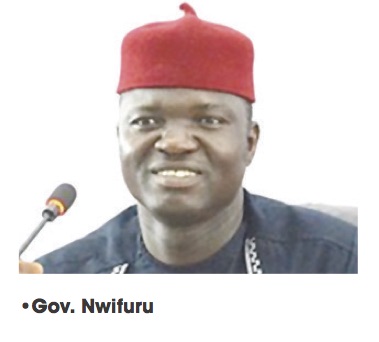
•We needed water but Umahi gave us flyovers, they lament
From Obike Ukoh
When Ebonyi State was created on October 1, 1996, by military head of state, Gen. Sani Abacha, many federal civil servants posted to the state entertained one fear: Being infested with guinea worm, a water-borne disease.
As a result of great deficit in potable water supply, guinea worm was endemic, especially in the Abakaliki bloc of the state.
On guinea worm endemicity, Prof. Ekanem Braide, then zonal facilitator, Nigeria Guinea-worm Eradication Programme (NIGEP), said in February 2000: “As we close our books for 1996, the current status of guinea worm in Ebonyi is that Ebonyi accounts for 3,370 of the 4,684 cases reported in South-East zone in 1996.
“This is equivalent to the number of cases reported in India, Cameroon, Yemen, Chad, Mauritania and Benin Republic put together, and about the number of cases Burkina Faso reported in 1996.’’
She said, based on the projected case reduction, Ebonyi may carry guinea worm disease into the 21st century. She, however, said that the state may be guinea worm-free by 1999, if there was sustained water supply.
The projection, according to Braide “assumed that everyone in Ebonyi will drink only safe water during 1999 transmission session.”
About 3,000 people were infested with full-blown guinea worm infection when Gov. Sam Egwu assumed office on May 29, 1999.
To check the spread, government identified 1,273 ponds for treatment, while 873 were treated. Government also stepped up health services, implemented in 451 endemic villages.
Nigeria did not record any case of guinea worm since 2008, but the country had to wait for the mandatory period of six years of zero case before being certified guinea worm-free. The certification, unarguably, was as a result of sustained water policies by Ebonyi State, the most endemic guinea worm area in the world.
Without doubt, massive investments in potable water supply by Ebonyi State Government made it possible for Nigeria to exit the club of guinea worm-endemic countries.
It was on arrival in Abakaliki, that the “newcomers’’ who came as a result of the creation of the new state, discovered that guinea worm was indeed a rural disease, prevalent in areas that lacked potable water supply.
Also to their surprise, unlike in many state capitals, public water supply was functional in Abakaliki, the capital of the state.
The Ezillo Regional Water Scheme built during the tenure of Gov. Jim Nwobodo of old Anambra State, from August 1979 to 1983, serviced Abakaliki and its environs.
With a new administration in place, investments in the water sector were beefed up. Engr. Uduma Eze, the pioneer general manager of Ebonyi Water Corporation, extended the frontiers of water supply in Abakaliki and its environs.
Eze’s successors sustained water supply within Abakaliki and its environs. Supply of potable water within Abakaliki and its environs peaked during the tenure of Engr. Paul Okorie, who served as the GM of Ebonyi Water Corporation, from March 2000 to October 18, 2005.
Regrettably, today, the taps have gone dry, with residents depending on sachet water to quench their thirst, among other sources. The economy of depending on sachet water is, however, hitting hard on many residents.
Mr. Otti Amah, a director in the Ebonyi pubic service, said, depending on sachet water was very expensive, especially for a large family, adding that he could not afford sachet water daily for his family. He said his family was made up seven persons and, on the average, they consume three bags of sachet water daily. “At the cost of N200 per bag, that means that I will spend N600 daily only on sachet water,’’ he lamented.
He said, since he could no longer afford that, in addition to other responsibilities as a family man, he had resorted to drinking water fetched from a bore hole.
“I moved round Abakaliki and located where they have boreholes of standard. That is where I go regularly with big containers to fetch potable water for family use.
“It is regrettable that water, an essential commodity, is now scarce in Abakaliki. During the time of Sam Egwu and Martin Elechi, there was no problem of public water supply, as the Ebonyi State Water Corporation supplied water to Abakaliki, the state capital, and its environs.
“What Ebonyi people need most is potable water supply, not the kind of projects executed by the government, especially flyovers that have no direct or indirect impact on the people,’’ Amah stressed.
He also said that, during this rainy season, many families fetch rain water for drinking.
Engr. Okorie, the former GM of Ebonyi Water Corporation, who spoke on the issue, said investments were not sustained in the water sector, which resulted in the present situation.
Okorie, who was the water corporation’s GM from March 2000 to October 18, 2005, said public water supply was regular during his tenure. He noted that supply of potable water was weakened by the scrapping of Ebonyi Water Corporation by the past administration. Okorie noted that merging Ebonyi Water Corporation with the ministry was not the best decision.
“Water corporation is the engine room of water supply. If you merge it with the ministry, how can it perform?” he wondered.
Okorie also said government showed commitment during his tenure to sustain potable water supply: “Money was regularly released for the purchase of chemicals. At a point, N100 million was released for the purchase of chemicals. That chemical lasted two to three years.”
Okorie explained that the Ezilllo Regional Water Scheme was functional throughout his tenure. He added that the 40 million litres-capacity water reservoir located along the Abakaliki-Enugu expressway was in good shape during his tenure.
“Water was regularly pumped from the Ezillo Regional Water Scheme to the reservoir; water supply was regular in Abakaliki. At a time, almost all parts of Abakaliki enjoyed regular water supply, water supply was even extended to the Army Barracks in Nkwegu,’’ Okorie added.
He said the way out was to show commitment by investing in the water sector. He stressed that the Oferekpe Regional Water Scheme, which has capacity to supply potable water to eight local government areas, constructed by the Elechi administration, should be made functional once again.
Water was supplied to some parts of the state from the Eferekpe Water Scheme in 2007, shortly before Elechi left office on May 29, 2007.
He said the Ezillo Regional Water Scheme needed rehabilitation and, if that is done, the potable water scarcity in Abakaliki and its environs would be greatly reduced.
Stakeholders said Abakaliki enjoyed uninterrupted water supply even without an Eferekpe Regional Water Scheme. The Ezillo Regional Water Scheme should be restored to its previous status as a remedial measure, in order to save residents from further economic hardship of buying sachet water daily for consumption.