Follow Us on Google

• How he earned formidable nickname, shaped generations of surgeons and is ‘re-tyring’ for fresh purpose after retirement
By Beifoh Osewele and Ighomuaye Lucky
“Maximum! Maximum! Maximum!” The chants rang out among senior academics and surgeons at Ahmadu Bello University (ABU), Zaria, after they discovered that a young member of a visiting medical accreditation team came from the University of Benin Teaching Hospital (UBTH). Their excitement centred on a former colleague whose reputation remained firmly rooted in the institution long after his departure.
For the visitor, neurosurgeon David Udoh, the reception was initially bewildering.
“I was almost embarrassed. I was wondering what was Maximum?”
The mystery cleared when his hosts explained their connection with Vincent Isibor Odigie, professor of general surgery, whose uncompromising standards, professional accomplishments and courage to challenge wrongdoing had earned him the enduring nickname, Maximum Chief.
Once they established that Udoh worked with their celebrated former colleague at the UBTH, their affection extended to him. “They treated me like a prince until I left accreditation and came back to Benin,” he recalled.
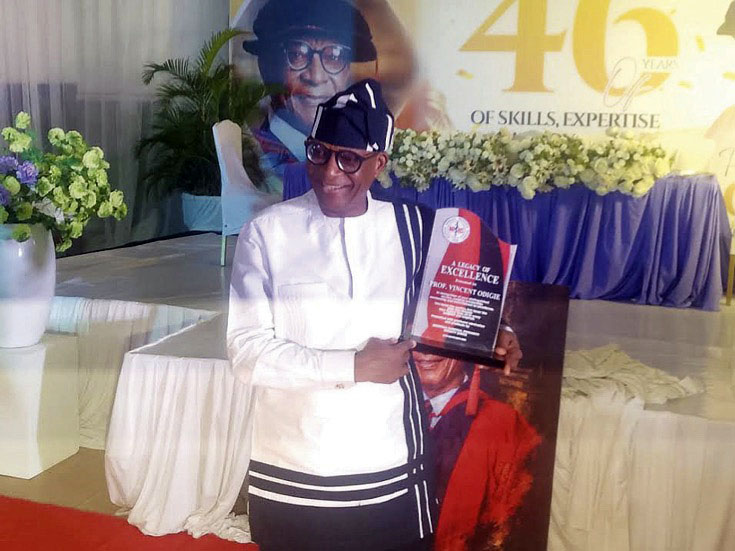
That encounter was among the recollections that enlivened Odigie’s retirement celebration at Doctors’ House, Ugbowo, Benin City, on Friday, November 20, 2026, five days after his 70th birthday.
Colleagues, former students, medical associations, friends and relatives gathered to celebrate a career spanning approximately 46 years in medicine, recalling the exacting teacher, accomplished surgeon and generous neighbour whose formidable reputation concealed a deeply compassionate disposition.
The man behind Maximum Chief
For Odigie, standing his ground was a matter of conscience, including when those involved occupied positions of authority. “I have never been afraid to tell even people in authority what is wrong. This thing is wrong. Please, let’s not do it,” he said.

His Christian convictions, he explained, required respect for constituted authority, but also the courage to speak honestly, preferably in circumstances that allowed correction without public humiliation or spectacle.
“I may not tell you openly because my Bible tells me that you should respect authority and kings, but I’ll come back to you one-on-one when I’m in your office.
“I’ll tell you, look, there’s nobody here now. It’s you and I. That thing you did was wrong.”
He disclosed that he serves as spiritual adviser to six Anglican archbishops, a responsibility that sometimes requires similarly uncomfortable conversations.
“Just tell him the truth and your conscience becomes clear. In anything you do in life as a surgeon, as a doctor, please be upright,” he counselled.
That insistence on uprightness extended to appearance, punctuality and conduct. Consultant obstetrician and gynaecologist, James Terkula Adia, recalled that students who appeared before Odigie without ties could be sent away to dress properly, even in the evening.
His famous declaration captured the philosophy: “Even in hell, there is order.”
Adia remembered ward rounds conducted in disciplined formation, with the matron following closely behind with a trolley.
“You were a man who believed that excellence was not negotiable and that professionalism extended beyond the operating theatre,” he wrote, describing Odigie as a “Professor of Professors.”
A representative of UBTH Chief Medical Director, Idia Nibokun Ize-Iyamu, similarly acknowledged the reach of his influence, saying: “He is a very senior colleague who has worked and has saved many lives and has taught professors of professors. He has taught many people and has actually impacted lives.”
From Zaria to Benin
Odigie attended Edo College before proceeding to Ahmadu Bello University, Zaria, where he graduated in medicine in 1980, having originally contemplated a career in architecture. After his NYSC at St. Louis Hospital, Zonkwa, Kaduna State, he undertook surgical residency training at Ahmadu Bello University Teaching Hospital (ABUTH).
He obtained fellowships of the National Postgraduate Medical College of Nigeria in 1993, West African College of Surgeons in 1996, International College of Surgeons in 1998 and American College of Surgeons in 2015.
He joined ABUTH in 1990, headed its Department of Surgery between 2000 and 2002, and transferred to the University of Benin in 2014. He subsequently headed the surgery department at UBTH between 2017 and 2018.
His scholarly contributions include more than 100 scientific publications, research into breast, thyroid and gastrointestinal diseases, and the development of the affordable, reusable Zaria colostomy belt and bag. He also explored mobile telephone applications in cancer care and delivered the University of Benin’s 366th inaugural lecture.
Chairman of the Nigerian Medical Association (NMA), Edo State branch, Andrew Eigbedion, described him as an exceptional surgeon, dedicated teacher and compassionate practitioner whose accomplishments and values continued to inspire younger doctors.
In its tribute, NMA acknowledged his contributions to surgical practice, specialist training, research and institutional development. “Some individuals distinguish themselves through professional accomplishments, while others leave enduring footprints through service, mentorship and institutional impact. Professor Vincent Odigie undoubtedly belongs to the latter category.
“His career exemplifies the values of excellence, integrity, mentorship and service that our association holds very dear.”
The Nigerian Surgical Research Society, which he previously served as secretary-general and president, presented him with a commemorative plaque bearing the inscription: “A Legacy of Excellence.”
Its representative said.“You leave the service but never the lives you shaped. Your legacy lives on in every surgeon you inspired.”
When the formidable teacher became a father
For one former resident doctor, the first prospect of working under Odigie provoked considerable anxiety.
“One of my colleagues came to meet me and said, ‘Go and change that thing. There is one man in GS3 that will kill you.’”
The warning appeared to acquire frightening significance when the young doctor encountered a complication during a vascular access procedure. Expecting a severe reprimand, he eventually contacted the professor, only to receive reassurance.
“He said, ‘Don’t worry, don’t worry. I was once in that situation. Don’t worry. I survived it.’”
When Odigie arrived at the ward, he gently tapped the frightened doctor on the back.
“Don’t worry. I know you are afraid. You are afraid. Don’t worry.”
In that moment, the intimidating Maximum Chief became a reassuring father.
Mercy and Danjuma Kalba offered another glimpse of that humanity. Mercy recalled how Odigie visited after her father’s burial 26 years earlier and made her laugh for the first time since his death.
“You may have simply been paying a visit, but you were doing something much greater: helping a grieving daughter find a little light in the darkness,” she wrote.
Other News
“Prof, you may be retiring from the professorship, but you can never retire from the hearts of those whose lives you have touched.”
Udoh recalled similar generosity beyond the hospital, including Odigie’s purchase of solar lights for a neighbour’s compound and assistance with maintaining adjoining residential buildings.
For him, the professor’s influence illustrated the personal commitment required to nurture succeeding generations.
“Surgery is discipleship. Surgery is apprenticeship,” he declared.
Honour for life
Chairman of the Medical and Dental Consultants’ Association of Nigeria (MDCAN), UBTH chapter, Benson Okwara, who said he suspended his clinic activities to attend the celebration because Odigie deserved the honour, recalled, with humour, how the professor’s fondness for storytelling could turn a brief encounter into hours of conversation, sometimes prompting colleagues in a hurry to take another route. Those conversations, however, were rich in wisdom, professional experience and lessons about life.
Such was the affection he commanded that his preferred seat in the doctors’ lounge would remain reserved. “Nobody is permitted to sit there henceforth because that is Prof’s seat,” Okwara declared.
Football clubs have withdrawn shirt numbers in honour of their legends, with AC Milan retiring Franco Baresi’s number 6 and Ajax Johan Cruyff’s number 14. In the doctors’ lounge, preserving Odigie’s favourite seat carried a similar sentiment: an affectionate recognition that Maximum Chief would always have his place among them.
‘No amount of money can pay for life’
When Odigie spoke about the financial difficulties confronting patients, the celebration assumed a more reflective tone. He recalled the distress of operating on someone who lacked the resources to continue treatment, leaving the surgeon to confront both a clinical emergency and a financial dilemma.
“The trying moment of a surgeon is when you are operating on a patient who has no money to continue treatment, but you have to save him. Therefore, you have to use your own money to save him.”
For Odigie, the obligation to preserve life demanded a compassionate response.
“What will I do? Will I leave them to die? No. No amount of money can pay for life, but you can prevent death by helping the person with your own money. So, that is what I generally do, and God has been very faithful.”
He urged younger practitioners to recognise the suffering behind unpaid hospital bills and assist where they could.
“Finally and finally, please, as doctors, whether you are a physician or you are a surgeon, be compassionate to your patient. Be very compassionate and have empathy.
“If you are convinced that your patient doesn’t have money, spend your money for the patient to leave hospital.”
He also called for wider health insurance enrolment, particularly among traders, artisans and other informal-sector workers.
“If you are selling even groundnuts, you should key into it, declare your monthly income and they will put an insurance policy for you. Nobody should go home without having an insurance scheme in this country,” he said.
Alongside compassion, he stressed accountability, urging surgeons to examine their decisions honestly whenever complications or unexpected outcomes occurred.
“You only become a surgeon when you are able to judge your conscience, audit your conscience. What did I do wrong? Hey, this has happened again. What did I do wrong?”
Faith, family and the demands of surgery
Odigie identified his Christian faith and involvement in the Full Gospel Business Men’s Fellowship International as important influences on his personal and professional development. “I want to thank finally Full Gospel Business Men’s Fellowship International. They made me grow. They made me grow in studying the Bible.”
He recalled silently singing Christian choruses during difficult operations, drawing reassurance from prayer when confronted with delicate decisions.
“I sing it in my mind when I am in trouble,” he explained.
Reflecting on suggestions during his years in Zaria that mysterious powers accounted for his surgical accomplishments, he attributed his strength to faith. “The only thing that works with me is prayer,” he declared, adding: “Please know God, because we treat, God heals.”
His understanding of Christian service also placed practical responsibility on the believer.
“For you to serve God, you can’t serve God by just praise and worship. You must help the needy. Good religion is this: to help the widow, the orphan, the poor.”
He acknowledged the sacrifices of medical professionals’ families, particularly spouses who shoulder additional responsibilities because of the demands of hospital work. Drawing on his 42 years and six months of marriage, he humorously urged couples to cultivate mutual respect and express their love.
He thanked colleagues, mentors, residents, patients and associates for their contributions to his career, paying particular tribute to Osime and other professors for their friendship and support. Whatever disagreements had arisen over the years, he said, he held no bitterness against anyone.
Re-tyring for fresh purpose
For Ukpoke, his ancestral community in Esan West Local Government Area of Edo State, Odigie’s retirement carries the promise of closer access to the experience and expertise celebrated by his colleagues.
President of the Ukpoke Area Development Foundation (UADF), Charles A. Osezua, a natural gas engineer and former President of the Nigerian Gas Association, expressed the community’s pride and expectations. “We are very proud of you and your achievements. We thank God for your life and your record of excellence. You are a blessing and we look forward to welcoming you home. It is the beginning of a great new chapter in your life and our community. Congratulations.”
That welcome has particular significance as Odigie prepares to assume full duty at the specialist healthcare facility in Ukpoke-Uhiele. He is the sole promoter and financier of the project, which he also intends to manage, bringing decades of surgical experience and professional connections to healthcare delivery in the community.
Another distinguished Ukpoke son, Professor Sylvanus Ikhide, captured the expectation with a playful blessing. “As you retire from public service this day, may the good Lord ‘retyre’ you for the next stage!”
For Odigie, it is an invitation to fit new tyres for a fresh journey, carrying accumulated knowledge, experience and wisdom into deeper service to humanity. At 70, the specialist healthcare project gives that renewed purpose concrete expression, with the years ahead holding the promise of achievements as fulfilling as those already celebrated.
One colleague’s tribute, titled The Last Dance with the Legend Himself, recalled a particularly memorable engagement: performing a completion thyroidectomy and an abdominoperineal resection with Odigie before retiring to the pantry for a quiet moment.
“From the operating theatre to the pantry, a fitting finale to a journey I’ll always cherish. Forever grateful,” the colleague wrote.
Udoh’s reflection placed those shared experiences within the larger responsibility of preserving professional standards.
“Legacy is not a building. Legacy is not an intention. Legacies are actually men. And institutions are men. That’s why some people grow so great that we begin to call them institutions.”
Turning to younger surgeons, he added: “The legacy is you. You are the one to leave something for those who are coming behind you.”
Across the tributes ran a consistent portrait: the teacher who insisted that even in hell there must be order, the mentor who reassured a frightened trainee and the surgeon who reached into his own pocket when a patient’s life depended on it.
Those are the qualities Maximum Chief now carries into his next undertaking, as the journey that took him from Benin to Zaria and back turns towards a specialist healthcare facility in his ancestral home.