Follow Us on Google

From Okwe Obi, Abuja
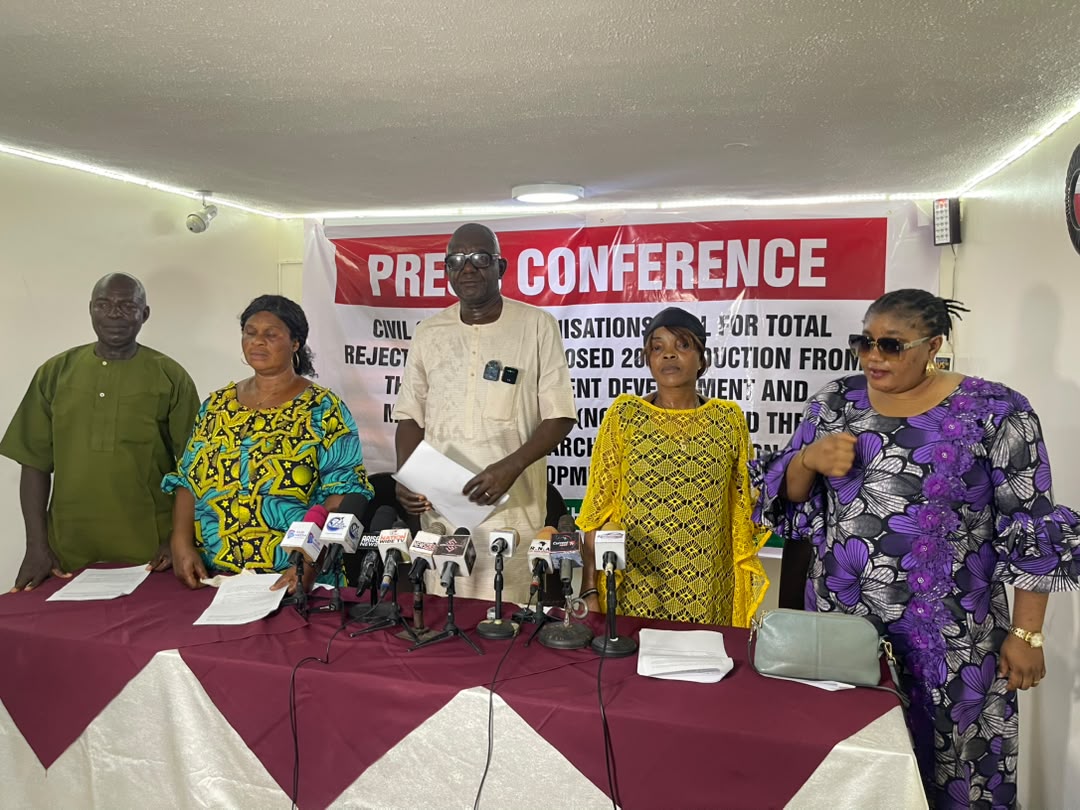
The Coalition of Civil Society Organisations in Nigeria (COCSON) has opposed a proposed legislation seeking to deduct 20 per cent of funds accruing to the Nigerian Content Development and Monitoring Board (NCDMB) to finance the proposed National Research and Innovation Development Fund and the National Council on Research and Innovation, warning that the move could undermine indigenous capacity development in the oil and gas sector and set a dangerous precedent for the funding of other specialised government agencies.
Spokesman of the coalition, Tabuko Kennedy, who addressed a press conference in Abuja, argued that the proposed deduction would deprive the board of resources needed to develop indigenous companies, train Nigerian engineers, promote local industrial capacity and retain wealth within the country.
Kennedy described the proposed deduction as a breach of trust between the government and stakeholders in the oil and gas industry, insisting that funds accruing to the board were specifically earmarked for local capacity development and should not be treated as general government revenue.
“If we take 20% away from the Local Content Board to fund a new research body, we will starve the oil and gas sector of the funds it needs to mature.
“You cannot claim to promote national development while crippling the engine that drives local industrial capacity.
“We must continue to prioritise and aggressively fund local value addition, not divert it. Local Content Board money is stakeholders’ money, not free government revenue,” he said.
Kennedy explained that the funds accruing to the NCDMB were derived from contributions by companies operating in the oil and gas sector and were specifically dedicated to developing local capacity, describing the arrangement as a social contract between industry stakeholders and the Nigerian people.
Other News
“To unilaterally deduct 20% from the stakeholders’ pool without their consent, and without alignment to the mandate for which the money was collected, is a breach of trust.
“It is tantamount to cannibalising a specialised fund to build a general fund, thereby weakening the original mandate. It is not free money for government to distribute to new agencies.
“Beyond the immediate damage to the oil and gas sector, this proposal sets a troubling precedent,” he said.
The coalition further warned that the proposed legislation, if passed, could expose other specialised government funds to similar deductions, undermine institutional effectiveness and create uncertainty in the execution of long-term development programmes.
“If the National Assembly can, by legislation, redirect 20% of the internally generated revenue of a performing agency to fund a new body, then no agency’s funds are safe.
“What stops the next bill from taking 30% of the Tertiary Education Trust Fund (TETFund)? What stops another from raiding the Universal Service Provision Fund (USPF) or the Police Trust Fund?
“This ‘raiding culture’ will foster inter-agency rivalry, destroy long-term planning and discourage agencies from optimising revenue generation, because success will simply attract legislative poaching.
“We must not institutionalise a system where new agencies are built on the carcasses of existing, functional ones,” Kennedy said.