Follow Us on Google
From John Adams, Minna
For the past eight years, Niger State has depicted English philosopher Thomas Hobbes’ ideal state of nature, where life is short, nasty and brutish. Indeed, bandits, terrorists, kidnappers and all sorts of criminal elements have made life hellish for the people of Niger State, riding roughshod on them without let or hindrance.
The security apparatus of the state appears helpless and unable to respond to the ugly trend as they look on while the people go through hell on earth. People are killed and abducted on a daily basis, farmlands have turned to burial grounds, thousands were forced to abandon their ancestral homes and live in camps, even as women are raped, sometimes to death, while cattle rustling has become a booming business for criminals.
Although the security challenge is not peculiar to Niger State, as every part of the country is battling with one kind of insecurity or the other, facts have emerged that lack of political will, insensitivity and sheer misplacement of priority on the part of the immediate past administration led by Alhaji Abubakar Sani Bello were largely responsible for the heightened insecurity in the state.
Security agents, including local vigilance groups, have paid dearly in their attempts to protect the people against their common enemies. About 340 security agents, cutting across all the security services, and vigilantes have died, while fighting with the bandits, terrorists, kidnappers and other criminals in the state. Goods and property worth hundreds of millions of naira have equally been destroyed following the evil activities of the bandits and other criminal elements in the state.
Worried by the escalation of attacks by bandits, the government, through the initiative of the then Commissioner for Local Government, Community Development and Chieftaincy Affairs, Mallam Abdulmalik Sarkin Daje, created the Ministry for Internal Security, with the sole aim of addressing the security challenges in the state. Prior to the creation of the internal security ministry, issues of security were placed under the ministry for local government.
Regrettably, funding of the new ministry allegedly remained very poor as the past government continued to pay lip service to issues of security, while communities in the state bled daily from the bandits’ attacks.
From lack of operational vehicles to inadequate equipment, various security agencies in the state struggled without success to withstand the superior firepower of the rampaging bandits and other terrorists that often showcased more modern and sophisticated weapons.
For eight years, the immediate past administration could not purchase a single operational vehicle for any of the security agencies in the state; rather, the state government, according to sources, only provided funds for the repair of some malfunctional vehicles belonging to one of the security agencies.
A senior security agent told our correspondent that those refurbished vehicles could not travel beyond 10 kilometres, let alone be used for operations against criminals. This, he said, added to the many challenges that hindered the war against terrorism, banditry and other criminal activities in the state.
The development posed concerns to the communities in the state, which were constantly under attack from terrorists, with nobody coming to their rescue, giving the criminals a field day.
According to community sources, distress calls to the security agents during attacks were not responded to due to lack of equipment and operational vehicles; a development that led to the abduction of scores of villagers.
The latest of such incidents before the expiration of the tenure of Bello was the abduction of about 57 people, including women and children, from Adunu, Kwagana, Kafin-koro and Beni communities in Paikoro Local Government Area of the state. Five of the victims were killed by the gunmen in order to put pressure on the communities to pay the N100 million initially demanded as ransom.
A member of one of the communities told our correspondent that 24 hours before the attack, a retired policeman, who was among the victims, was said to have alerted the security agents of an impending attack, after a similar attack on neighboring Beni community, but there was no response due to lack of operational vehicles.
“That was the same situation when the Catholic Priest in Kafin Koro, Rev. Isaac Achi, was killed, because the security agents had no vehicle to respond to the distress call,” our source alleged.
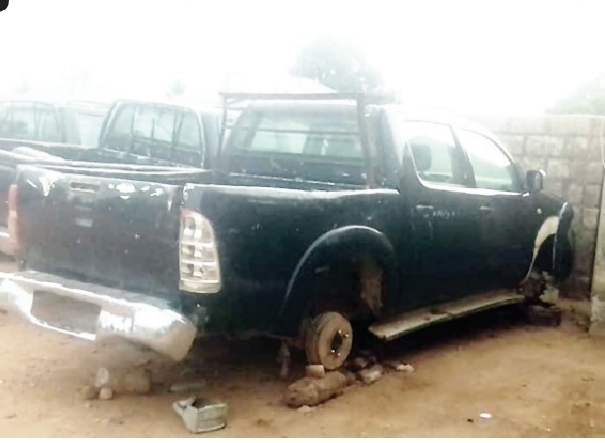
Checks revealed that the situation is the same across the state, as the security agents continue to lament over the dearth of operational vehicles to enable them patrol around the flashpoints or respond to distress calls from communities. For instance, the Joint Security Taskforce (JST) stationed around the troubled communities in Shiroro Local Government Area of the state cannot boast of one single functional patrol vehicle at the moment. All the patrol vehicles attached to them are grounded and parked at a roadside mechanic’s workshop in Zumba community.
A member of the Zumba community told our correspondent that for the past three months the vehicles have been abandoned in the workshop by the security agents. The vehicles, he continued, are in bad condition and the government said there was no money to repair them, not to talk of buying new ones.
“Right now, the security people only remain in their camps; they don’t go out for patrol because there are no patrol vehicles. As it is now, they cannot even respond to any distress call from the communities”, our source further disclosed.
The story of lack of operational vehicles and other equipment for the security agencies to fight the insecurity in the state is the same across all other the local government areas, where communities are under siege from gunmen. From Rafi to Munya, Mariga to Mashegun, Paikoro to Rijau local government areas, the condition in which the security agents operate is better imagined than experienced. Operational vehicles are completely nonexistent, except a few motorcycles in some cases, and this has frustrated the war against banditry in the state in the last eight years.
A senior officer in one of the security agencies told our correspondent that none of the security agencies in the state could boast of two functional and well equipped vehicles provided by the last administration. He said: “These vehicles you see here (referring to his agency) were given to us by our headquarters. We made several appeals to the Ministry of Internal Security but everything ended with promises, which never saw the light of day.
“Go and ask other sister security agencies in the state if they can boast of any functional and well equipped vehicle given to them by the last administration in the last eight years. The vehicles you see them with are all from their various headquarters, like ours.
“That is just talking about operational vehicles only; what about other equipment? There are no bulletproof vests or helmets and many other things that would have assisted us in this war against the bandits. We have lost so many men because they are not properly equipped,” he lamented.
However, even the condition of the operational vehicles for the parent security agency that is in charge of internal security in the state is pathetic and nothing to write home about. No division or area command of the Nigeria Police across the 25 LGAs of the state can boast of well equipped and functional patrol vehicles. For instance, the last time the Nigeria Police in the state took delivery of functional and well equipped vehicles from the state government was during the administration of former Governor Babangida Aliyu, when about 250 vehicles codenamed ‘Operation Zuma’ were launched to assist the police in the war against criminals in the state.
Eight years after, the only vehicles for security launched by the last administration were a few vehicles and motorcycles donated to the state’s vigilante corps by the Ministry of Local Government, Community Development and Chieftaincy Affairs, when the activities of some miscreants in Minna, the state capital, became alarming.
However, during a media briefing on banditry in the state, and government’s efforts at addressing the security challenges, the former Commissioner for Internal Security and Humanitarian Affairs, Emmanuel Umar, disclosed that the state spent over N5 billion on security between 2019 and 2021 alone.
According to him, the bulk of the money was expended on the allowances of security agents who were in the frontline, neglecting equipment and other things that could aid them in the fight against bandits.
It was exclusively gathered that the Ministry of Internal Security and Humanitarian Affairs had written several memos to the Office of the Governor, seeking approval for the purchase of some operational vehicles, including Armored Personnel Carrier (APC) for the Joint Security Taskforce and other security agencies in the state to help in their operations, but such memos never saw the light of the day. This made the commissioner make a number of unfulfilled promises in the area of provision of operational vehicles to the various security agencies in the state.
But, when contacted to confirm whether the state police command ever took any delivery of operational vehicles from the immediate past government in the state, the police public relations officer in the state, Wasiu Abiodun, a deputy superintendent of police, referred our correspondent to the former Secretary to the State Government (SSG), whose office coordinated security matters in the state.
However, all attempts to get the former SSG, Mallam Ahmed Matane, to comment on the development, could not yield any positive result. But, the Information Officer, Mallam Lawal Tanko, directed our correspondent to the Permanent Secretary, Cabinet and Security, who explained that the SSG’s office was no longer handling security matters in the state before he left office on May 29. All attempts to get the Permanent Secretary Cabinet and Security, Mallam Abdulraheem Tariq, to comment on the matter proved abortive.