Follow Us on Google
As young students of St. Augustine’s College Kabba, between the late 1980s and early 1990s, a certain Bishop John Onaiyekan, Bishop of Abuja Diocese, was one of our most revered role models, along with other eminent Catholic clergymen and prominent sons and daughters of Kabba town, Kogi State, such as Bishop Joseph Ajomo and Bishop Aloysius Makozi as well as Air Vice Marshal Femi John Femi, then Chief of Air Staff, Architect Stephen Olurunfemi [Steve Ben], businessman and politician, Ambassador Joseph Lewu, Nigeria’s then ambassador to the Republic of Brazil, and Col. Bello Fadile, among many others. Every week, during the morning general assembly, our principal, Mr. Ikenazor. from Ihiala in Anambra State, devoted a large chunk of his time counselling us on why we needed to take our studies seriously in order to turn out successful in life like the Onaiyekans, Lewus and John Femi’s. Princy, as we fondly called Mr. Ikenazor, always expressed bewilderment at some of our very awkward and abnormal behaviours such as scaling the school’s perimeter fence late in the night to sneak into the town and engage in activities young teenagers had no business doing, with his characteristic “How can a normal human being” do this and that? Our contingent of students from Okene, my hometown, was particularly notorious for being outlaws and we paid dearly for it with different kinds of corporal punishment, including cleaning Princy’s goat house.
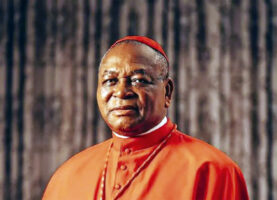
However, among the many role models we held in awe and high esteem and truly looked up to as epitomes of success as well as accomplishment, Bishop Onaiyekan stood out spectacularly. Born on January 19, 1944, His Eminence John Cardinal Olorunfemi Onaiyekan was such a highly revered personality that he almost became a mythical figure and the stuff of legend. Born into the prominent Catholic Onaiyekan family of Kabba, the family house of the Cardinal, which was located a few metres away from our school’s football field, was a site of pilgrimage for us as we thronged there to catch a glimpse of the house in which this legendary figure was born and to feel its essence. And the main reason why Cardinal Onaiyekan was such an outstanding role model for us as secondary school students was because of his famous academic brilliance upon which his lifelong accomplishments were built. In 1962, when he passed out from St. Michael’s Secondary School, Aliade, in present-day Benue State, Cardinal Onayiekan was the best graduating student throughout the old Northern Region of Nigeria, which comprised the 19 states of northern Nigeria and the FCT Abuja. So outstanding was his academic performance that Sir Ahmadu Bello, the Premier of Northern Nigeria, sent a delegation from Kaduna to the household of the Onayiekans in Kabba, with offers of scholarship for the young John to pursue higher education. But, as though destined for the pulpit, the young John Onaiyekan decided to go into the seminary and train as a Catholic priest. I recall vividly on one occasion when he visited Kabba and had to attend an event at the St. Augustine’s Parish, we all filed out to catch a glimpse of our favourite role model.
Many years later, our paths crossed at many inter-faith activities and nation-building events across Nigeria. And if I were to describe Cardinal Onaiyekan in a few words, it would be “integrity, patriotism and love of God through service to humanity without religious, racial and ethnic boundaries”. Consecrated as Bishop by Pope John Paul II in 1983, Cardinal Onaiyekan served the body of Christ in Nigeria in many leadership capacities, including Bishop of Ilorin and Abuja, president of the Catholic Bishop’s Conference of Nigeria [CBCN] and, later, president of the Christian Association of Nigeria [CAN]. In November 2012, he was created Cardinal by Pope Benedict XVI. And in line with the Catholic social doctrine, which is a body of teachings on human rights, economic justice and the common good built around human dignity, solidarity and subsidiarity, John Cardinal Olorunfemi Onayiekan has been a moral voice of truth to power in furtherance of the welfare and security of not just Catholics and Christians but for all of the peoples of Nigeria. And when the Prince of the Holy Roman Catholic Church speaks truth to power, his voice is usually unshaken.
As far back as 1983, Cardinal Onaiyekan was one of those who condemned the President Shehu Shagari government for the massive rigging that characterized the 1983 general election. As an anti-corruption and good governance advocate, then Bishop Onaiyekan of the Ilorin Catholic Diocese, in 1985, sought an audience with Mohammed Umar Ndatsu, retired Air Vice Marshal and then military governor of Kwara State. In the meeting with the military governor, the Cardinal didn’t ask for money, contract, land allocation, appointment or any other such material favours. He went into the meeting to demand good governance of Kwara State in a manner that was devoid of corruption. This demand for good governance, ethical leadership and corruption-free public administration has become a lifelong undertaking by the Cardinal from military dictatorship era into the Fourth Democratic Republic.
While Cardinal Onaiyekan was a strong voice against the Babangida military regime for the annulment of June 12 presidential election, he urged the transition government of Chief Earnest Shonekan to set a time frame for transition to democratic rule, just as General Sani Abacha was not spared as the Cardinal and his brother Bishops pressured him to conduct a transition from military to civil democratic rule. And when Nigeria eventually transited in 1999 to civil democratic rule, Cardinal Onaiyekan remained consistent on the demand for good governance and improvement in the lot of the people. He was particularly vocal against the Prsident Olusegun Obasanjo government for failing to uphold fundamental democratic tenets and, by 2005, Cardinal Onaiyekan strongly cautioned him against falling for the temptation of tenure elongation through a third term agenda. The Cardinal was loud in his condemnation of the President Goodluck Jonathan administration for rising corruption, just as he consistently criticized the Buhari government for rising insecurity. Therefore, Cardinal Onaiyekan’s recent intervention on the socio-economic and security situation in the country was only consistent with his call for good governance, fidelity to constitutionalism and ethical leadership since 1983.
But the response from the President Bola Tinubu administration and its partisan supporters has been despicable, sacrilegious and devoid of logic or common reasoning. To tag a man like John Cardinal Onaiyekan as “partisan” because he spoke the truth of the plight of Nigerians while noting that President Tinubu seems to think otherwise is the height of intellectual dishonesty and media rascality, for which I think the President should apologize to the Cardinal. In their quest to hold on to power and protect the privileges that come with it, politicians must know when to apply the brakes on recklessness and crass irresponsibility. To brand Cardinal Onaiyekan as an ‘Obidient’ for airing an opinion that tells the truth of our reality as a country is the height of arrogance of ignorance.