Follow Us on Google
By Beifoh Osewele
Serene, scenic and largely agrarian, Uhiele sits within Ekpoma in Esan West Local Government Area of Edo State. Life remains closely tied to the land, family and community, with farming providing livelihood for many households. But behind that tranquil setting lies a contradiction that has increasingly exercised the minds of its people: Uhiele has produced academics, professionals, entrepreneurs, technocrats and political actors who have excelled across Nigeria and the diaspora, yet development at home has not always reflected that rich pool of human capital. Roads need attention. Schools and healthcare facilities require improvement. Potable water remains a challenge. Young people need opportunities. Insecurity worries families.

On September 5, 2026, sons and daughters of Uhiele came together at the Community Town Hall, Ukpoke, to begin confronting those challenges at the maiden summit of the Uhiele Development Forum (UDF).
Held under the theme, “Advancing the Cause of the Uhiele People,” the summit brought unity, political influence, infrastructure, security, youth empowerment and diaspora engagement into one conversation.

At its heart was a proposed Five-Year Uhiele Development Agenda intended to identify priorities, assign responsibilities, mobilise resources and expertise, set timelines and measure results.
UDF President, Zuberious Edeoghon, set the tone when he said: “Today is more than a gathering. It is a defining moment in the history of Uhiele.
“For the first time, our people are coming together on this platform in a deliberate and collective effort to reflect on who we are, where we are today, and, most importantly, where we intend to take Uhiele tomorrow.”
But he was equally clear that the summit could not be another talk shop. “This summit must not become another gathering where we speak eloquently and return home without measurable results. We are here to build a roadmap. Our greatest achievement today will not be the speeches we deliver. It will be the commitments we make and the actions that follow,” Edeoghon said.
Chairman of the occasion, Fidelis Inegbedion, described the gathering as a milestone in Uhiele’s quest for self-realisation and collective development – an opportunity to identify its challenges, harness its resources and build “the Uhiele of our dreams for ourselves and for future generations.”
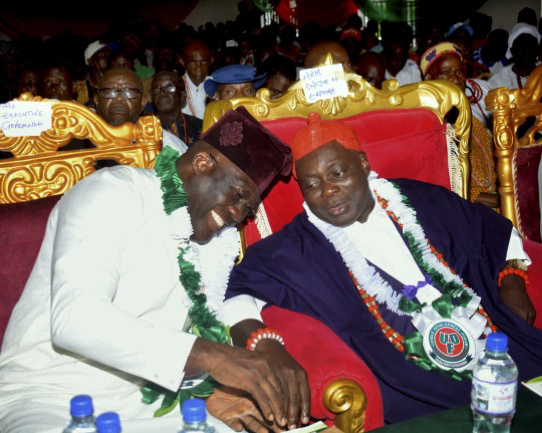
The gathering drew some of the crème of Uhiele and Ekpoma’s traditional, professional, political and community leadership.
Onojie of Ekpoma, Anthony Ehizogie Abumere II, was Royal Father of the Day, joining traditional and community leaders, professionals, political actors, business people, women and youths, as well as sons and daughters of Uhiele from home and the diaspora.
And for all the “big grammar” and serious conversations about development, politics and security, the summit was not all work.
The colourfully decorated hall provided the setting for a community reunion as much as a policy conversation. Between the presentations came live music, comedy, jokes and traditional dances. There was food and refreshment, and enough room for guests to relax, unwind and enjoy the company of people some had not seen in a long time.
Away from the microphones, old acquaintances were renewed, new contacts made and conversations continued in smaller groups. For many, it offered a rare opportunity to network at individual level and build relationships across professional, political and social divides.
It was, in its own way, part of the summit’s message: development is about people, and people must first find ways of connecting with one another.
Keynote speaker, Prof. Godwin O. Ejodame, brought an architect’s eye to the challenge, identifying four pillars on which he believes a new Uhiele must rest—unity, political organisation, development and security.
“We have not gathered here merely to celebrate who we are. We have gathered to determine what we intend to become.
“To advance means to move forward intentionally. It means we cannot afford to remain static, stagnant, or stuck in old patterns of thinking. We must draft the architectural layout of our shared destiny,” he said.
Then came his prescription: “We must move from identity to institution, from sentiment to strategy, and from discussion to measurable action.”
For Ejodame, the community cannot outsource responsibility for its future. “The future we want will not be handed to us; it must be designed, funded, and protected by us,” he said.
That future begins with unity. Uhiele’s eight villages, Ikhirolo, Idumigun, Ukpoke, Ebhoidiza, Akahia, Idumegan, Ehanlen and Ebhoakhuala, retain their identities, but Dr. Omo-Ehijele Frank Odafen warned against allowing them to become barriers to collective progress.
Speaking on unity, he reduced his message to one urgent appeal: “If Uhiele must advance, Uhiele must unite. Not tomorrow; not later; but NOW—it is the urgency of NOW.”
For him, the community’s greatest asset is not its land but its people. He described trust, relationships, mutual support and the ability to disagree without becoming enemies as Uhiele’s “human infrastructure.”
“It is a development strategy. It is a security strategy. It is a political strategy. It is an economic strategy. It is a cultural strategy. And ultimately, it is a survival strategy,” he said.
Then he posed the uncomfortable question: “What is the value of being the strongest village in a weak community? Our children will attend the same schools. Our people will use the same roads. Our businesses will depend on the same environment. Our security challenges will not stop at village boundaries. Our political strength will depend on our collective voice,” he said.
Prof.Ejodame proposed a Global Uhiele Registry to help connect that human capital, giving sons and daughters anywhere in the world a structured channel to contribute to home.
Politics provides perhaps the biggest test of that unity. Prof. Ejodame argued that Uhiele’s political capital had been fractured over the years, with political actors able to divide its votes and interests.
“We have repeatedly allowed external political actors to divide our votes, split our interests, and use our vibrant youths as foot soldiers, only to completely forget Uhiele once the ballot boxes are closed,” he said.
His conclusion was emphatic: “This counter-productive cycle ends today.”
Ehiyamen Osezua of the University of Texas at Austin, United States, brought both academic and personal political experience to the conversation. A former governorship aspirant, he said his own experience reinforced a basic lesson: “politics is local.” Political ambition and party affiliation, he argued, must never overshadow the larger community interest. “We may belong to different political parties, but we should not belong to different Uhiele development agendas.” Osezua suggested a simple political slogan: “Different Political Platforms, One Uhiele Interest.”
Prof. Osezua also wants the community to change what it demands from politics. “Our people should not approach politicians only with requests for personal assistance,” he said.
Instead, he wants representatives confronted with questions such as: “What have you done for education? What infrastructure have you attracted? What opportunities have you created for young people? What government programmes have you brought to our community? What investments have you attracted? What measurable impact can you demonstrate?” “This is how communities become politically sophisticated,” he said.
For development advocacy itself, he urged Uhiele to stop making vague demands. Instead of merely saying government should develop the community, he said Uhiele should be able to say: “These are the five priority projects required by Uhiele; these are their estimated costs; these are the government agencies responsible; and this is our proposed implementation timeline. That is the language of serious advocacy,” he said.
Prof. Osezua proposed an Uhiele Political Compact built around community interest, competence, unity, youth and women’s inclusion and accountability, as well as a Policy and Development Think Tank to research needs, prepare proposals and monitor government programmes.
He also proposed putting five years on the clock. First year would focus on organisation and needs assessment; second year on leadership development, youth mentorship, women’s participation and diaspora engagement; Year three on advocacy, government engagement, partnerships and investment and fourth year on developing emerging leaders and positioning qualified Uhiele people for public service. Year Five would be for evaluation, including an Uhiele Development Scorecard measuring political representation and development outcomes.
Other News
Edeoghon wants the wider development agenda treated with similar seriousness.
“At the conclusion of this summit, we expect to produce a Summit Communiqué and a framework for a Five-Year Uhiele Development Agenda,” he said.
“That document should not remain on paper. It should become our collective reference point for action, advocacy, partnerships and accountability.”
Prof. Ejodame’s background as an architect and urban planner came particularly into play when the discussion shifted to physical development. “A community’s dignity is visible in its infrastructure,” he said.
He proposed a more deliberate approach to development, with Ukpoke, already home to the Uhiele Community and Development Centre, strengthened as a civic and administrative hub, while Akahia, with Uhiele Grammar School and the developing ICT College, could evolve into an educational and technical hub.
But amid talk of technology and long-term planning lies a much more basic problem: potable water.
He said Uhiele’s plateau location makes groundwater difficult and expensive to access, leaving many households dependent on rainwater and tanker supplies. He proposed seeking Niger Delta Development Commission intervention for a sustainable water project.
‘We can’t replace government’
UDF is not starting from zero. When Uhiele Grammar School faced a serious teacher shortage in 2022, the forum engaged 10 community teachers. It subsequently provided an underground water tank for the school and facilitated a delivery bed, mattresses and security doors for the health centre.
But Edeoghon drew an important line between community self-help and government’s responsibility. “Community development is possible when commitment is matched by collective action,” he said. “But we must also recognise that voluntary intervention alone cannot replace the responsibility of government.
“Our role is to complement government efforts, mobilise our people and advocate constructively for the development of our community.”
The community’s requests include rehabilitation and fencing of schools, renovation of the health centre and nurses’ accommodation, electricity infrastructure at Ikhirolo, roads and improvement of Akahia Market.
“These are not merely requests for physical infrastructure. They are investments in the future of our people.
“Better roads will improve mobility and commerce. Better schools will improve the prospects of our children. Better healthcare will protect our mothers and families. Reliable electricity will support businesses and livelihoods. Improved markets will stimulate economic activity,” Edeoghon said.
Every development dream eventually runs into the question of money. UDF is proposing an Uhiele Development Endowment Fund, professionally managed so that its capital is preserved while investment income supports education, healthcare, youth development, infrastructure, economic empowerment, cultural preservation and maintenance of completed projects.
“Our ambition should be bigger than raising money for individual projects. We should build an institution capable of financing development for generations. That is the legacy we should leave behind,” Edeoghon said.
But roads, schools, water and investment will count for little if people cannot sleep peacefully or safely reach their farms. So, historian, Ibhasebhor Solomon, approached contemporary insecurity through the prism of Esan’s past, recalling the roles once played by elders, hunters, age grades and community institutions in maintaining order.
His conclusion is not that the past should simply be recreated, but that its local knowledge and community intelligence should complement professional policing. His paper advocates a security framework combining effective policing, community participation, intelligence sharing, youth empowerment and accountability.
Prof. Ejodame brought the problem down to everyday life.
“You can build tech centers and map out agricultural businesses, but if our people cannot sleep with both eyes closed, or if our mothers cannot farm safely, development is built on sinking sand,” he said.
“Security is the absolute bedrock of economic prosperity.”
He proposed using the ICT College complex as a strategic security administrative hub, equipped with computer and communication systems to support intelligence and local security operations.
Perhaps some of the most emotional words of the summit were reserved for the younger generation. “Our young people are watching us,” Dr. Odafen said. “They are watching how we disagree. They are watching how we treat one another. They are watching whether leadership means service or self-interest. They are watching whether our meetings produce results or just a talk-shop.”
Then came the challenge: “If we want the next generation to love Uhiele, we must give them an Uhiele worth loving.”
He painted a picture of what that might mean: a child from Ebhoakhuala supported by a professional from Ehanlen; a young woman from Akahia finding a mentor in Idumegan; a student from Ebhoidiza receiving a scholarship funded by people from Ukpoke; and an entrepreneur from Idumigun partnering with somebody from Ikhirolo. “That is the Uhiele I want to see,” he said.
Prof. Osezua was equally insistent that young people must not be treated merely as “campaign crowds, electoral mobilizers or political supporters.”
“They must be prepared to become councillors, legislators, political appointees, administrators, entrepreneurs, policy advocates and community leaders,” he said.
“The political future of Uhiele is fundamentally the future of its youth.”
The summit also challenged Uhiele’s traditional relationship with its diaspora. “We must move beyond asking the diaspora for financial contributions,” Prof. Osezua said. “We should also ask: ‘What knowledge, networks and expertise can our diaspora bring home?’”
Dr. Odafen was more evocative, saying: “Diaspora People will invest emotionally, intellectually and financially in a community where they feel they belong. Our Diaspora should not simply be People who left Uhiele. They should remain People who belong to Uhiele.”
Prof. Ejodame’s proposed Global Uhiele Registry could provide the structure for making that connection more systematic.
The music eventually stopped, the jokes and laughter subsided, guests ate, exchanged contacts and began the journey home. But the summit’s final word has not yet been written. The presentations, interventions and recommendations are expected to be distilled into a communiqué to be released in due course, which should clarify the resolutions adopted and the next steps towards the proposed Five-Year Development Agenda.
Until then, proposals such as the Global Uhiele Registry, Political Compact, security hub and Development Scorecard remain ideas presented for consideration rather than settled community decisions.
What was settled, at least from the tone of the presentations, was the determination that the gathering should not end as another annual ritual.
“Let this year’s Summit not end with applause. Let it end with commitments,” Dr. Odafen said. “Let us leave this gathering with practical programmes that can be measured.”
Prof. Osezua’s challenge was equally direct: “We must ask: What has our political participation produced?”
Prof. Ejodame, fittingly for an architect, put it in the language of builders: “Let this maiden summit be remembered as the day we stopped complaining and started constructing.”
And Edeoghon brought the responsibility back to the people themselves: “The greatness of Uhiele will not be determined by what others do for us. It will ultimately be determined by what we are prepared to do together.”
The colourful decorations will come down. The music has ended. The food has been eaten and the visitors have returned to their different destinations. What remains are the ideas, promises and expectations generated in that hall.
For Uhiele, a new dawn beckons. Whether it truly breaks will depend on what its people do together after the summit.