Follow Us on Google
By Juliana Taiwo-Obalonye
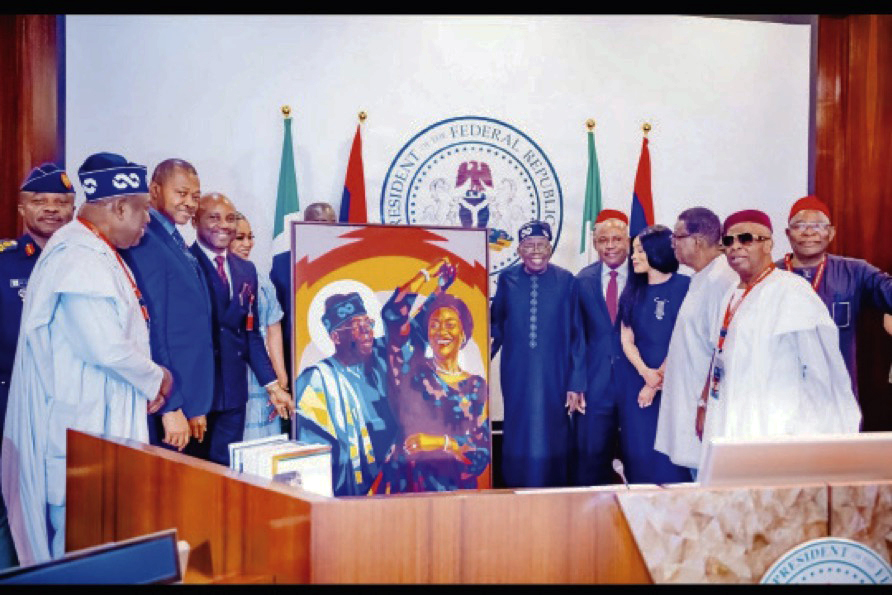
Enugu State’s political landscape has just taken a dramatic lift off, and the destination is clear: President Bola Tinubu’s re election in 2027. On a crisp, sunny Tuesday afternoon, April 21, at the Presidential Villa in Abuja, a high flying delegation of Enugu’s political heavyweights landed with a loud, unified endorsement. Led by Governor Peter Mbah, the group of ministers, military chiefs, former governors, lawmakers, traditional rulers, religious leaders, and academics delivered a powerful message: Enugu’s seven million people are boarding Tinubu’s unity flight to 2027.
The gathering was more than a courtesy call; it was a carefully choreographed political airlift, signalling that the South East’s old wariness of the federal centre is giving way to a new calculus of trust and deliverables. The delegation, which included Minister of Innovation, Science and Technology Dr. Kingsley Tochukwu Udeh, Chief of Air Staff, Air Marshal Sunday Kelvin Aneke, former Senate President Sen. Ken Nnamani, former Chief of Naval Staff, Vice Admiral Emmanuel Ikechukwu Ogalla, ex governors Sullivan Chime, Ifeanyi Ugwuanyi, and Jim Nwobodo, did not come with a shopping list this time, but with a declaration of loyalty.
In his opening remarks, Mbah anchored the visit in the Igbo concept of collective strength: “Igwe bụ ike” – strength lies in unity. Drawing on the age old Igbo story of the tortoise and the birds, Mbah painted a picture of mutual dependence and shared success. The tortoise, once lifted by the birds’ feathers, tried to hog the banquet in the sky; when the birds withdrew their feathers, the tortoise fell. The moral, Mbah stressed, is that “success that is shared will last.”
He reminded President Tinubu that the delegation was not there as a mere formality, but as a cross section of the seven million people of Enugu. He said the visit was symbolic, speaking to a shared future and a commitment to progress. “We have come to express our deepest and most heartfelt gratitude for the engagement and the investment you have extended to the people of Enugu State,” Mbah told Tinubu. “If it were possible, the entire Enugu State population would have converged here at the Villa to express our gratitude,” he added, underscoring the emotional weight of the visit.
The governor then issued the headline making pledge: “We have come to state, boldly and without ambiguity, that this relationship has earned our trust and support. On that basis, we will stand proudly with you on election day in January 2027.” The statement was delivered with deliberate clarity, leaving little room for speculation about Enugu’s political direction in the approaching contest.
President Tinubu received the declaration with visible appreciation. He hailed Mbah as a “transformative leader” and pointed to the rapid pace of development in Enugu under the current administration. “The results you are outlining, like security, infrastructure, education and health care, are not abstract. They are the evidence that reform is working, that difficult decisions are yielding real outcomes and that Nigeria is moving forward,” Tinubu said.
He tied Enugu’s progress to the broader architecture of his economic reforms, reminding the audience that his administration had removed the fuel subsidy, unified the exchange rate, strengthened public finances, and reformed the power sector – decisions that many criticized but that, he argued, had freed up resources for sub national development. “These are the bold decisions that have allowed states like Enugu to invest, to build, and to translate national decisions into tangible outcomes for our people,” he stated.
President Tinubu also acknowledged what he described as a “political realignment” favouring the APC, noting that Governor Mbah, once in the opposition camp, had crossed to the ruling party. Playfully, he refused to “give them credit by naming them,” but said, “I am proud of that.” He urged the delegation to ignore the naysayers and stay focused on governance. “Democracy will survive despite all intimidation. Ignore the naysayers. Stay focused. When you succeed and they are angry, let them be. I do not lose sleep over criticism because we are committed to building a nation of bright hope for our children,” he said.
From the President’s perspective, the Enugu visit was confirmation that his reform trajectory is not only producing results, but also winning political capital. “With a leader like you, who is so committed and visionary, Nigeria is on the right trajectory to becoming a very successful leading African nation,” he told Mbah. He credited governors who were effectively utilising funds released to sub nationals for the improvements in health, education, infrastructure, and citizens’ welfare, and expressed appreciation for some governors from other parties who had come to acknowledge the partnership with the federal government and had begun to align with the APC.
Mbah, however, was quick to clarify that Enugu’s success story is not a one man show. He walked the President through the package of federal interventions that had given Enugu “wings,” while stressing that the state government had worked hard to use those resources efficiently. He recalled President Tinubu’s January 4, 2025, visit to Enugu, which he described as a turning point in federal–state relations. At a time when Enugu’s electorate did not favour the APC, Tinubu chose to invest in the state, crossing party lines. “You broke a long standing political distance between this region and the federal government,” Mbah said. Standing side by side, the two leaders cut ribbons on several projects, including new road sections, upgraded facilities, and other infrastructure.
“So remarkable are your deeds, Mr. President, that the applause for one hardly dies down before another similar grand gesture emerges,” Mbah said, referencing a string of federal projects that had touched Enugu. He highlighted the concessioning of the Akanu Ibiam International Airport, which has transformed Enugu into a functioning international gateway and opened the entire South East – over 30 million people – to greater air connectivity, trade, and tourism. He pointed to the establishment of the South East Development Commission and the Vision 2050 forum, which have created a regional framework for coordinated infrastructure, investment, and growth that no single state could achieve alone. The extension of the gas pipeline to Enugu will connect the state to the national gas grid and unlock the region’s own gas reserves, paving the way for Enugu to become an energy hub in the South East. The approval of the reconstruction of the abandoned Port Harcourt–Enugu rail corridor has revived hopes for a vital rail link, though Mbah cautioned that contractors had yet to return to some sites due to funding delays and urged the President to ensure continuity. He also listed the Enugu–Port Harcourt expressway, over 100km of which has been rebuilt to safer standards, the progress on the Enugu–Onitsha road with flyovers emerging at key pressure points, and the 700 metre flyover at Eke Obinagu along the Enugu–Abakaliki expressway, all as evidence of federal commitment to easing the region’s travel and trade bottlenecks.
Mbah’s list was not just a recitation of projects; it was a political narrative. Each federal investment, he argued, had become a building block for trust between Enugu and the centre – trust that now underpins the 2027 endorsement. Beyond projects, Mbah emphasised that Enugu’s political airlift is also being carried aloft by national appointments and visible inclusion.
He pointed to Air Marshal Sunday Kelvin Aneke as Chief of Air Staff, entrusted with the security of the nation’s airspace, and Dr. Kingsley Udeh as Minister of Innovation, Science and Technology, steering federal science and technology policy. He highlighted Professor Simon Ortuanya as Vice Chancellor of the University of Nigeria, Nsukka, breaking a 65 year jinx by becoming the first Nsukka area appointee to the position. He also referenced Rt. Hon. Ifeanyi Ugwuanyi, his immediate predecessor, as Nigeria’s Ambassador to Greece, and noted that there were over ten other Enugu indigenes appointed to consequential national positions across key institutions. “These gestures reflect confidence, inclusion, and a deliberate effort to bring our people into positions of national responsibility,” Mbah said, drawing a parallel between the delegation at the Villa and the wider cadre of Enugu professionals now serving the nation.
Other News
Enugu, he argued, is no longer on the political tarmac. Its people are flying in the cockpit of national leadership, and that visibility, in turn, strengthens the political compact for 2027. Mbah was careful not to present Enugu as a mere beneficiary of federal largesse. He laid out the state government’s own reform agenda, which he described as the “engine” that powers the overall flight. On security, he revealed that incidents of violent crime in Enugu have dropped by 96%, restoring a sense of safety and normalcy. “People can now go about their daily lives with confidence,” he said, noting that the federal government’s ringing endorsement of these efforts has further boosted morale.
On education, Mbah announced that all 260 Smart Green Schools – one in each ward – have been completed, bringing modern classrooms, digital tools, and experiential learning to rural communities. “From September, school feeding programmes will reach over 260,000 children, improving attendance and nutrition at the same time,” he said, framing the policy as both a social safety net and an investment in human capital. On healthcare, the state has delivered 260 Type 2 Primary Healthcare Centres across the wards, with many already operational. “Maternal and child health services are now reaching more women and children than ever before, with significant reductions in preventable deaths,” Mbah said. A new 300 bed international hospital and upgrades to existing facilities have increased the state’s hospital bed capacity to over 4,000.
Perhaps most striking was the fiscal turnaround.
Mbah disclosed that Enugu’s Internally Generated Revenue (IGR) had surged from ₦26.8 billion in 2022 to over ₦406 billion by the end of 2025. “This gives the state the capacity to fund services and long term development,” he said, explaining that the growth is a direct result of aligned federal policies and disciplined state execution. With that extra fiscal runway, the state has refurbished or built over 1,000 kilometres of roads, cutting travel times and preserving citizens’ vehicles and incomes. The Governor also pointed to the reopening of the International Conference Centre, the expansion of Hotel Presidential, the launch of Enugu Air, and various tourism initiatives that are drawing business travellers and visitors to the state. In agriculture, farm estates and agro processing plants are linking farmers to storage, markets, and higher yields, while the construction of an integrated livestock hub and the country’s largest ranch, with a capacity of up to 30,000 heads of cattle, underscores Enugu’s ambition to become an agro industrial hub.
“For the first time in a long time, there is a sense that not one single project, but the whole system is beginning to work. People are beginning to feel the difference in how they live and what they believe is possible,” Mbah concluded.
Former Senate President Sen. Ken Nnamani, who anchored the gratitude segment of the visit, echoed and amplified Mbah’s points. “We have a leader in Enugu State. We have a leader, and we have confidence in him. He is leading us right,” Nnamani declared. He stressed that the achievements under Mbah’s leadership would not have been possible without federal support and that the President’s steady backing has translated directly into visible gains for the people. “The entire population of Enugu State, of more than seven million people, would have loved to come here to say a big thank you, Mr President. You will benefit tremendously from the support,” Nnamani said, before also affirming Enugu’s backing for Tinubu in 2027.
Nnamani’s statements were significant because they came from a seasoned South East political figure who has seen the region oscillate between hope and frustration. His endorsement lent a decades deep credibility to the unity flight narrative, suggesting that Enugu’s support for Tinubu is not an isolated aberration but part of a broader regional recalibration.
For President Tinubu, the Enugu visit is a strategic win in a region that has long been one of the most difficult to crack politically. The South East has historically leaned away from the ruling party, and no incumbent president has comfortably carried the zone in recent memory. By flying Enugu to his corner, Tinubu is not only gaining a critical bloc of votes, but also sending a signal to other South Eastern states that aligned governance can yield tangible returns.
The President’s remarks on the “political realignment” bearing the APC’s imprint also serve as a warning to opposition forces that patronage and deliverables are shifting. When he noted that governors from other parties are now acknowledging the “healthy and rewarding partnership” with the federal government and many are gravitating towards the APC, he was effectively mapping the political sky ahead of 2027.
Tinubu also used the platform to commit to further investments, particularly in the areas that matter most to Enugu: the Port Harcourt–Enugu rail line, the power sector, and long term infrastructure funding. He reiterated that the era of funding long term projects with short term budgets had been curtailed and that states now have more predictable resource flows to plan and execute their development agendas. “I can assure you we will continue to work together, think together and build together a nation that will be a pride of place for all our citizens,” he said, linking the Enugu visit to the broader national project he wants to complete by 2027.
As the entourage prepared to leave the Presidential Villa, the atmosphere was one of quiet confidence. The “unity flight” had not only taken off; it appeared to be cruising smoothly. Mbah’s closing remarks captured the mood: “Behind us stand more than 7 million people. Their lives are shaped by what we do here. They have placed their trust in us, and they are beginning to place that same trust in you.”
He returned to the tortoise and the birds, reminding the President that the flight to 2027 will only succeed if everyone remains on the same flight path. “There is a banquet in the sky before us. We will rise to it together. We will lend feathers to those who need them. But we must remain on the same flight path of shared endeavour,” he said.
In political language, this was a promise of sustained support: Enugu’s political leaders will not be mere passengers, but committed co pilots on Tinubu’s campaign airliner. Whether the unity flight can maintain its altitude and reach the 2027 runway in one piece will depend on the consistency of delivery, the management of emerging economic headwinds, and the ability of the South East’s diverse political actors to keep their wings in alignment. For now, however, the message from Enugu is clear: Tinubu’s 2027 re election campaign has just gained a powerful regional booster – and the engines are revving.