Follow Us on Google

Michael Akuche
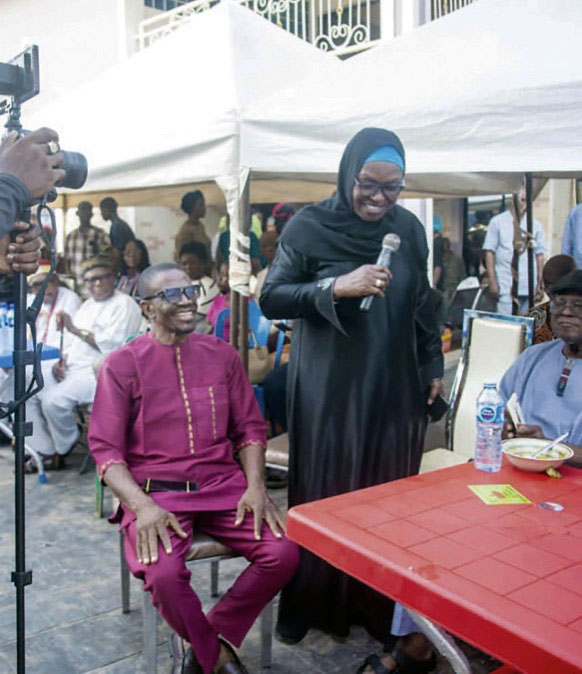
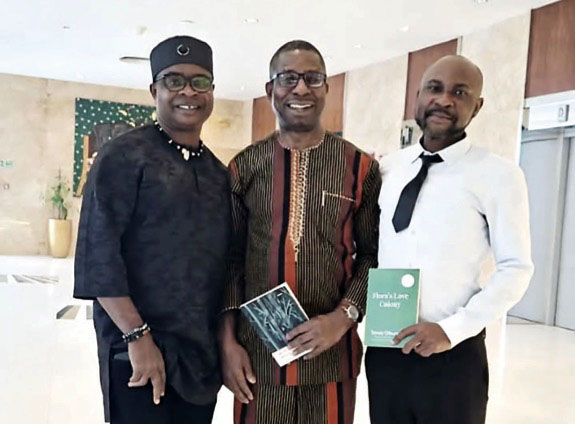
The 1000 Lecture Theatre, Faculty of Arts, University of Benin, was filled to capacity when two Lagos-based writer-journalists, Henry Akubuiro and Anote Ajeluoruo, were hosted by the Department of English and Literature to a reading session and writing master class recently.
Coordinated by Professor Tony Afejuku and Esther Jamgbadi (PhD) of the Department of English and Literature, the two scholars led the visiting writers to office of the departmental head, Professor Ugwu, on a courtesy call on Friday morning.
The HOD was delighted that the writers honoured the invitation of the department, as it was part of its programmes to boost creative writing in the university. Both writers cherished the honour and opportunity to read and impart writing skills to the students.
After Jamgbadi had introduced the event to the audience at the 1000 Lecture Theatre, Prof. Tony Afejuku, a writer himself, introduced the visiting writers. He informed them that Anote, who was until recently the Arts Editor of The Guardian, and now the current Political Editor of the paper, was recently longlisted for the Nigeria Prize for Literature with his debut children’s literature, Igho Goes to Farm.
He said Akubuiro, the Arts Editor of The Sun, apart from his debut novel, Prodigals in Paradise, had written three other works of fiction, but would be reading from the former for that event. Both writers, whom he described as “creative journalists”, were chosen on account of their sterling performances on the Nigerian literary scene over the years.
First to take to the floor was Ajeluoruo, who read excerpts from Igho Goes to Farm. He then gave a talk on children’s literature. Ajeluoruo charged teachers of literature in universities and other higher institutions to incorporate the study of and research into children’s writing in their departments’ curricula.
He argued that those at the cradle of learning were being denied the benefit of sound reading texts, because the experts in the field were not involved in what constitute recommended texts. As a result, he said, badly written and substandard texts flood both private and public schools’ classrooms that become a deterrent to efficient mastery of the rules of grammar in spoken and written English. He affirmed reading well-written children’s storybooks, like Igho Goes to Farm, would help the linguistic ability of children, just as bad ones would have an adverse effect on them.
Ajeluorou further argued that the foundation of children’s education needed to be protected from badly written texts in order to get a good start in life. He stated that such poor foundation in children was hard to correct later in life, as it trailed them to their university education level and life after school.
The children’s author, therefore, said teaching children’s writing in higher institutions, as a specialised field of study, would further enrich writing in that genre, facilitate its research and documentation, and elevate children’s writing in the country to an enviable level.
Akubuiro was the next to read. He read excerpts from Prodigals in Paradise, to the ecstatic audience, situating the setting of the novel and the pace of the narrative. In his lecture entitled “10 Practical Steps to Write a Novel”, Akubuiro said, first of all, the writer should choose a genre of prose fiction, whether a literary fiction, romance, fantasy, science fiction, thriller or specluative fiction.
“You have to decide which genre of fiction will serve your purpose and what market you are targeting. In Nigeria, literary fiction is more popular. Abroad, other genres tend to be more popular. Chinua Achebe’s Things Fall Apart, Chimamanda Adichie’s Americanah and my own Prodigals in Paradise are all works of literary fiction: they are social issues-oriented works of fiction.”
He further taught them how to choose a story idea. “There must be a message you want to put across to the world. This is called THEME. Once you have this message or messages at the back of your mind, you are good to go. In my own case, I chose to write on socio-political contradictions in a post-military Nigeria with rising unemployment, corruption, religiosity, social dysfunction, and the like. The essence is to continue the post-colonial conversation in a different era.”
He stressed that you can’t be a good writer without being a good reader. “It is not just about reading books; you have to also own books, too. There are many reasons why you should read other writers. First, it will enable you to have an understanding of what has been done already in your genre of fiction and, therefore, prepare you on creating a new one. In addition, it will make you understand what has proven popular in a given genre,” he said.
Akubuiro further taught the class on the relevance of choosing a relevant point of view that would match the narrative, establishing a setting, developing the main characters, establishing the conflict, creating an outline and developing the structure. “My favourite style is the fichtean curve, which skips exposition and starts right in the rising action,” he said.
The multiple award-winner emphasised the writer should create a unique style, for, “Every writer has a story to tell, but how it is told is what matters most. Stand out from the crowd by having a unique style. That is where language comes in. The subject matter of a story may become irrelevant after some years, but your style will keep the reader going back again and again.”
After a loud ovation, both visiting writers and students were engaged in an interactive session on their writings. The students were then given assignments based on what the two writers taught them.
Akubuiro told this reporter afterwards, “It was a mind-blowing experience. I have been reading across the country for years now, but this Uniben outing ranked among the most exciting. The turnout was massive. In terms of book sales, it was good news for me. The lecturers in the Department of English and Literature stopped their classes to be with us. I encourage other Nigerian universities to borrow a leaf from Uniben in promoting creative writing and creating that synergy between writers and students.”
__________________________
• Michael Akuche is an undergraduate in the Department of English, University of Benin