Follow Us on Google
From Uche Usim, Abuja
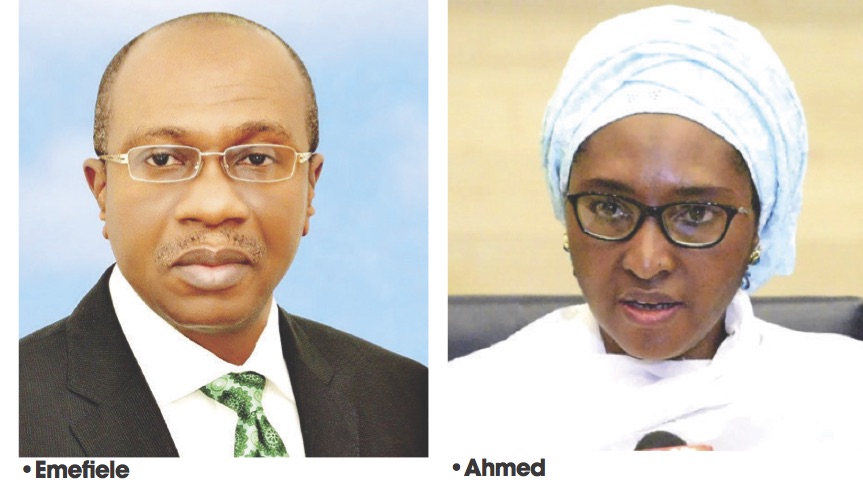
Many did not see last week’s naira notes redesign announcement coming; not even the Finance Minister, Mrs Zainab Ahmed, who came close to calling it a ‘coup’ that would unsettle Nigeria’s financial ecosystem.
But the Central Bank of Nigeria (CBN) quickly responded and explained that due process was followed, as all legal approvals, including President Muhammadu Buhari’s nod approving the exercise, which was 12 years due.
As expected, therehave been divergent experts’ opinions on the rationale behind having new N200, N500 and N1,000 notes by December 15.
Nonetheless, the CBN Governor, Mr Godwin Emefiele, said the action draws legitimacy from Sections 2(b), section 18(a), and section 19, Subsections a and b of the CBN Act 2007 and has the best of intentions for the economy.
Emefiele advised depositors to hit the banks to exchange their old currencies for the new ones before the January 31, 2023 deadline, when the old notes would cease to become legal tender.
For a nation battling deep-rooted insurgency, the CBN is convinced that the incidents of terrorism and kidnapping would be minimised as access to the large volume of money outside the banking system used as source of funds for ransom payments will begin to dry up.
More so, with the 2023 general elections on the horizon, where moneybags plan to use stashed cash to influence outcomes via vote buying and thuggery sponsorship, the new development is expected to fracture such structures as humongous funds would no longer be available.
According to Emefiele, as at the end of September 2022, available data shows that N2.73 trillion out of the N3.23 trillion currency in circulation, was outside the vaults of commercial banks across the country; and supposedly held by the public.
“Evidently, currency in circulation has more than doubled since 2015; rising fromN1.46 trillion in December 2015 to N3.23 trillion in September 2022. This is a worrisome trend that cannot be allowed to continue”, he said.
Statistically, over 85 percent of currency in circulation are outside the vaults of commercial banks, a worrisome development experts said should not be condoned as currency hoarders can easily gang up against constituted authorities and vandalise the levers of governance.
In recent years, the CBN said it has recorded significantly higher rates of counterfeiting especially the N500 and N1,000 banknotes. While global best practice is for central banks to redesign, produce and circulate new local legal tender every five to eight years, existing naira notes have not been redesigned in the last 20 years.
To ensure a seamless transition, Emefiele ordered the immediate stoppage of bank charges on deposit, just as he directed banks to keep open their currency processing centers from Monday to Saturday to accommodate all cash that will be returned by their customers.
He added that currency management has faced several daunting challenges that have continued to escalate in scale and sophistication with attendant and unintended consequences for the integrity of both the CBN and the country.
However, experts who interrogated the issue applauded the apex bank as the redesign of the currency will help deepen the drive to entrench cashless economy as it will be complemented by increased minting of the eNaira.
This will further rein in the currency outside the banking system into the banking system thereby making monetary policy more efficacious.
To ensure it’s not bark and no bite, analysts have asked the CBN and Economic and Financial Crimes Commission (EFCC) to synergise to ensure the success of the planned currency reissue.
They asked the EFCC operatives to mount surveillance in banks to apprehend those who make huge and suspicious lodgements.
The Executive Chairman of the EFCC, Abdulrasheed Bawa described the move by the apex bank as “a well-considered and timely response” to the challenges of currency management which has negatively impacted the country’s monetary policy and security imperatives.
Bawa, however, warned that EFCC will monitor the process to ensure that unscrupulous players and currency speculators and their cohorts among the BDCs do not undermine the exercise. He also charged banks to be alive to their reporting obligations and not assist unscrupulous customers in laundering suspected proceeds of crimes through their system.
“The EFCC, the CBN and some other regulators in the financial sector have worked closely in the recent past to determine how best to stabilize the country’s monetary policy environment. It is heart-warming that the CBN has demonstrated courage in taking this bold decision which I believe will bring sanity to the currency management situation in Nigeria”, he said.
He called on operators in the Nigerian financial services sector, especially deposit money banks and bureau de change operators to work within the guidelines provided by the Central Bank of Nigeria to ensure seamless withdrawal of the old currency.
More so, a former Deputy Governor of the Central Bank of Nigeria (CBN), Kingsley Moghalu, has thrown his weight behind CBN’s plans to redesign naira notes.
He noted that while the move may not stem inflation, it remains a necessary step.
“I fully support the Central Bank’s redesign of the Naira. If 80 percent of bank notes in circulation are outside the banks, that’s troubling. The CBN obviously wants to force all those notes back into the banking system. Those with the notes must surrender to get new ones or else it becomes illegal tender after January 31 2023.
“This is also a way to withdraw currency from circulation, an unorthodox way of tightening the money supply since the country is battling high inflation.
“The flip side is that people who are holding huge amounts of cash outside the banking system for nefarious reasons will go to the parallel forex market to buy hard currency, putting further downward pressure on the value of the Naira as too much Naira will be chasing too few dollars.
“I doubt it will solve inflation because there also are other major reasons for inflation such as the forex crisis, which this new move could exacerbate, as well the impact of the security crisis on food price inflation.
“But overall it is a necessary step. I just think the time window for its implementation is rather short. This will put a lot of operational pressure on commercial banks and the financial system in general. A 90 day window would have been better, but one can understand the need to avoid interfering with the elections.”
However, the Director General, Centre for Promotion of Private Enterprises (CPPE), Dr Muda Yusuf described the planned currency redesign as a rude shock as there are more important issues bugging the economy. He noted that recently, Nigeria was downgraded by Moody’s from B2-B3 on account of a messy and weak financial system locally and internationally.
“We also know there are issues around foreign exchange. We know what is happening to the manufacturers, investors and foreign airlines. There is also the issue of high inflation that imposes huge cost on the economy and all that?
“How can you navigate the complex rural areas? That’s an issue around connectivity. What of areas without banks?
It’ll cause panic and we should retrace our steps”, he advised.
Nigeria’s first professor of the capital markets, Prof Uche Uwaleke, told Daily Sun that the decision to replace some naira denominations with new ones will be positive for the economy in the medium to long term.
“Although the measure does not amount to demonetisation of big currency notes often carried out by Central banks to curb black money and corruption, it will go a long way in ensuring that a lot of naira notes circulating outside the banks are crowded in. If it leads to large deposits in banks, it means the banks will have more money to lend which may reduce interest rates.
“I also think it may have the effect of reducing speculative attacks on the naira in the parallel market.
I expect that the Financial Intelligence Unit will be on the watch out for huge deposits as a way of monitoring illegitimate transactions. Despite the huge cost involved in changing currency notes, I think it’s time to sanitize the system especially now that electioneering activities have kicked off.
“However, I think the deadline of Jan 31 2023 is short in view of the number of naira denominations involved, from 100 to 1000. The CBN may consider extending it with time”, he said.
A Trade and Investment Expert, Ikenna Nwosu, in his view, said the decision of the Central Bank of Nigeria (CBN) to redesign some naira notes will increase the dollarisation of the Nigerian economy.
“Politicians are going to start using the naira to buy dollars; because they are going to be afraid to pay the cash. So, there will be increased dollarisation of the economy. They won’t buy pounds because pounds will soon be changed because there is a new king.
“So, there is going to be dollarization and that has national security implications, again that is going to have an impact on inflation,” he said.
Nwosu, who is the Chief Executive Officer Mooregate Limited, Investment Advisory, said there has to be a collaborative efforts from all stakeholders including the Economic and Financial Commission (EFCC), the Independent Corrupt Practices and Other Related Offences Commission (ICPC), the Nigerian Financial Intelligence Unit (NFIU) and the Nigeria Police Force to address the heightened dollarisation possibility.