Follow Us on Google
From Adanna Nnamani, Abuja
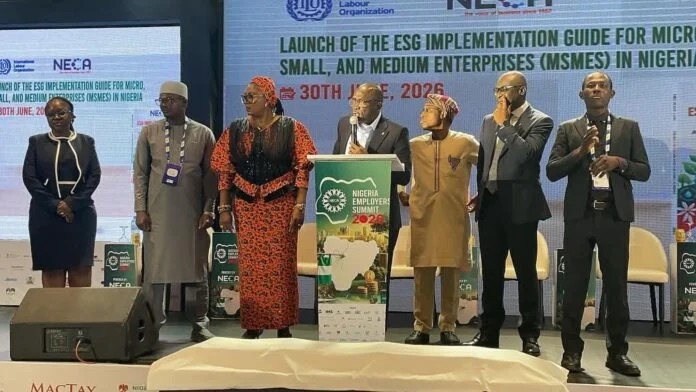
The Nigeria Employers’ Consultative Association (NECA), has launched an Environmental, Social and Governance (ESG) Implementation Guide for Micro, Small and Medium Enterprises (MSMEs), aimed at improving access to finance, strengthening competitiveness and positioning Nigerian businesses for greater participation in global markets.
The guide, unveiled during the 2026 Nigeria Employers’ Summit in Abuja on Tuesday, is the first ESG implementation guide specifically developed for MSMEs in Nigeria and across Africa. Chairman of the NECA ESG Advisory Board, Femi Jaiyeola, described the initiative as a milestone for Nigerian businesses, saying MSMEs remain the backbone of the country’s economy and require practical tools to compete in an increasingly sustainability-driven global business environment.
According to him, ESG has evolved beyond a regulatory compliance requirement to become a key business strategy for attracting investment, improving competitiveness, strengthening resilience and creating long-term enterprise value.
“ESG has gone beyond a tick-box exercise to satisfy regulatory requirements. It now provides enormous opportunities for MSMEs and for Nigeria as a country,” Jaiyeola said. He noted that the implementation guide comes at a critical time when regulators, financial institutions and global markets are increasingly demanding sustainable business practices from enterprises of all sizes. “The message for MSMEs is very clear. By 2030, ESG reporting is expected to become mandatory in Nigeria. Therefore, the time to prepare is now,” he said.
Jaiyeola explained that the guide provides a practical, step-by-step roadmap to help MSMEs begin their ESG journey while generating measurable business value, strengthening organisational resilience and improving access to finance and international markets.
“This guide is more than a document. It is a practical tool that will help Nigerian MSMEs compete, grow and thrive in a sustainability-driven economy,” he added.
He commended the International Labour Organization, consultants and members of the NECA ESG Advisory Board for their technical support in producing the guide.
Jaiyeola recalled that NECA, with support from the International Labour Organization, conducted a comprehensive assessment of ESG practices in Nigeria, launched in December 2025, which highlighted the need to integrate MSMEs into the country’s sustainability framework because of their strategic role in economic development and job creation.
He also disclosed that six NECA officials are currently undergoing specialised ESG training for SMEs at the International Training Centre of the ILO in Turin, Italy, and will, upon completion, train MSMEs across Nigeria’s six geopolitical zones.
Speaking with journalists on the sidelines of the summit, NECA Director-General, Adewale-Smatt Oyerinde, said the organisation developed the guide to help small businesses understand and take advantage of the growing global emphasis on environmental, social and governance standards.
Other News
He explained that investors now consider ESG compliance when making investment decisions, making it essential for businesses seeking funding and expansion opportunities.
“Before, the focus used to be profit maximisation. But now it is no longer just about profit. Investors are looking at how businesses interact with their environment, their social impact and their governance structures before deciding to grant funds, concessions or other forms of support,” Oyerinde said.
He described MSMEs as the engine of economic development, noting that they account for the overwhelming majority of businesses in many economies.
According to him, the implementation guide is intended to simplify ESG principles and create a pathway for small businesses to adopt sustainable practices without undue difficulty.
“For SMEs and MSMEs, there is a need for us to first create an inroad so they understand the opportunities that exist in ESG. Once they understand it, we also create a path for them to play in that ecosystem. Once they have the capacity, implementation becomes easy, and that opens the door for global opportunities to scale their businesses,” he said.
On the broader economic environment, Oyerinde stressed that sustainable businesses are fundamental to national development and employment creation.
The NECA Director-General also called for continuous engagement between government and the organised private sector to ensure ongoing economic reforms achieve their intended objectives.
He said while reforms inevitably affect businesses, workers and individuals, government must continually review their implementation and remain open to alternative approaches that could deliver better outcomes.
“Our recommendations are not frivolous or antagonistic. They simply provide another pathway to achieving the government’s economic objectives. Government has its route, but the private sector can also show other routes to the same destination,” he said.
Oyerinde added that recommendations from the summit would be compiled into a communiqué and presented to relevant government ministries and agencies for consideration in future policy decisions.