Follow Us on Google

•Urges UN to act •Sanctions 3 top Wagner’s Malian allies
By Emma Emeozor
United States has berated Russia of trying to use food as weapon in its war with Ukraine.
US stance is informed by the decision of Russia to suspend the Black Sea Initiative and the consequent “vicious strikes” Moscow launched on Odesa.
At a press briefing, United States State Department spokesperson, Mathew Miller said the strikes “further illustrate Russia’s willingness to use food as a weapon in its illegal war against Ukraine.”

Miller said “the Kremlin wants to deprive Ukraine’s economy of a major source of income, without regard for needy people across the globe who will feel the consequences and be forced to pay higher prices for food.”
He noted that since Russia announced its withdrawal from the Black Sea Grain Initiative, it has used missile and drone strikes to “kill and injure scores of civilians, devastated UNESCO-listed heritage sites, including the historic Orthodox Transfiguration Cathedral, and destroyed port infrastructure and grain stockpiles that could have fed hundreds of thousands around the world.”
He drew attention to what he described as “appalling images of burning churches and flattened residential buildings,” adding that “Russia attacked grain warehouses on the Danube River, now a vital export route for grain since Russia has effectively blocked Black Sea ports.”
Miller said while the US and its allies are trying to “help Ukraine rebuild and find alternate ways to continue its grain exports to the world, the Kremlin remains determined to cause destruction.”
He reiterated the support of US and its and partners for Ukraine, saying stressing that “they will not waver in our support for Ukraine as it defends itself, and fights to reclaim its sovereign.”
He said it is their shared responsibility to demand Russia halt its attack on Ukraine until it withdraws its forces and demonstrates that it has an interest in peace.
According to Miller, US and its allied and partners will continue to “help Ukraine defend its territory and protect its people, and to hold Russia to account for the suffering it chooses to inflict on so many.”
He also commented on Russia’s military drilling and assault on a mock ship in the Black Sea last week as well as expected support from Romania. His comment was a response to a question on Secretary Antony Blinken’s call on his Romanian counterpart, Bogdan Aurescu, for support following attacks on the Danube.
While expressing optimism over the two minsters encounter, Miller said a “broader Black Sea Grain Initiative” was discussed. “The Secretary made clear that he would welcome Romania’s support, as they would welcome the support of all of our allies and partners in the region in finding ways to restart the Black Sea Grain Initiative. As you know, President Erdogan said on Friday that he’d look to have further discussions with President Putin to urge him to rejoin the Black Sea Grain Initiative. We obviously would be hopeful that there would be some success out of those discussions.”
This is even as he said, “we’ve had information to suggest that they may be preparing a false flag operation, we believe they may be preparing a false flag operation; their threatening of ships operating in international waters; and then just today, this attack on the Danube.”
Miller noted “there is no perfect solution that would allow Ukraine to ship the same amount of grain as it did under the Black Sea Grain Initiative without the reopening of those sea lanes. There just simply isn’t a way to get enough grain out through the Danube ports or over land or any other means.”
Therefore US “will continue to consult with our partners in the region on how we might find alternative ways to get grain out of Ukraine.”
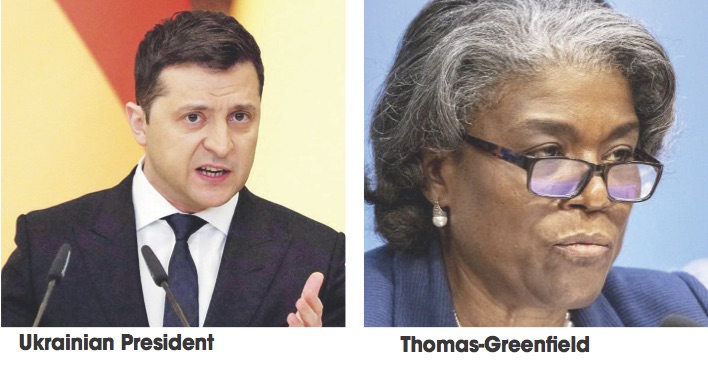
Meanwhile, Russia came under heavy attack by the US at the United Nations Security Council on Wednesday as Ambassador Linda Thomas-Greenfield slammed Moscow. “Russia wasted this Council’s time with another sham,” she queried. Thomas-Greenfield is US Representative to the UN. She was reacting to Russia’s suspension of the Black Sea Grain Initiative.
She was quick to call on the Security Council to act. “This Council cannot be silent. It is time to act. And this is a pressing matter of international peace and security.
“The Ukrainian people need peace. The world needs peace. President Putin: It is far past time for you to silence your guns. Withdraw your troops. And end your brutal aggression.”
Her anger was followed reports of Russia’s “brutal” attacks on Odesa and other port cities. “And this one was cruelly ironic given that Russian forces destroyed Odesa’s historic Transfiguration Cathedral just this week with a targeted Russian missile,” she said.
Quoting the UNESCO, she said, “roughly 270 cultural sites have been damaged since President Putin launched his full-scale invasion of Ukraine. The loss of Ukrainian cultural heritage is staggering and it is truly shameful. And the attack on the historic Transfiguration Cathedral was just one of the many attacks Russia has carried out in the Odesa region this week.”
Thomas-Greenfield lamented, “The Ukrainian people are paying a heavy price. My heart goes out to the loved ones of those killed and injured. To the communities that have been rocketed by Russian missiles and drones. To the children who have endured so much needless suffering and violence.”
She wants members of the Council to be mindful of the global implications of Russia’s attacks and blockade to Ukraine grain. “Colleagues, Russia is hell-bent on preventing Ukrainian grain from reaching global markets, which is why it unilaterally suspended its participation in the Black Sea Grain Initiative. Even though Russia never fully implemented the Black Sea Grain Initiative, this arrangement helped get food to those in need,” she said.
Drawing attention to World Food Programme report, the Ambassador said: “Over the past week, the Russian military has bombarded Odesa and other port cities. One attack destroyed 60,000 tons of grain, which according to the World Food Program is enough to feed more than 270,000 people for a year.
“And on July 23 and 24, Russia struck Ukrainian ports on the Danube destroying grain storage infrastructure at the port of Reni just across the river from Romania. Russia’s attacks on Chornomorsk a port that facilitates nearly 70 percent of Ukrainian wheat exports to developing countries caused damage that experts say will take at least a year to repair.”
She appeal to the UN Secretary-General António Guterres to continue his efforts to find a path forward to resume the Black Sea Grain Initiative, noting that it has benefited the developing world. She disagreed with Russia’s argument that it is only Western countries that benefited from the Initiative.
Her words: “And as the Secretary-General has said, it has been a “beacon of hope.” And we encourage him to continue his efforts to find a path forward to resume the Initiative.
“This Initiative, brokered by the United Nations and Türkiye, lowered food prices for all. It has been critical to the World Food Program’s humanitarian work in places like Afghanistan, Somalia, and Yemen. And the Black Sea Grain Initiative disproportionally benefited the developing world. And as Mr. Khiari said, it was a lifeline to many.
“Russia will tell you otherwise. It will say that only Western countries benefited from this arrangement. But the facts are not on Russia’s side. And they know it. Which is why they have chosen not to speak in the Chamber today. Another temper-tantrum for not getting their way.”
Using UN’s record to back her opposition to Russia’s remark that it is Western countries that benefited from the Initiative, Thomas-Greenfield said: “According to the UN, nearly two-thirds of the wheat exported through this arrangement went to developing countries.
“Global food prices spiked to near record highs after Russia launched its full-scale invasion of Ukraine. They rose again after Russia suspended its participation in the Black Sea Grain Initiative. And this past Monday, wheat prices spiked in response to Russia’s missile barrage against Odesa.”
Meanwhile, the US on Monday announced that it is imposing sanctions on three top Malian officers “who have worked closely with the Wagner Group to facilitate and expand Wagner’s presence in Mali since December 2021.” The Wagner Group is a gang of Russian mercenaries led by Yevgeny Prigozhin.
The officials are: Defense Minister Colonel Sadio Camara, Air Force Chief of Staff Colonel Alou Boi Diarra, and Deputy Chief of Staff Lieutenant Colonel Adama Bagayoko.
The statement read in part: “Today, the United States is designating three Malian officials who have worked closely with the Wagner Group to facilitate and expand Wagner’s presence in Mali since December 2021. Civilian fatalities have surged by 278 percent since Wagner forces deployed to Mali in December 2021. Many of those deaths were the result of operations conducted by Malian Armed Forces alongside members of the Wagner Group.
“The United States will continue to take action against those who facilitate the Wagner Group’s destabilizing activities, which pose threats to peace and security in Mali and the region. As th e largest bilateral donor of development and humanitarian assistance to Mali, the United States supports the people of Mali in their aspirations for peace, prosperity, and democracy.
“The U.S. Department of the Treasury designated Malian Defense Minister Colonel Sadio Camara, Air Force Chief of Staff Colonel Alou Boi Diarra, and Deputy Chief of Staff Lieutenant Colonel Adama Bagayoko, pursuant to Executive Order (E.O) 14024 for having materially assisted, sponsored, or provided financial, material, or technological support for, or goods or services to or in support of, the Wagner Group, a U.S.-designated entity, pursuant to E.O. 14024. For more information on today’s actions.”