Follow Us on Google
From Stanley Uzoaru, Owerri
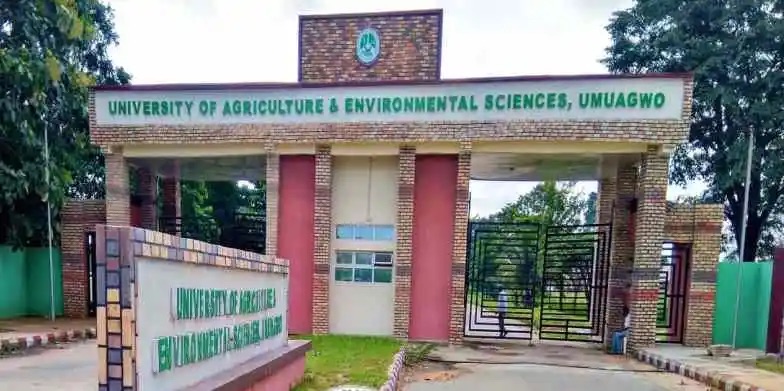
The University of Agriculture and Environmental Sciences, (UAES)has launched the Digisol Farm Website in conjunction with the EU Delegation office in Abuja and West Africa as part of on-going innovation for sustainable agriculture in South East Nigeria.
Acting Vice Chancellor of UAES, Umuagwo, Imo State, Professor Christopher Chiedozie Eze, who made the disclosure said the institution has established the Directorate of Research and Development to strengthen institutional research culture.
According to him, the outcome includes two academic staff, who won the TETFund National Research Fund (NRF) Grant and five others, who are currently participating in the Final Phase of TETFund Alliance for Innovative Research (TETFAIR) Programme in Abuja.
A professor of Agricultural Economics, Eze disclosed this when he declared the inaugural edition of the International Conference Series of the Institution (UAES) which had the theme “Innovative Solutions for Sustainable Development, Bridging Agriculture, Environment and Technology.”
Eze noted that the world currently stands at crossroads as food insecurity is the major disease ravaging the African continent and nations of the world.
“From climate change to food insecurity, biodiversity loss to technology disruptions, our world is confronted with complex challenges and in these challenges lie unpredicted opportunities for innovation.”
Represented by the Deputy Vice Chancellor (ADM), Professor Emmanuel Ezenwa, Eze added that UAES had established a robust synergy as a panacea towards building resilient and climate friendly realities that could unlock new possibilities of economic prosperity in the country.
“With the world standing at crossroads consequent upon food insecurity, there is need to either promote rapid advances in technology in order to reduce the food and environmental risks that face us today and improve the sustainable production of food and the environmental maintenance of our continent and nations or we play down on the realities of the situation, the choice is ours.”
Other News
The vice chancellor who professed his commitment and that of his institution to deeper linkages between research and rural reality, to co-create with farmers, train the next generation of food system leaders and to amplify African voices in global policy arena disclosed that it is now compulsory for all students of his institution to study agriculture and environmental courses and to acquire the required skills before graduation.
“Our thinking is to promise entrepreneurs/job providers and not job seekers and since I assumed office, we have initiated and commenced Top-up HND conversion and IJMB Advanced Level Programmes, thereby expanding access to higher education and professional progression”.
Chairman of the Local Organizing Committee (LOC) of the conference, Professor Christian Chukwuemeka Ike, in a welcome speech earlier explained that the programme was meant to chart pathways that could secure a future where agriculture thrives sustainably, the environment preserved and technology becomes a driving force for inclusive development.
According to Ike, through precision agriculture, eco-restoration techniques, climate smart farming, biotechnology, renewable energy solutions, digital technology and green revolution, the world could unlock new possibilities for sustainable growth.
He expressed optimism that the conference had the capacity to provide the platform for such transformative ideas to be shared, refined and translated into action.
A lecturer, Professor Joshua Edet Udoh of the University of Uyo, voted that the world is grossly immersed with solutions and measures for enhanced food production to take care of the population explosion.
“Now, we are confronted with climate change such as drought, flooding and uncommon diseases and the irregularity of weather conditions discourages our farmers.”
The don lamented that this untoward condition dampened the spirit of farmers and challenged experts to come up with solutions to remedy the situation, saying, “every innovation must respect the environment that sustains us and we must think of adopting new technology while our findings must guide policies with innovations being contextual.
Again, “we must domesticate technology that will be adaptable to our own environment and for us to bridge the agricultural environment, we must close the knowledge gap, the bridge policy gap and the collaboration gap,” he concluded.