Follow Us on Google
• Discarding safety rules, Lagos traders court death, disaster while selling on rail tracks
• We know it’s illegal, but we’re too poor to rent shops
By Kafilat Odunayo
You could say they are perpetually walking and working in the shadow of death. But they are not perturbed.
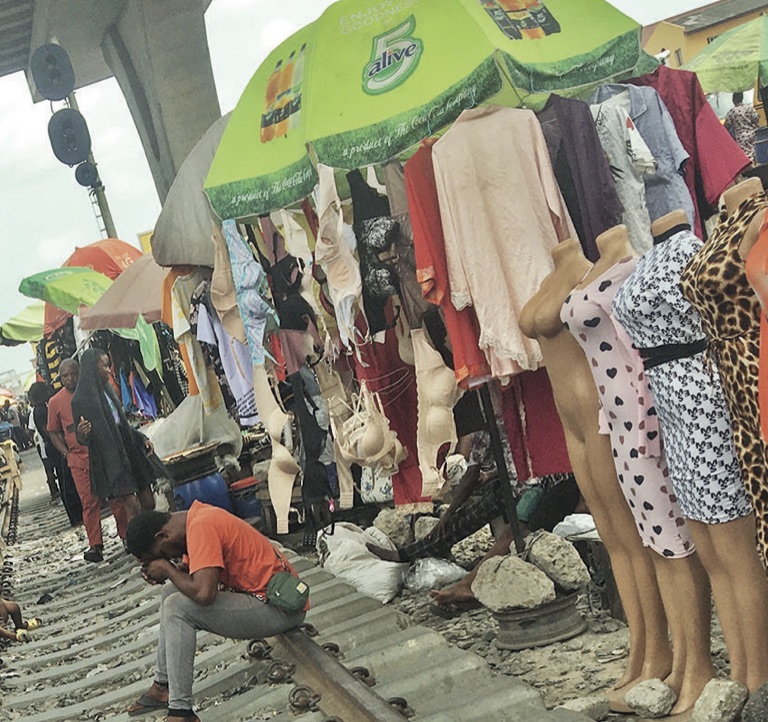
Each day, they throng the rail tracks in Lagos, displaying their numerous wares just by the tracks. Some others put their merchandise right on the tracks and remove it when tnhey hear the menacing blaring of the train’s horns. The fear of the death and disaster lurking when a train appears in the distance, speeding towards them with undisguised fury, simply does not exist.

Only recently, tragedy struck in Lagos, when a train collided with a high capacity bus crossing the rail track in Ikeja. The moving train crushed the bus and dragged it for about 100 yards, sending some of its passengers to their agonising death and leaving many injured.
So why would they continue to trade on and beside rail tracks? Saturday Sun encountered some of the traders recently.
Some of the traders said the sole reason for embarking on such seemingly dangerous ventures every day is because they have no shops of their own. They expressed the desire to own personal shops where they could better transact their business instead of staying on the rail track to sell their goods. They blame the high cost of renting shops for their decision to keep transacting business on the rail tracks.
Some of the women told the reporter that owning a shop in Lagos is for people who are financially stable and comfortable. They claimed that it is better to be on a rail track than to rent shop and pay over N1million and still not make enough sales.
Indeed, in Lagos, the major rail tracks in places like Agege, Oshodi and Ikeja Along, are on daily basis occupied by traders and their customers, turning the tracks to commercial centres. The traders oftentimes block routes with their wares thereby making it explicitly difficult for passersby to move. And when some of the passersby mistakenly step on their wares, the traders get and angry and could resolve to fighting the passerby. Many of them resume trading in the morning or in the evening, displaying their wares to make sales.
Although, they are conscious of the time of the arrival and departure of trains on the routes, they would display their wares on the rail tracks and carry on with their businesses. But as soon as they sight an oncoming train, would rush to pack their goods off the rail.
When the reporter visited the Agege, Oshodi rail-track markets, usually known as rail markets or Oju-irin by residents on Monday afternoon, most of the sale points were filled with passengers, buyers and sellers. These popular rail tracks markets are known for its lively sales of Okrika wears, shoes, bags, belts and lots more. While waiting for customers to arrive, some of the traders spoke to our correspondent on how the hike in shop prices has contributed to their sales on railways.
One of the traders at Agege rail market who identified himself as Benjamin explained to Saturday Sun how he and his fellow traders have been surviving on the rail tracks.
He said: “I know it is illegal, but I have to survive and feed my family. Shop rental is too much to bear, considering the fact that there is extra charge for agreement and commission. We depend on the train movement and we’re conscious of the time. Anything after 4:00 pm, we pack from this lane while people from the other lane pack by 6:00 pm. We also help ourselves out if any of us is not around. Moreover, the train doesn’t move on all tracks at the same time. Even as these shoes are arranged on the track, I have time to pack one after the other before the train reaches me.”
Daniel, who sells jeans on the rail tracks, also explained how trading on the track has been for him. We know the time the train passes. I remove wares that might get crushed when I’m leaving for somewhere else. I’m not scared because I’m sure of the time the train will pass and I’m always prepared for it.”
He went further to explain that the traders were already used to life on the rail tracks. “Only our customers get scared; we’re not usually scared because we’re used to it. It’s what we do every day, and we’re familiar with it.”
Another of the rail tracks trader, who identified himself as Chuchu Desmond, expressed his fear without holding back when he spoke with Saturday Sun: “I’m very scared, but I’m due to not having money to rent shop. I’d rather be here than rent a shop that might not even cater to my needs, not to talk of that of my family because of the expenses involved in renting one. Although, we also pay N200 naira every day for being here. There’s no alternative, instead of begging or stealing, we would rather find a place like this to struggle.”
Mrs Esther who sells kiddies wears explained why and what brought her to the rail track. According to her, she has to stay on the tracks to be able to take care of herself and her family.
She said: “It’s not like we’re not scared, but many of us don’t have a choice. It’s not that we’re happy to be here. To rent a shop now is money. Look at that shop over there (pointing towards a direction of shops), when it was earlier completed I had asked for the price to move there for my sales. I was shocked to hear that it was almost N2 million. Where on earth will I get such huge amount of money from? In fact, no location can make your business as lucrative as ours because the railways are always crowded. That’s why I chose to be here even though I’m scared.”
A young lady in her mid 20s, who identified herself as Ogechi, and whose sales table was placed across the rail lines, told the reporter; “I wouldn’t have put my table across the rail metal if I was the one that arranged the wares in the morning. But even as it is, if a train is coming, I’ll ask someone to help me so that we can lift the table away from the railway. The reason most people also resort to selling wares on the rail tracks is because there are no markets in most areas of Lagos State. I discovered that everywhere in Lagos is a market. Even if there’s money to rent shop, how much will I make in a month when my shop costs a million naira and above? That’s why people prefer to be here. It’s not as if we don’t pay tax here. We do. But it’s little compared to renting a shop. The 4:00 pm train mostly comes from the railway station. Train works four times in a day and we’re used to being time-conscious for our safety and that of passersby, because sometimes we also save them from looming train accidents either by calling out to them or pulling them when they’re lost in thought or listening to music while walking on rail tracks.”
One of the rail tracks traders at Oshodi, Mrs Jennifer Favour told Saturday Sun she’s been trading on the rail tracks for more than two years. She shared how she’s been able to survive the hazards of her job.
Her words: “We’re very vigilant and sharp. A dull person cannot sell on the rail. Some people will see it from afar when it’s coming. They will tell everybody and those in the lane of the coming train will vacate the lane. We have security people that raise the alarm with a flag when a train is coming. Trains don’t move on the three lanes at once; each has its time of arrival and time of departure. Accidents cannot occur because even the train drivers are aware of the market and they honk very loud when coming. We are poor and we can’t afford a shop of N700,000, N800,000 per annum. That’s why we start with the little capital that we have.”
Mrs Emmanuella Ladi, one of the market women selling used clothes shared her experience over the years that she has been trading on the rail tracks and how she’s survived so far.
“We usually know when the train is coming through the flag, headlights and the honking from the upcoming train. We move very fast because the train is fast too. I’ve been here for years, since I couldn’t afford a shop and that’s why I’m not really scared to see a train coming,” she stated.