Follow Us on Google

There are moments in history when one is compelled to stop, look back and wonder how human beings could have been so cruel to fellow human beings. How could one man look at another, made of the same flesh and blood, created by the same God, and decide that he was not a human being but a piece of merchandise to be bought, sold, branded, chained and transported across the oceans like cattle?
To think that there was once slave trade! The words sound almost unbelievable. Yet it happened. It happened on such an enormous, barbaric and inhuman scale that its echoes continue to reverberate across generations and continents.
The recent controversy surrounding King Charles III and demands for a formal apology for Britain’s role in the transatlantic slave trade have brought this painful chapter of human history back into international conversation. At the Commonwealth gathering in Antigua, the King described the trade as a shameful chapter that filled his heart with horror and profound personal sorrow. He stopped short of offering a formal apology. But beyond the politics of apologies and reparations lies a human story that must never be forgotten.
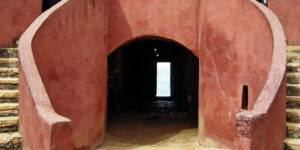
I have had the opportunity of visiting Goree Island in Senegal, one of the most haunting places associated with the Atlantic slave trade. It is a small island off Dakar, beautiful in its setting, almost deceptively peaceful. The sea is blue, the atmosphere quiet, and the old colonial buildings carry the appearance of a place where time has stood still.
But beneath that beauty lies a terrible memory.
At the House of Slaves, the museum preserves the story of those captured, confined and prepared for the journey across the Atlantic. One particular place remains permanently etched in my memory: the passage known as the POINT OF NO RETURN.
What a name! What a cruel description of a human journey!
Imagine being brought to that point with your mother, father, wife, husband or child. Imagine the fear and helplessness. Imagine knowing that the next journey would take you away from everything familiar: your village, language, ancestors, land and possibly every person you had ever loved. For many, it was their last glimpse of Africa. Some would never see their homeland again. Some would never see their families again. Some would die during the voyage, their bodies thrown into the Atlantic. Others would survive only to begin another chapter of suffering on the plantations of the New World.
Standing at Goree, one cannot help asking: What kind of civilisation was capable of organising such an evil business? The transatlantic slave trade lasted for centuries. Millions of Africans were forcibly taken from their homes and transported to the Americas and the Caribbean. They became the human engine behind enormous plantations producing sugar, tobacco and cotton, enriching merchants, plantation owners and European economies.
Africa was losing its sons and daughters. Europe was accumulating wealth. The Americas were being built, in considerable part, on the backs of enslaved Africans. And what a cruel irony! The very people whose labour helped build the prosperity of other nations were denied the most basic prosperity of their own lives: freedom.
Think of the mother whose child was sold away from her. Think of the young man chained in a ship’s dark belly, not knowing where he was going or whether he would ever return. Think of the women who endured humiliation and violence. These were not statistics. They were human beings with dreams, emotions, families and ambitions. They were somebody’s children. Somebody’s parents. Somebody’s brothers and sisters. And they were Africans.
Other News
There is also an uncomfortable part of this history that must be acknowledged. Some African rulers, merchants and middlemen participated in the capture and sale of fellow Africans. Their role cannot be erased or excused. But neither should the responsibility of the European powers that organised, financed, expanded and profited enormously from the transatlantic system be diluted. It was a vast international enterprise sustained by greed, racism and the denial of another human being’s humanity.
Then came the long struggle for abolition. It took the courage of enslaved people who resisted, revolted, escaped and refused to surrender their humanity. It took the work of abolitionists, campaigners, religious groups and ordinary men and women who challenged the moral foundations of the trade. We must remember the Haitian Revolution, one of the most extraordinary events in modern history. Enslaved Africans rose against their oppressors and eventually established Haiti as an independent republic in 1804. It was a thunderous declaration that Africans and their descendants were not born to be slaves. They were born to be free.
Britain outlawed its participation in the slave trade in 1807 and abolished slavery in most of its colonies in 1833. But freedom did not automatically bring equality, justice or prosperity. Look at the world today. Look at the United States, Jamaica, Haiti, Cuba, Brazil and the other Caribbean nations. Look at the millions of people of African descent whose ancestors were uprooted from this continent and scattered across the New World. They are our brothers and sisters. Their skin carries the memory of Africa. Their music carries its rhythm. Their food, dance, spirituality and cultural traditions, though transformed by centuries of experience, retain echoes of the continent from which their ancestors came. Think of American jazz, Jamaican reggae, the rhythms of Haiti, the samba of Brazil and the many other cultural expressions that have enriched humanity. Think of African influence on world literature, sport, fashion and popular culture.
Africa travelled across the Atlantic in chains, but it did not lose its soul.
The descendants of those who were taken have produced great writers, musicians, intellectuals, scientists, sportsmen and political leaders. Their contributions have helped shape the modern world. Yet one question refuses to go away: What would Africa and the world look like today if millions of its young, strong and productive people had not been forcibly removed over several centuries?
We can only imagine the villages that might have grown, the families that might have flourished and the generations that might have inherited a different Africa. This is why the argument about apology and reparations is not merely about the past. It is about memory, responsibility and the consequences of historical injustice. An apology cannot bring back the dead. No amount of money can restore a stolen childhood or reunite families separated centuries ago. But acknowledgement matters. Truth matters. Historical honesty matters.
When a nation apologises for a historical wrong, it does not mean that every living citizen is personally guilty. It means that a nation is mature enough to acknowledge what was done in its name, under its institutions and for its benefit. That is the moral conversation the world should be having. Africa, too, must look inward. We must teach our children this history, preserve our monuments and museums, and protect places such as Goree Island. We must tell the stories of those who were taken and those who resisted. We must never allow the memory of this tragedy to disappear beneath the weight of modern distractions.
I keep returning in my mind to that passage at Goree Island. The POINT OF NO RETURN.I imagine the faces of those who stood there. I imagine their tears and prayers. Perhaps some called upon God. Perhaps some called the names of their mothers. Perhaps some looked towards the African mainland, hoping against hope that somebody would come to rescue them. Nobody came. The ships sailed. The ocean swallowed their cries. But history remembers.
Today, when we see a Jamaican, a Haitian, an African American or a Dominican of African descent, perhaps we should look beyond nationality and see a shared human ancestry. We should recognise a family separated by history, not by choice. To think that there was once slave trade! To think that human beings could be bought and sold! To think that a person’s freedom, dignity and very existence could be reduced to a price!
Thank God for those who fought, resisted, sacrificed and died in the struggle for freedom. But let us not congratulate ourselves too quickly. Modern slavery, human trafficking, forced labour and the exploitation of vulnerable people still exist. The chains may have changed their appearance, but the struggle for human dignity is not over.
Goree Island taught me something I shall never forget: a place can be beautiful and still carry the memory of an unspeakable crime. The POINT OF NO RETURN should never become a point of no remembrance. We must remember. We must teach. We must acknowledge. Above all, we must never allow humanity to repeat such a terrible mistake.
Never again!