Follow Us on Google
From Juliana Taiwo-Obalonye, Abuja
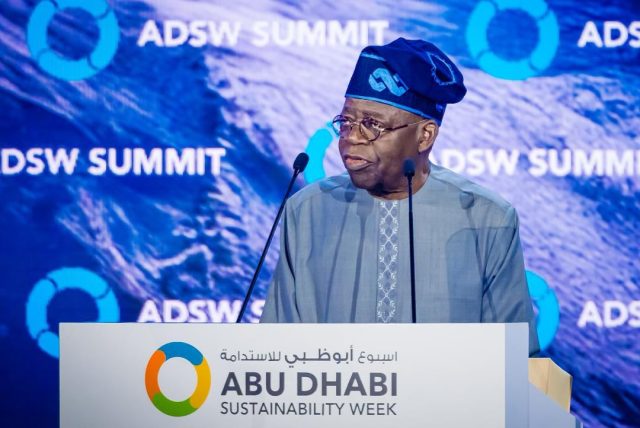
President Bola Tinubu o. Tuesday positioned Nigeria as a global sustainability frontrunner, announcing ambitious plans for $20-30 billion in annual climate finance and AI-driven energy modernization at the Sustainability Summit here.
Speaking to world leaders, ASEAN representatives, and UAE officials under the theme “Nexus of Next: System Go,” Tinubu emphasised integrated action across finance, technology, energy, and human capital. “We move forward with confidence because we know who we are and because we know what we seek,” he declared, hammering on Nigeria’s role in linking climate action with economic growth and social inclusion.
Tinubu highlighted 2025 milestones, including the National Carbon Market Activation Policy (NCMAP) and National Carbon Registry for better emission tracking. “In the year 2025, Nigeria took a vigorous regulatory step to strengthen our climate governance and strategy,” he said, crediting these for mobilising partnerships and impact. The president spotlighted the 2023 Electricity Act’s push for decentralized energy, promising sustainable power to rural areas, off-grid health centers, schools, and markets. “Nigeria recognises the urgent need to deploy and advance technologies to improve green efficiency, modernize infrastructure, and accelerate the delivery of sustainable energy to underserved areas,” Tinubu stated. He urged immediate AI adoption: “The adoption of artificial intelligence to optimize efficiency is no longer a matter of the future.”
Investment pledges dominated the address. Nigeria launched a climate and green industrialization fund targeting $20-30 billion yearly, alongside a $500 million U.S. distribution and World Bank-backed $715 million project to electrify 17.5 million people. “We are deepening access to green finance. Our climate investment platform targets 500 million for climate resilient infrastructure,” Tinubu revealed. He touted a national platform for $2 billion in capital and a sub-regional green bond—oversubscribed by 97.7%—as proof of investor confidence.
He tied it all to Nigeria’s Energy Transition Plan, aiming for net-zero emissions by 2060 while ensuring universal energy access, industrial growth, and pilot electric mobility projects. “Sustainability, sustainable development ensures that all systems, policy, finance, infrastructure, nature, and human capital must move together,” he asserted, calling on developed nations for equitable finance and tech transfers. “Developing countries require equitable climate finance, accessible technologies, and robust capacity building to support true climate commitments without losing focus on advancing their developments and priorities”, he said.