Follow Us on Google
From Ndubuisi Orji, Abuja
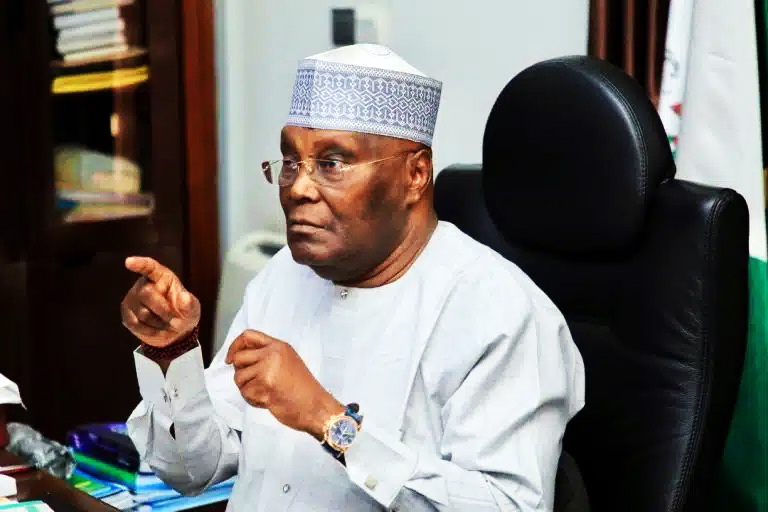
The African Democratic Congress (ADC) and its presidential candidate, Atiku Abubakar, have launched a fresh attack on President Bola Tinubu’s economic policies, accusing his administration of pushing Nigerians “dangerously close to the limits of human endurance” while exporting the country’s wealth and “importing hardship.”
The opposition party said the latest increase in the price of Premium Motor Spirit (PMS) to as much as N1,470 per litre had worsened transportation, food, electricity and other living costs, while Atiku argued that the country was exporting increasing volumes of raw materials even as local manufacturers struggled with N2.14 trillion worth of unsold goods.
In a statement by its National Publicity Secretary, Bolaji Abdullahi, the ADC said every increase in petrol prices reverberated through virtually every aspect of household expenditure, leaving families with increasingly difficult choices.
It noted that reports of private schools increasing fees by between 30 and 40 per cent were particularly troubling because incomes had not risen by anything close to the same margin.
“President Tinubu has turned the petrol pump into an instrument of punishment for everyday Nigerians. Food, transportation, electricity, education, and everything Nigerians need to survive responds directly to the price of fuel and combine together to make life difficult for the majority of Nigerians,” the party said.
It added: “Parents are not earning 40 per cent more. Their salaries have not risen with the prices of fuel, food, rent, transportation, and school fees. Yet, at every turn, this government demands that already exhausted families pay more.
“At N1,470 per litre, petrol is no longer simply a commodity. It is Tinubu Tax, which has made life unbearable for the majority. Under Tinubu and the APC, Nigerians have been tightening their belts. Now, there are no more holes left, and people have started to choke. Families are now skipping meals, withdrawing children from school, abandoning medical treatment and shutting down businesses.”
The ADC maintained that economic reforms should ultimately translate into improvements in the welfare of citizens rather than worsening their living conditions.
“A reform that continuously makes the people poorer is not working. An economic policy that produces impressive figures at government briefings but hunger in Nigerian homes is a failure. When parents must choose between feeding their children and educating them, the government has failed spectacularly in its most basic responsibility,” it said.
The party said the 2027 presidential election would offer Nigerians a choice between the economic policies of the Tinubu administration and the programme being proposed by Atiku.
“Unlike Tinubu and APC, we recognise that economic reform must serve the people, not sacrifice them. Nigeria cannot be an oil-producing country whose citizens experience every visit to a filling station as punishment,” it stated.
Reinforcing the party’s criticism, Atiku accused the administration of pursuing an economic model that exports Nigeria’s wealth in raw form while weakening the purchasing power of citizens and leaving domestic industries struggling.
In a statement by his Senior Special Assistant on Public Communication, Phrank Shaibu, the former vice president said Nigeria’s raw-material exports rose by 106 per cent from ₦1.86 trillion in the first half of 2025 to ₦3.84 trillion in the corresponding period of 2026.
He contrasted the figure with about ₦2.14 trillion worth of unsold manufactured goods, which he said reflected weak consumer demand, high production costs and declining purchasing power.
“This is the painful paradox of Tinubu’s economy: the ships are leaving our ports full, but the pockets of Nigerians are empty. Government celebrates exports and trade surpluses while families are cutting meals, businesses are counting unsold stock and manufacturers are struggling to keep their gates open.
“You cannot build a $1 trillion economy by making your own people poorer. There is nothing wrong with exporting. The problem is exporting the cheapest part of the value chain and buying back the expensive part,” Atiku said.
He argued that exporting cocoa beans instead of processed cocoa products, hides instead of leather products, cotton instead of garments and minerals without local processing meant surrendering the more profitable segments of the value chain to other countries.
Other News
“That is not how prosperous nations are built. Nigeria must stop behaving like a loading bay for raw materials,” he said.
Atiku said the ₦2.14 trillion worth of unsold manufactured goods provided another indication of the pressure on household purchasing power.
“That ₦2.14 trillion sitting in warehouses is not just a manufacturing statistic. It is a picture of the Nigerian family.
“It means the mother who sees what she needs in the market but cannot afford it. It means the salary earner whose pay finishes on transport, electricity and food. It means the trader whose customers now price goods and walk away.
“Nigerians have not stopped needing these products. Tinubu’s economy has simply made them too poor to buy enough of them,” he said.
The ADC candidate blamed rising energy, transportation and borrowing costs as well as the depreciation of the naira for increasing pressure on manufacturers and households.
“Fuel is more expensive. Electricity is more expensive. Credit is expensive. Transportation costs have risen. The naira is weaker. Manufacturers pay more to produce, and families have less money to buy.
“That is why factory shelves are full while kitchen cupboards are empty,” he said.
While acknowledging that a trade surplus was positive, Atiku argued that the composition of exports was more important for long-term economic development.
He said Nigeria should increasingly export finished and processed products, including chocolate, leather goods, textiles, pharmaceuticals, petrochemicals and processed foods, rather than depend predominantly on crude oil and raw commodities.
Atiku said his Economic Recovery Plan would focus on affordable long-term finance, industrial clusters, agro-processing, mineral beneficiation and support for businesses adding value locally.
He also proposed what he described as a production-linked fuel subsidy, under which support would be restricted to petroleum products refined locally and tied to verified production, domestic supply and measurable benefits to consumers.
“No production, no subsidy. No domestic supply, no subsidy. No measurable benefit to Nigerians, no subsidy,” he said.
The former vice president also proposed a $10 billion financing programme for young entrepreneurs and start-ups, saying it would help develop networks of small and medium-scale businesses around agriculture, manufacturing, processing, packaging, logistics, technology and distribution.
Atiku maintained that headline economic growth figures would mean little unless improvements were reflected in household incomes and living standards.
“You cannot rebase your way to prosperity. A $1 trillion economy must be something Nigerians can feel in their salaries, their markets, their businesses and their homes.
“Our promise is simple: we will make it cheaper to produce, easier to do business, more rewarding to manufacture and more affordable to live,” he said.