Follow Us on Google
By Philip Nwosu, Juliana Taiwo-Obalonye, Abuja and Ndubuisi Orji, Abuja
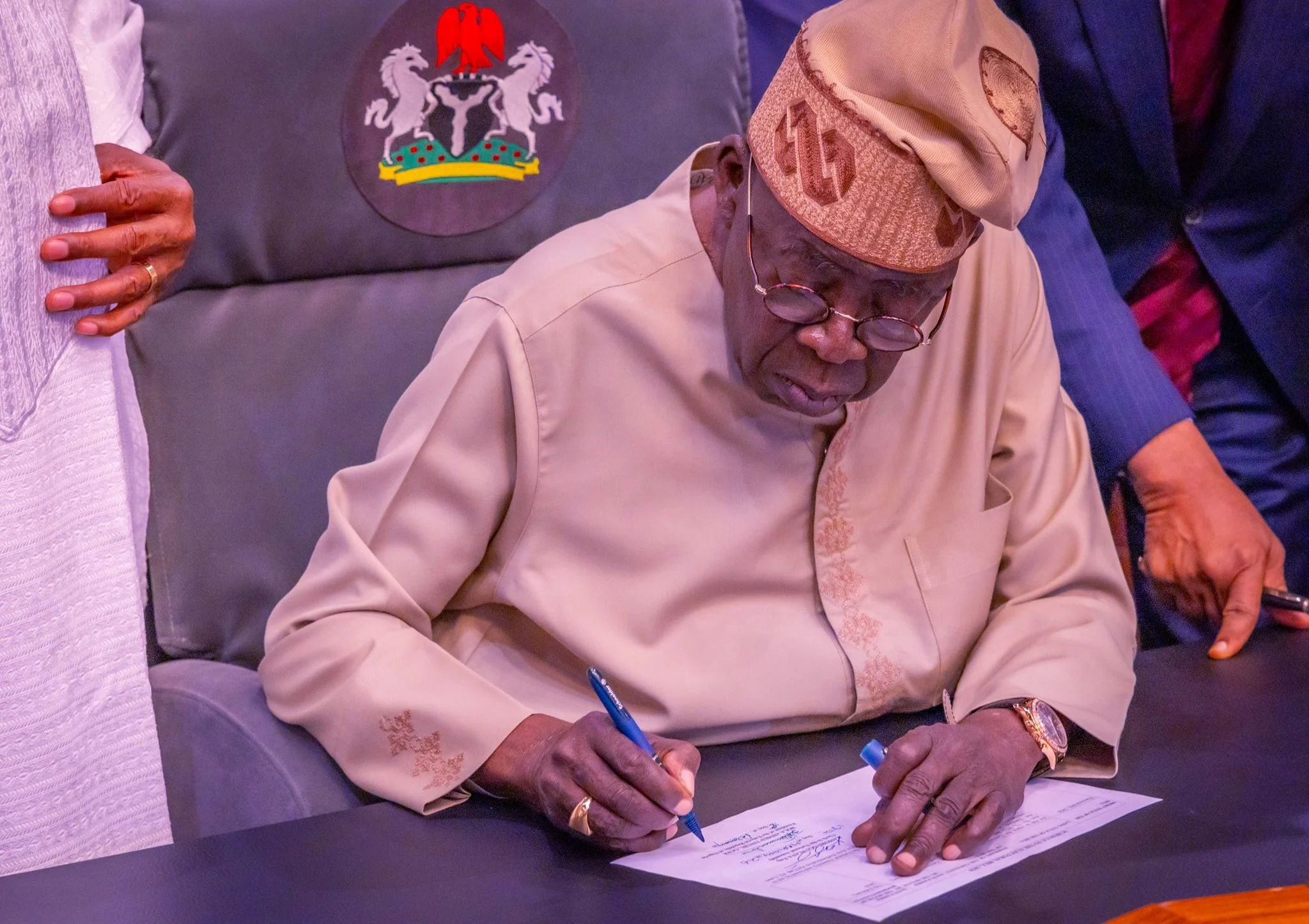
Despite opposition to the the Electoral Act 2026 (Amendment) Bill by the Conference of Nigeria Political Parties (CNPP), the Peoples Democratic Party (PDP), the Labour Party (LP) and others, President Bola Tinubu, yesterday, went ahead to appended his signature to the Bill.

The assent, which took place at the State House, Abuja, around 5pm, was witnessed by top National Assembly leaders. Lawmakers had fast-tracked the bill’s passage on Tuesday amid heated debates.
Tensions centred on real-time electronic transmission of polling unit results to INEC servers, a provision activists deem essential to curb vote rigging. Last week, civil society groups and opposition figures protested at the National Assembly, demanding mandatory live uploads to restore electoral trust. Protesters argued technology would minimise manipulation, but APC leaders countered that unreliable rural networks make it impractical, favoring a hybrid electronic-manual model.
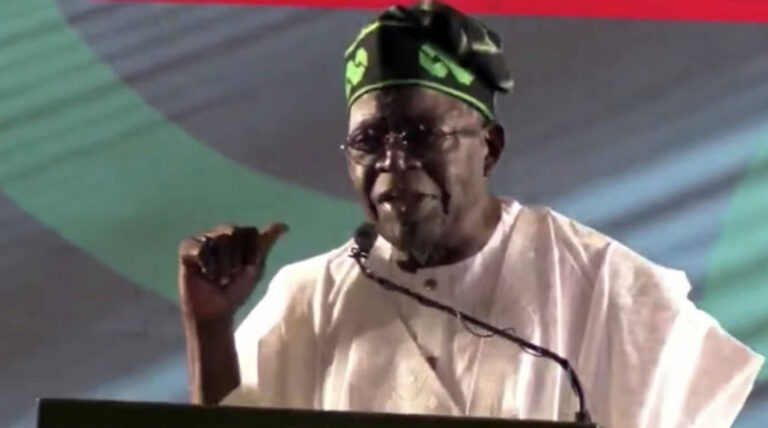
In his remarks after signing, President Tinubu emphasised managed processes over rigid technology, quoting extensively on democracy’s human element: “I followed keenly what you were doing. The essence of democracy is to have very solid brainstorming discussions committed to national development and nation building, the stability of the nation.”
He downplayed historical precedents, stressing practical stability: “It’s not as important as the history aspect of this. What is crucial is the fact that you manage the process to the extent there will be no confusion, no disenfranchisement of Nigerians and we are all going to see democracy flourish.”
Tinubu highlighted the need for public confidence, saying, “It is time that we will have confidence in our system. No matter how good a system is, it’s managed by people, promoted by people and results are finalised by people. In fact, for final results, you are not going to be talking to the computer. You are going to be talking to human beings, who will announce the results.”
He questioned Nigeria’s technical readiness amid debates on real-time transmission, saying, “And when you look at the crux of various agreements, maybe, Nigeria should question our broadband capability. How technical are we today? How technical will we be tomorrow? To answer the call of either real time transmission or not and as long as you appear personally as a manual voter in any polling booth, ballot paper is given to you, manually, you decide in a corner and fingerprint or thumbprint the person of your choice. You cast your vote without hindrance and any interference.”
The President underscored manual counting with electronic safeguards: “Ballots are subsequently counted manually, sorted and counted manually. It’s just the arithmetic accuracy that is entered into form EC8A. It is still manually. Essentially, the transmission of that manual result is what we’re looking at and we need to avoid glitches. I’m glad you did, interference, unnecessary kicking in this age of you know, computer inquisitiveness.”
Tinubu concluded optimistically: “Nigeria will be there. We will flourish. We will continue to nurture this democracy for the fulfilment of our dream for prosperity and stability of our country. I thank all of you very much.”
Speaking to State House Correspondents, Senate President Godswill Akpabio hailed the amendments as a patriotic triumph tailored to Nigeria’s realities. “A lot of provisions in the amended act will definitely make Nigerians very happy. We did a very thorough job, very painstaking. We took cognisance of the peculiarities of the country. We don’t allow too much outside interference and we’re very patriotic in our submissions,” he said. “At the end, we believe strongly that what the President has just assented to is an Act of Parliament that will make for a better election in the future, lead to prosperity and ensure transparency in the electoral process. In the end, Nigerians will benefit a lot from future elections, every vote will now count.”
Addressing protests over electronic transmission, Akpabio explained the hybrid solution, saying, “All Nigerians wanted was that in the IReV Portal, which is a kind of viewing centre for polling unit results, they would like to see those results transmitted electronically. We have included that in the amendment just signed into law. But, we also took cognisance of areas where there may be no network or communication capacity. We said that since the polling unit result comes in from Form EC8A, signed by the presiding officer, party agents and independent security agents, with copies given to all, then we can use that as the primary source of collation at that unit. Then, of course, we transmit it, even if there’s no network at that time, once we step out toward the ward or local government centre, it will drop into the IReV and people will still be able to view it.”
He detailed the anti-tampering safeguard, saying, “The implication is that if what is eventually collated at the next centre differs from what’s in the IReV, Nigerians will be able to compare and see if the result was tampered with. That has always been the problem in our country: once an election result leaves a polling unit, it gets tampered with or mutilated. That has been eliminated today. So, we are satisfied that we have met Nigerians’ aspirations. The issue of real-time transmission also comes in: once you transmit, even if there’s no network, once you reach where there is a network, it will drop. So, eventually, everything will still be shown.”
Akpabio defended the process: “We are happy and satisfied that we have interpreted the intentions and yearnings of the majority of Nigerians, not those who are politically motivated. No matter what we did in the last two years, we went on retreats in Lagos, Obara, everywhere, those were mere consultations. The final outcome of what was amended happened in the plenaries of both chambers. In the last month, we have done a lot. Even the Senate sacrificed holidays; the Speaker had to recall members from break and budget sessions to undertake this all-important national assignment. That’s why we are very satisfied that going forward, we will have more transparent elections.”
He touted historic innovations, saying, “This has never happened since 1960. We have never had electronic transmission of results in any of our laws. We never even recognised the IReV in the 2022 Act. All those things are now there. More powers are given to political parties to decide their candidates. Above all, participative democracy and more inclusiveness: members of different political parties can now do direct primaries. That means you can choose the person you want; delegate selection, one person can’t just write the list and submit. This time, party members will stand up and vote for their candidates of choice.”
Akpabio warned against misinterpretation: “There are other provisions you need to read, because if I stay here to tell you everything, it will lead to controversy on social media. Some people don’t understand that it’s not good in an election to have five contestants where one scores 300,000 votes, another 290,000 and for some reason, the top scorer is disqualified by court, then the person with 1,000 votes, not popularly elected, becomes the winner. All those things are eliminated. We have recommended that where such a case happens, they should call for a fresh election. This applies even to governorship elections, where the second-highest scorer may not meet the two-thirds spread requirement across local governments to be declared winner. No, we don’t want that. We want something that will help Nigerians truly elect their leaders. I thank you.”
On his part, Speaker of the House of Representatives, Tajudeen Abbas endorsed the changes, adding a key detail: “Well, I think the Senate President has said most of the things we did yesterday during the amendment exercise. However, there is one area I’m sure he forgot to mention; the number of days’ notice, which was 360 days in the 2022 Act. Now we have seen the wisdom to reduce it to 300 days. This will inadvertently allow holding the presidential and National Assembly elections in January 2027, technically avoiding elections during Ramadan 2027. I think this is another ingenious piece introduced by the National Assembly to avoid voter apathy in the next general election.”
•Opposition parties kick
Reacting to the development, the PDP alleged that the hasty assent to the Electoral Act 2026 by President Tinubu was an indication that both the President and the National Assembly are deaf to the yearning of Nigerians.
The PDP National Publicity Secretary, Ini Ememobong, told Daily Sun, yesterday, that it was unfortunate that the President and the parliament ignored the request of Nigerians for a more transparent electoral system.
Ememobong, who described yesterday as a sad day for democracy, said the speedy assent to the electoral law 24 hours after it was passed, despite protestations on some sections of the law, was a confirmation that the process of the Electoral Act Amendment was a script by the ruling All Progressives Congress ( APC).
He said: “The assent by the President despite the humongous hue and cry by Nigerians is a confirmation that the whole scenario was a well scripted drama by the ruling APC to deepen the opacity of our electoral process. It is a sad day for democracy that both the National Assembly and the President are deaf to the yearning of Nigerians.”
The PDP, had in an earlier statement, also by Ememobong, described the removal of mandatory electronic transmission of election results from the electoral law as a betrayal of the people.
The opposition party stated that, “the anti-democratic stance of the Senate and the sudden somersault by the House of Representatives on the amendment of the Electoral Act 2022, specifically on the mandatory electronic transmission of election results from the polling units is an act of treachery against the Nigerian electorate.
“This is a huge betrayal of the collective trust of Nigerians, who unambiguously expressed their overwhelming demand for the electronic transmission of results. This betrayal is most painful because it strikes at the core of democracy, electoral sanctity.”
It added: “The shocking aspect of the whole drama is the brazen manner in which the legislators acted. They clearly showed disdain for the Nigerian people who voted them into office by openly challenging the supremacy of the voters. The excuses advanced for inserting this obnoxious proviso are weak, illogical and insulting to the intelligence of Nigerians.
“When lawmakers begin to dilute transparency mechanisms ahead of elections, only one conclusion is rational – there is a calculated attempt to create room for electoral manipulation.
By this act, the National Assembly has violated the foundation of legislative representation, which is anchored on mirroring the wishes of the majority of their constituents. This is a painful betrayal, which the people will certainly repay in equal, if not heavier measures.
“Furthermore, the restriction of party primaries to direct and consensus methods constitutes a blatant intrusion into the internal affairs of political parties. The Supreme Court has consistently affirmed that political parties possess autonomy in managing their internal processes. This provision is, therefore, ultra vires and condemnable.”
Other News
The PDP further noted that, “if the ruling party truly believes it enjoys the support it claims, it should welcome every mechanism that guarantees transparency. Their shameless support for this anomaly shows their fear of impending defeat in a free and fair election. It is most shameful that a party that demanded electronic voting in 2015 is now unwilling and unprepared to have electronic transmission of results; this is a crying shame.”
Similarly, the Labour Party (LP) caucus in the House of Representatives, said now that the ruling party has had its way with the Electoral Act, the battle for the redemption of the country had only just begun.
The caucus, in a statement by its leader, Afam Ogene, said it is interesting that President Tinubu assented to the Electoral Act before “the ink” on the new law dried up.
“Let us begin by congratulating President Bola Tinubu and the leadership of the National Assembly for the signing of the contentious Electoral Bill, 2026, into law, with the speed of light.
“It is quite interesting that, even before the ink with which the Parliament crossed the t’s and dotted the i’s on the clean copies of the Bill dried up, the President has gleefully put his imprimatur on the Bill, leaving Nigerians to wonder if, indeed, the Executive had ample time to look through the document.
“Gone with the signing are the genuine concerns of apprehensive Nigerians regarding what the new Act portends to the integrity of the country’s future elections,” he stated.
Ogene added that, “Nigerians, and indeed, the world must now begin to see the clear difference between campaign promises and actual motives of political players.
“While it is convenient outside the confines of power to oppose incremental increase in the price of petroleum products, it is convenient to pronounce ‘subsidy gone’ when they have the opportunity; while it is right to advocate electronic voting in 2013, it has become obtuse, 13 years after, to even canvass a fragment of it. While it was convenient to ask a sitting administration to quit, on account of an alleged inability to halt the spread of insecurity, today under their watch and allure of office, insecurity of multifarious forms have become an insistent by-word.
“For emphasis, on January 13, 2013, National Publicity Secretary of the defunct Action Congress of Nigeria (ACN), Alhaji Lai Mohammed, had in a statement said: ‘We assure INEC of our full support towards using electronic voting in 2015. We also appeal to all other political parties, civil society organisations, and indeed, all Nigerians to join us in pushing for a system that will eliminate the role of thugs and sideline vote thieves during our elections, in addition to making our elections free, fair and credible.’
“Today, 13 years afterward, neither Mohammed, who moved on to become Nigeria’s Minister of Information and Culture for eight years nor his principal, who is now our country’s current leader, see anything worthy in electronic transmission of results, much more electronic voting.
“Now that they have had their way, we call upon Nigerians not to despair. On the contrary, the battle for our country’s redemption has only just begun.
“As an opposition bloc, we certainly have our job cut out, the mobilisation of fellow Nigerians to reject, at the polls, those who specialise in asking them to do only as they say, instead of living by their own creed.”
However, the CNPP had earlier called on President Tinubu to withhold assent to the Electoral Act 2026 (Amendment) Bill, citing what it described as dangerous ambiguities capable of undermining electoral transparency ahead of the 2027 general elections.
In a statement after consultations with political stakeholders, civil society organisations, election observers and constitutional experts, the CNPP expressed deep concern over a controversial provision in the amendment that allows Presiding Officers to rely on Form EC8A for result collation in cases of alleged network failure preventing electronic transmission.
The coalition argued in the statement by its Deputy National Publicity Secretary, James Ezema, that while technological limitations may exist in remote areas, the amendment fails to establish a clear, transparent and verifiable framework for determining when network failure has genuinely occurred.
According to the CNPP, the bill did not provide any independent or technological verification procedure to confirm network availability or outage at polling units.
The group warned that leaving the determination of network failure solely at the discretion of polling officials creates a loophole that could be exploited for electoral manipulation.
“In modern electoral governance, transparency must be anchored on measurable, auditable and tamper-proof procedures,” the statement read, adding that the amendment weakens safeguards introduced through recent electoral reforms.
The CNPP also raised concerns about potential security risks to officials of the Independent National Electoral Commission (INEC).
It noted that in many communities, citizens can easily verify network availability using personal mobile devices. Any contradiction between public network access and claims of network failure by electoral officials, it said, could trigger distrust, confrontation and possible breakdown of law and order.
The coalition warned that such ambiguities may expose INEC officials to public suspicion and hostility, thereby endangering their safety and undermining the credibility of the electoral process.
The CNPP further argued that Nigeria has made incremental progress in strengthening electoral transparency through electronic transmission of results and digital accreditation systems.
It cautioned that the proposed amendment risks reversing those gains by reopening avenues for manual collation processes that lack strict oversight and regulatory safeguards.
According to the group, reintroducing incident-form style procedures without clear accountability measures could erode public confidence in Nigeria’s electoral system.
The coalition urged President Tinubu to return the bill to the National Assembly with specific recommendations that incorporate technology-driven verification protocols for determining network failure.
It described such action as a demonstration of democratic commitment and statesmanship, particularly as the country approaches the 2027 general elections.
Among other measures, the CNPP proposed, “Establishment of an independent real-time network verification system integrated with telecommunications infrastructure, mandatory multi-layer authentication and timestamp verification before manual collation can be activated, clear accountability measures and sanctions for officials found to have falsely declared network failure and provision for third-party monitoring of network status accessible to political parties and observers.”
The CNPP reiterated its commitment to credible, transparent and technologically driven elections, stressing that electoral laws should eliminate grey areas rather than create new vulnerabilities.
It maintained that withholding assent to the amendment in its current form would serve the national interest and help safeguard Nigeria’s democratic stability ahead of the 2027 polls.