Follow Us on Google
Let’s call this the African swag
Sometime around the 23rd of October 2024, the Lagos Fashion Week decided to bring a shocker. Shoo! It was indeed a shocker. Well, no surprises, they’ve been doing that since 1990 (actually, 2011). When it comes to fashion, they are ‘Àgbà’ (senior).
What made this year different must have been the full mix of what Africans called the ‘oyibo’ (white) style with ‘tiwa n tiwa’ (what belongs to us). Before African fashion was even known on the Global stage, fashion was fully the ‘oyinbo style.’
You attend a fashion show, and all you can see is either clothes made with Western fabric, from the suit and shirt to the jeans and tops for males. At the same time, the female there was either the snatchy gown or skinny gown, but the African fashion brought disruption to that when it introduced fabrics like Ankara, Adire and Aso-oke to the runway. Even the white person couldn’t help but embrace the beauty in this cultural heritage.
We all thought we’d seen it until this fashiob brand, Cynthia Abila, introduced UNBROKEN, a brand deeply rooted in the African heritage, yet with a touch of the West in bits and pieces.
UNBROKEN was presented on the second day of the 14th edition of the Lagos Fashion Week. The brand aligned completely with the theme ‘Commune: power of community.’ It shows the blend of two different communities, tiwa n tiwa and oyibo, giving definition to what we know as the ‘contemporary fashion. Some were a full touch of tiwa n tiwa, while others were fully oyibo. Well, this is the new African swag. Let’s find out what the hype is about.
‘Ugebe Bubble dress.’
The first piece from the UNBROKEN collection was called the ‘Ugebe Bubble dress.’
It was a puffy short dress. It could have easily passed for what the Yoruba culture calls ‘Oleku’; however, this was not a short iro and buba (wrapper and blouse), instead it was a short gown traditionally known as ‘Kaba Penpe’ (short gown).
This piece took us back to the early 19th century, when ‘Kaba Penpe’ was stylishly worn by women of class, often tailored from traditional fabrics, mostly Aso-oke and later Adire (tie-dye). The Bubble dress was no exception; it was stylishly made from Ankara, another traditional fabric.
However, it was unique, and its uniqueness lay in the lower part of the dress, the balloon skirt commonly known as a puff, that set it apart from the ‘Kaba Penpe.’ It was firmly attached to the upper part of the dress, around the waist, giving it a puffy look and placing it correctly as a Bubble dress.
Using the African eyes, the puff appears to be stiff, and the walk down the runway seems limited. It’s a bubble dress; it should shake as the model moves.
The off-shoulder style, instead of the usual round neck, took the dress to another level, giving off the ‘Ọmọ́gẹ’ (child of fashion) vibe. The sleeve was just the perfect match for the off-shoulder, which shows off the collarbones and makes the shoulder appear broader.
Its colour pattern showed and told a beautiful African story, with the mix of yellow, the major colour theme, neatly combined with green, red, and finally orange. That made the dress a perfect wear for an African beauty queen.
The overall look was more African traditional than the contemporary story UNBROKEN told.
Recommendation: To adjust the stiffness of the puff, the strong Ankara fabric should be replaced with a lighter fabric to fix it without distorting the shape. Also, adding a piece of a western complementary fabric will give the perfect oyibo plus tiwa n tiwa feel.
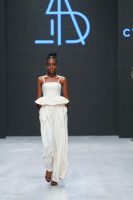
2. Bebe two-piece.
The two-piece was the second outfit from the UNBROKEN collection. It was a cloth sewn by a ‘sabi tailor,’ consisting of top and high waist trousers that sat above the waist instead of sitting on the waist. The top looked like what the Yoruba would call ‘Sinmi’- it’s the traditional name for a spaghetti hand top or a thin strap gown
But it appeared as though the two pieces were quite different from the ‘tiwa n tiwa’ wear; the top was an off-white top with pleated gathers at the waistline instead of the usual straight top. It is commonly known as a ‘Peplum top’ in modern terms. The top was tightly attached to the body by the spaghetti strap.
Also, the top was beautifully complemented by baggy trousers; in modern terms, it is a pant, although quite free for a pant, as it flowed freely as the model walked in grand style across the runway. The looseness can be traced to the choice of fabric: although 100% cotton, it was a very soft cotton material. Nothing about the outfit told a contemporary story but a modern story. Perhaps the choice of fabric made it so, but that’s on a closer look.
Comparing it to a similar brand, Donni, side by side, the difference was clear. The Donni two-piece used an ‘oyibo’ fabric with a touch of ‘tiwa n tiwa,’ telling a more contemporary story than Bebe’s two-piece. Contrary to what Cynthia Abila tried to convey, this piece, rooted in African culture, leaned heavily towards a modern style.
The outfit is very suitable for an African woman who is trying to appear simple yet turn heads at a casual gathering.
Recommendation: For the Bebe two-piece to have the perfect mixture of ‘oyibo’ fabric and ‘tiwa n tiwa, it must be perfectly matched with a traditional print, either an Ankara as the top or one side of the cloth entirely tailored with traditional fabrics.
Other News
3. Rodo Jacket and Flo Wide-Leg Pants.
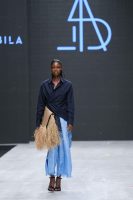
The next appearance spiced up the runaway. It was a patterned jacket paired with trousers similar to those in the second outfit. This piece truly captured what UNBROKEN represented, a perfect mix of cultural and western, giving a contemporary design.
If one could be heated up just by beholding an outfit, the jacket gave that feeling. It was a carefully handwoven jacket. Using the modern term, it was a blazer. Cynthia had called it the ‘Rodo Jacket,’ which was not far-fetched; it originated from the Yoruba culture and was inspired by the ‘heat’ of the Yoruba spice Atarodo, also known as scotch bonnet pepper.
The trousers called ‘flo pant,’ instead, were cut from plain yellow cotton, a lightweight fabric with a high waist and a wide-leg pattern for easy movement. The overall outfit was a good fit and looked perfect in a corporate office, except that the trousers kept getting caught on each other, a common occurrence known as ‘clinging.’ That prevented the model from achieving what the flo pant was intended to achieve, free movement
Comparing this to an Imad Eduso set, the difference is in the shape and the fit of the cloth. While Imad focuses on creating curvy forms with a soft, shiny, smooth material to achieve free movement, Cynthia Abila leaned into sharp shapes. The Flo pants are designed to ‘fall with ease’, but they maintain a much more tailored finish than the relaxed shape one can see in Imad’s ‘Ruby’ or ‘Adunni’ trousers from the Imad Eduso collection.
Recommendation: While this set gives a perfect contemporary vibe, the Flo pants would flow more freely and not cling, with a slightly heavier fabric. To really push the contemporary touch, I recommend trying a multi-fabric choice, especially for the trousers, to give them a contemporary look. The ‘Rodo’ zigzag pattern could also be used for the trousers, alongside the yellow fabric from the Flo pants. This addition would preserve the cultural identity while feeling even fresher.
4. Kala 2-piece.
The first male outfit from UNBROKEN made a remarkable entry with its powered-blue shorts and shirt, taking us to African heritage and landing us on the West African shore.
Cynthia Abila called it ‘Kala 2-piece’. The outfit bears a strong resemblance to Dàńṣíkí and Sokoto; it’s a free, easy-wear garment often worn by men with a pair of trousers just a few inches below the knees and many inches from the feet, and it takes its roots in the Northern part of Nigeria.
But this time around, there was a little step up: instead of a pullover garment or Sokoto, Cynthia Abila presented us with a button-down shirt with modernised Sokoto; it was a normal short with an even fringed hem, as popular among female clothing. The shorts were sewn in a way that each pattern lay side by side with the others, not the usual smooth layering.
The outfit appeared to be flawless, yet again it told a more culture-rooted story than a contemporary story, and the trousers were clinging as the model walked as a result of the light hem. A suitable wear for a casual gathering, which gives the wearer a sophisticated look
Recommendations: A heavier hem at the bottom of the trousers will address the clinging issue and add more polish to the wearer’s look.
5. Signature Print Convertible Trench
The fifth and last outfit for the male made so much sense. This silenced every one of the contemporary arguments as it was a clear contemporary piece; however, far off, it doesn’t.
As the piece was a complete male outfit, shirt and trousers with an imprint all over it, and over all coats over the entire outfit. The outfit bears a strong resemblance to a Balmacaan; it’s a loose-fitting overcoat often worn by men from South Korea.
Particularly, the choice of colour was great: the cloth had a peachy theme, similar to a popular colour choice among the ‘Aso ebi’ ladies. On the other hand, the overall jacket colour was off-white, blending with the outfit.
The entire outfit was well-tailored to fit the model; afar, one could mistake the outfit for a Dior collection, but up close, the fabric told a different story: it’s a Njam fabric from Delta State, which silenced the cultural concern.
However, it would do the brand a lot of good if the fabric had a more traditional fabric print; the fabric choice was very solo.
Recommendations: The outfit could easily be mistaken for an ‘oyibo’ wear; a brighter print would help tell a more contemporary story. Or, much better, a complete replacement of the overall jacket with an Ankara hand-woven jacket.
UNBROKEN collection has shown what a strong contemporary brand it is by blending oyibo with ibile (local). The cultural message here is deep; it is not just about fashion; it is about ‘tiwa n tiwa’ storytelling. From taking us across all the major tribes in Nigeria, a beautiful Western nation in Africa, to finally showing us the secret of those fabrics- the ‘Njam fabric,’ a traditional hand-woven cotton from the Niger Delta, Southern Nigeria.
Cynthia Abila has kept a piece of history alive. In Owerri, a city in Nigeria, ‘Njam means ‘my wrapper,’ and seeing it remade into what Cynthia called the ‘Ugebe Bubble dress,’ Kala 2-piece, Rodo Jacket and Flo Wide-Leg Pants, is such a powerful way to honour the African roots.
While other brands’ collections use bold clothing materials for a global, modern look, the UNBROKEN collection, like the ‘Rodo’ zigzag, is designed with the heat and energy of African culture in mind. It takes the traditional ‘Atarodo’ spirit and puts it on a runway. This collection is for the person who is not afraid to ‘carry Africa on their head.’
In conclusion, this collection has successfully combined history with the future.
From the collection Cynthia Abila called ‘Signature Print Convertible Trench’ to the ‘Bebe two-piece’ and other outfits from the UNBROKEN collection, every outfit tells a story of a Nigerian traditional fabric maker.
Some pieces could be lighter and made to move freely and also blend easily without losing shape and style.
This, in turn, can create a free motion when the wearer moves. In all, the overall vision is clear. Cynthia Abila has shown that our traditional weaves and hand-woven cottons belong on the global stage of contemporary luxury.
By Seun Emmanuel