Follow Us on Google
From Adanna Nnamani
For decades, smallholder women farmers in Abia State, southeastern Nigeria, have battled gully erosion, a devastating occurrence that snatches farmlands and residential areas.

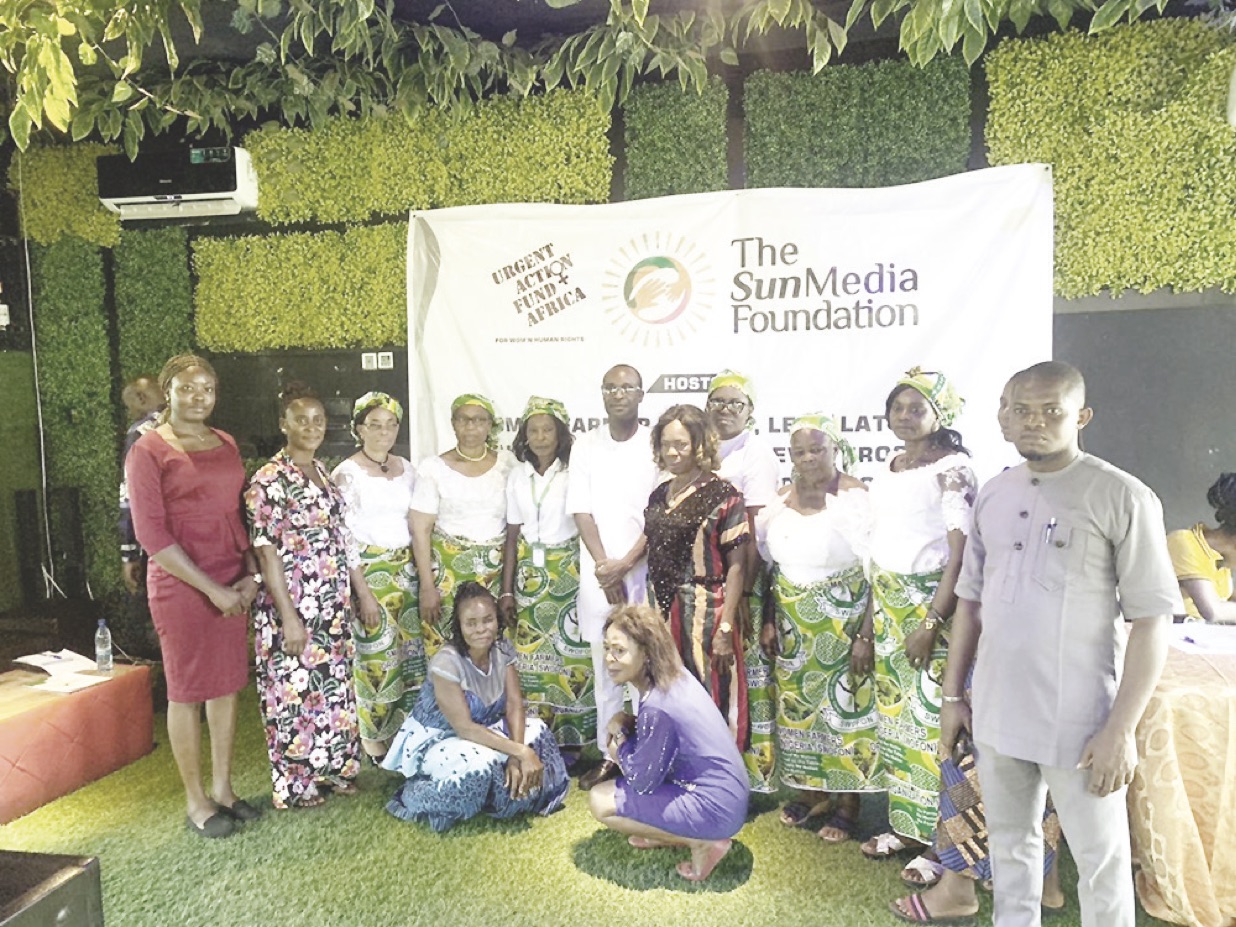
•Emereuwa and some of the smallholder women farmers at the stakeholders engagement in Abia
The fight for survival is a yearly horror as they do not have the scientific platform to accurately predict the areas prone to erosion to be avoided. It is until the rains pour that they gnash their teeth and count their losses.
With each passing year, the erosion intensifies, leading to a reduction in available farmland. Consequently, crop yields have consistently plummeted, posing a significant risk to food security within the state.

•Agbaeze addressing the women at the event
Regrettably, over the past 24 years, successive administrations in Abia have merely paid lip service to the challenge. The neglect has put women farmers, who make up approximately 88 percent of the state’s smallholder farming community, in dire straits.
They have perennially been left impoverished, unproductive, economically disadvantaged and vulnerable.
From available records, Abia State ranks among the top 10 erosion hotspots in Nigeria. The state hosts around 275 officially identified high-risk erosion sites, predominantly situated in farming communities densely populated by women. The gully erosion crisis in the state gained national attention in the early 1990s, underscoring the urgency of the situation.
The erosion menace is more rampant in Abia North and Central, where there are dangerous erosion sites, especially in Isuikwuato, Umunneochi, Bende and Umuahia North and South council areas.
Past governments built political campaigns around the matter.
They capitalized on the women’s vulnerability, got their votes on titillating illusory promises and dumped them when they got into office.
Consequently, there is rarely any state-backed action or legislation to end the environmental menace, or at the least aggressively address it.
Touched by the plight of the smallholder farmers and the urgent need to change the narrative, The Sun Media Development Foundation, with support from the Urgent Action Fund Africa (UAF-Africa), recently organised a one-day engagement programme with the Abia State Government, smallholder women farmers and other stakeholders to address the issue.
The event, titled “Women Farmers, Groups, Legislators, Stakeholders State Level Erosion Mitigation Support for Women Farmers in Abia State,” was held in Umuahia, the state capital. Participants came from all the 17 local government areas (LGAs) of the state.
In his speech, Mr. Victor Emereuwa, the executive director of the foundation, said the programme was the first stage of a project designed to address the pressing need to stop the destructive effects of erosion on farmlands owned by smallholder women farmers in Abia, which had been neglected for the past 24 years.
Emereuwa stated that the project would provide the women the platform to create a charter of demands, which they would then submit to the state government to be included and implemented in the state’s budget for 2024.
He explained that this will help advance the creation and execution of a long-term state-level erosion-mitigation strategy to assist women farmers.
According to the director, the goal is to assist the women to demand interventions that would facilitate their relocation from farmlands that can no longer be reclaimed due to excessive destruction by erosion, to alternative farmlands and, also, to develop and implement a sustainable state level erosion-mitigation plan to support them.
In addition, they would be able to call for the rebuilding of reclaimable lands and access roads lost to threats of erosion and flood as well as request an emergency environment fund that will provide financial support systems in the form of flexible loans or a grant scheme that would allow them expand their farmlands to make up for land and yields lost to erosion.
He said: “One of the biggest threats to food security, rural women’s economic freedom, social interaction and environmental security is the existential threat of erosion in southeastern Nigeria. That region in Nigeria experiences the worst form of gully erosion; heavily impacting on livelihood, food shortage and socialization and the dignity of women. Already identified in 10 states of Nigeria are 3,500 erosion sites.
“This presents an opportunity for women groups, social justice and environmental activists to act together to demand that the new government engage in rebuilding, relocation of erosion-laden farmlands, mostly owned by women, and implementing a sustainable state level erosion-mitigation plan to support women farmers.”
Also speaking, the Special Adviser to Abia State Governor, Alex Otti, on Agriculture, Dr. Cliff Agbaeze, lauded the initiative, noting that it was in line with the administration’s objective to shift the state from a consumption-based state to a production-based farm economy.
Agbaeze added that the government recognized the role of women as agents of development, which explained the reason for massive appointments of women in critical positions in the state.
He said: “The interest of women are well protected in this government, if you are making demands on issues pertaining to women, be rest assured that they will be considered with urgency.
“The government recognises women as development agents. The interest of women is cardinal to this administration, which is why in the composition of government, women play a significant role in terms of appointments and positions of leadership.”
The SA further disclosed that, out of 3,620 square kilometres of land for agriculture in Abia, only 387sq km of farmlands have been cultivated so far.
“With the involvement of foreign investors in the agric sector of the state, all the forests kidnappers made their hideouts would be cleared for farming,” he said.
Similarly, the Commissioner for Women Affairs and Poverty Alleviation, Mrs. Ngozi Felix, commended The Sun Foundation for spotlighting the plight of smallholder women farmers in the state.
Represented by Mrs. Chinyere Nwogwugwu, a director in the ministry, the commissioner stated that the activities of women farmers and the difficulties they face might not have been known, if it were not for the foundation.
She disclosed that the current Abia State administration was working hard to improve the welfare of women and to guarantee gender equality in the state through her ministry.
Additionally, the commissioner in the Ministry of Environment, represented by Obinna Onyebuchi, lamented that the state had become more vulnerable to erosion due to previous administrations’ disregard for flood hazards.
She expressed optimism that the partnership between the foundation and the present administration would help to expedite solutions to the situation, adding that three erosion sites were already being tackled in the state.
Mrs. Chinenye Emuka, coordinator of the smallholder women farmers, expressed gratitude to the foundation for their support. She emphasized that the intervention would positively impact numerous women in the state who depend on agriculture for their livelihood.
Sharing her personal story, she recounted how the loss of her husband initially left her hopeless due to financial constraints, but, through agriculture, she has been able to provide for her family, including putting her children through university.
Emuka expressed optimism that the programme would address one of the biggest problems they faced as farmers, while stressing that they would maximize the opportunity provided by the foundation.
The group’s leader said: “When my husband died and left me with kids, I thought it was the end of the road for me and that all hope was lost, because I had no money or job. Then I decided to go into agriculture and, today, I am a proud farmer who has been able to comfortably cater for her kids and see them through school even up to the level of the university with my income. I am happy about this programme because it will address the biggest challenge we face as farmers and ultimately increase our productivity and income. We promise to make the best of this opportunity that you have given to us.”