Follow Us on Google
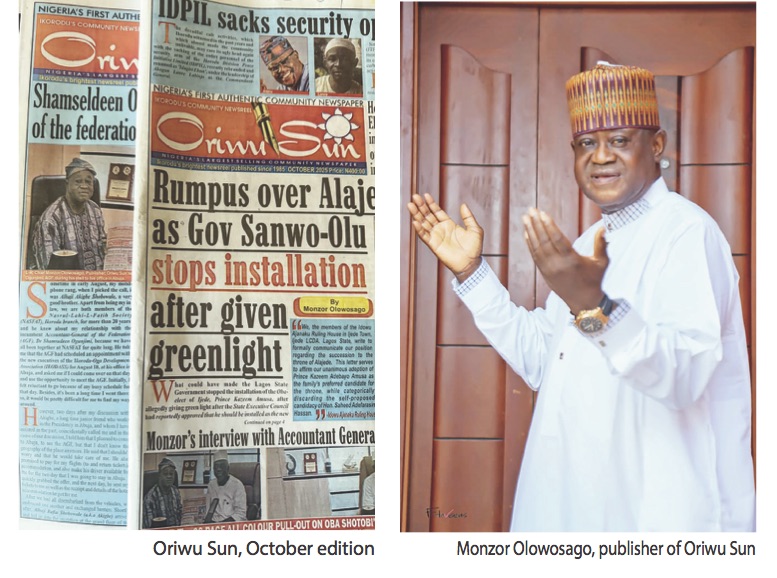
In April 1985, exactly on his birthday, Monzor Olowosago made a leap in the dark. From the Olympian height of mainstream journalism, he decided to play in the lowest league to pioneer his own brand of rural journalism, starting with a community newspaper called the Oriwu Sun, a paper that reported news and features from the perspective of his hometown: Ikorodu in Lagos.
At first, we all thought Monzor was on a suicidal mission when he angrily dropped his letter of resignation at the then Sunday Concord where we worked as reporters and as disciples of the legendary editor, Dele Giwa. It was at the point when M.K.O. Abiola, the Concord publisher had fired Dele Giwa and he was planning with his colleagues to come out with Newswatch, a weekly newsmagazine modelled after Time and Newsweek.
Dele Giwa’s successor at the Sunday Concord was his deputy, the late Sina Adedipe, a no-nonsense, iron-hand editor who queried Monzor for returning late from a holiday trip to London.
Even though he answered the query, Monzor felt enough was enough. He no longer wanted to work for anybody. He was going to stand on his own. From the big pond, he was going to fish in the smaller pond of journalism. As a student of journalism in London, he had seen journalism at the grassroots and how popular and influential community newspapers are. From that time, he had always had it at the back of his mind that one day he would pioneer a community newspaper in his Ikorodu hometown.
With a capital of 40,000 naira, Monzor launched his own newspaper. Incidentally, he only needed 700 naira to print the first 1,000 copies of the paper which he named Oriwu Sun. In doing this, he was leveraging on his experience as a newspaper production man. And the paper was an instant sellout. Monzor had discovered a niche in reporting about the triumphs and the celebrations of his rural community of Ikorodu. In journalism, they say, all news is local. And there is no better platform to practise this than in a community newspaper. To supply crisp editorial materials, Monzor depended on his former Sunday Concord colleagues who were moonlighting for him.
Forty years after, the paper is shining brighter than ever. From a 20-page black and white newspaper, Oriwu Sun is now a 180-page all-colour newspaper printed with bond paper instead of the normal newsprint. On a trip to London, Monzor, the late Dimgba Igwe and I met in the plane. And throughout the trip, we travelled back in time to reflect on our lives 25 years after. Today, the paper is celebrating its 40th anniversary. I remember that back in those days when we were in Sunday Concord, Dimgba and I were secretly freelancing for Monzor’s paper. I remember I interviewed and wrote a feature for the paper on Pa Mudashiru, the father of the late Air Commodore Gbolahan Mudashiru, the former military governor of Lagos State who was an indigene of Ikorodu. As freelancers we earned twenty naira for a story. Twenty naira was big money in those days, but it was not so much about money as helping a colleague to succeed.
During our plane chat, we looked back and shared sweet memories of our days under the editorship of Dele Giwa, a man who bubbled with life and who was so passionate about journalism. We remembered the dirty jokes we used to crack in those days, the camaraderie, the spirit of brotherhood and the dedication to journalism under the leadership of Giwa.
“Sunday Concord made all of us,” Monzor says. “Everybody who passed through Dele Giwa is now a big shot in the media today. In those days we were like brothers and sisters. There was no day we ever fought each other. I remember names like Banji Adeyanju, Lewis Obi, Basil Okafor, the late May Ellen Ezekiel, Sunny Ojeagbase, Chuma Adichie, Abel Oshevire, Ann Timni, Stella Balogun, Dimgba Igwe and you, Mike Awoyinfa. We were all making waves in journalism. Maybe it was because we worked under Dele Giwa. And you Mike, your style has not changed. From the beginning, you write in a simple style that a nine-year-old will understand. Once a reader starts reading your prose, you read it until you finish. Maybe because you have read a lot of novels, poems and good literature. That is the problem with journalism today. How many journalists read today? Look at your piece on Dele Momodu titled 50 Ovation for Mr. Ovation. I read it in London and I enjoyed it so much. Fantastic piece!”
Monzor traces the success of his Oriwu Sun to hard work, prayer, honesty and luck. “There is no single month that I don’t get advert,” he says. “Newspaper depends on advertisement to survive. I started with an advert rate of N500 per page. For my first edition, I made N20,000 and I was printing with N700. Can you imagine the gap? Right from the first edition, I made money. Gradually, the thing began to grow.”
If he had wanted to use his media influence and platform to go into politics, Monzor would have even made more money, considering how much our legislators earn today. But Monzor says no to politics.
“I have not gone into politics because I am a very contented man,” he says. “If I go into politics, what am I going to gain? Is it popularity or fame? I have houses, my children are graduates, I am ok. If it is to make money in politics, even God would be angry with me. God will tell me I am too greedy, in spite of all that He has done for me. Journalism has become my hobby. I graduated in 1977 and I have done no other job except journalism. So I don’t know any other job.”
Without any doubt Monzor Olowosago is a success story and he admits it. “I am a success in the sense that I started something on a smaller scale and today it is a bigger outfit. That is one success. Number two, newspaper publishing is very expensive. And to have survived a volatile town like Ikorodu where people are very controversial is itself a success story. Thirdly, I have never been sued for libel, I have never written any rejoinder. Oriwu Sun is my meal ticket, so if I see anything in doubt, where I suspect the person being reported can go to court, I will just drop it. Publish and be damned is not exactly my philosophy.
I don’t go out to injure an innocent man. I put myself in the shoes of the person I am writing about. I try to balance my story, but because it is ethical to do that in journalism. I try to survive using my common sense. If I want to attack, there are subtle ways of attacking.”
Monzor Olowosago is currently celebrating the 40th anniversary of the Oriwu Sun which appears to be a whole year affair. He has cause to thank God for being so good. He remembers during the time of Governor Fashola, how armed robbers invaded his home in Ikorodu and he nearly lost his life but for the grace of God. Instantly, Fashola deployed policemen to protect Monzor. It is the injury that he sustained from the encounter with robbers that takes Monzor periodically to London for medical check-up. Ah, Nigeria! A country where no one is safe. A country where you are in trouble whether you are a successful man or a struggling man.
At this point, I wish Monzor and Oriwu Sun a happy 40th anniversary celebration. We met on Wednesday, October 2025 at the Sir Kessington Adebutu Media Resource Centre, Nigeria Institute of Journalism, Ogba, Lagos. Taiwo Obe, the Founder/Director of The Journalism Clinic brought news media men of yesteryears together and hosted them to what was tagged “Appreciation Day for Nigeria news media elders.” The story of this hosting of old journalists is for another day.