Follow Us on Google
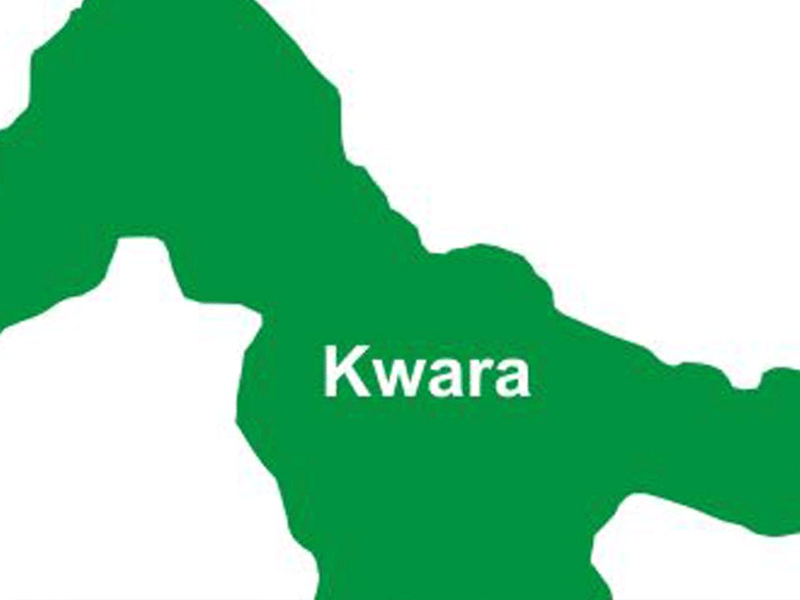
The assault on some women, who protested against worsening insecurity in Kwara State in December last year, has underscored the fragile civic freedoms in the country. According to reports, the women protesting worsening insecurity in some parts of the state were attacked by cane-wielding thugs, flogged and dispersed in a manner more befitting of a police state a constitutional democracy.
Before the incident, Kwara’s Ifelodun, Isin, and Ekiti local government areas had often come under kidnappers’ attack. On December 26, seven family members were kidnapped from Adanla community in Ifelodun local government area. A video footage of the attack showed an elderly woman in hijab bemoaning their fate in tears. Shortly after, the thugs descended on the protesting women.
The avoidable attack on Kwara women is condemnable. It is against the tenets of democracy and rule of law. Nigerians, including women have the right to protest. The treatment meted to the women by the thugs should not be tolerated. In many societies, women are still regarded as the more vulnerable gender, deserving of protection rather than violence. To see them beaten in public for speaking out against kidnapping is not just disgraceful; it is morally indefensible and repugnant.
More troubling is where it happened: in the vicinity of the Government House. This is a place where citizens should be protected. It should not be the venue for assault on protesting women. This singular fact casts a long shadow. Whether or not state actors were directly involved, the proximity alone opens the government to reasonable public suspicion.
In a democracy, perception matters almost as much as intent. Silence or evasiveness in the face of such allegations only deepens mistrust. Ordinary condemnation of the incident by state actors without bringing the culprits to justice is inexcusable and untidy.
The Kwara State Government therefore owes the public clarity. We call for an independent and transparent investigation to identify those responsible for the attack, trace the sponsors and ensure that all the culprits are prosecuted according to the law. Anything less will be interpreted as tacit approval or institutional complicity.
It bears repeating: peaceful protest is not a crime. The Nigerian Constitution guarantees freedom of expression and assembly. These rights do not evaporate because the message is uncomfortable or critical of those in power. Democracies are strengthened — not weakened— when governments tolerate dissent, especially dissent that speaks to genuine public anxieties such as insecurity.
The women who took to the streets in Kwara were protesting kidnapping—one of the gravest failures of governance in Nigeria. Kidnapping thrives where the state’s protective capacity is weak. Ineffective law enforcement and abandonment of communities can also fuel kidnapping. Assaulting women protesters does nothing to solve this problem. It merely shifts attention from insecurity to repression, from policy failure to human rights abuse.
Equally disturbing is the apparent double standard in the handling of protests. Pro-government demonstrations often enjoy protection, sometimes even facilitation. Anti-government protests, by contrast, are too frequently met with intimidation, violence, or dispersal by force. This selective tolerance undermines the very idea of equal citizenship and betrays the neutrality expected of a democratic state.
Sadly, the Kwara incident fits into a long and troubling national pattern. Nigeria has earned an unenviable reputation for hostility toward protest. Over the decades, students have been shot, arrested, detained, and brutalised for demanding better conditions of living or accountable leadership.
The #EndSARS protests in 2020, which began as a peaceful movement against police brutality, culminated in the tragic events at the Lekki Toll Gate—an episode that remains a scar on the national conscience. In 2015, Shiite worshippers in Zaria were gunned down in circumstances that shocked the world.
These are not isolated incidents; they are symptoms of a deeper democratic deficit. A system that treats protest as insurrection and dissent as treason cannot honestly call itself democratic. Democracy is not merely about elections, not about physical infrastructure; it is about everyday freedoms, especially the freedom to criticise power without fear of violence.
The Kwara women deserve more than sympathy. They deserve a public apology, not as a token gesture, but as an acknowledgment that a grave wrong was committed. They also deserve compensation for the physical and psychological harm suffered. Most importantly, they deserve justice—justice that is visible, credible, and impartial.
Punishing only the foot soldiers will not suffice. Those who organised, sponsored, or ordered the attack must be identified and held accountable. Ending impunity is the surest way to prevent recurrence.
Nigeria stands at a crossroads. The choice is between deepening a culture of fear and nurturing a culture of dialogue. Crushing peaceful protest may bring temporary quiet, but it sows long-term instability. Reforming and protecting civic space may be uncomfortable, but it is the only sustainable path. When protesting women are flogged for demanding security, democracy itself is wounded. Kwara and Nigeria as a whole, must decide whether such wounds will be allowed to fester or be healed through justice and accountability.