Follow Us on Google
Political power does not end with the act of political decision. It survives in the narratives through which that decision is subsequently remembered, defended, denied, justified or celebrated. The political actor who controls the narrative of an event exercises a second-order form of power: not necessarily the power to alter what happened, but the power to influence how what happened is subsequently understood.
That is why political language deserves to be read not merely for its surface meaning but for its agency, presuppositions, omissions, temporal positioning and distribution of responsibility. Aristotle treated political rhetoric as deliberative discourse concerned with decisions and future action. Centuries later, critical discourse analysts would shift attention from rhetoric as persuasion to the relationship between discourse and power: how social dominance is enacted, legitimised, reproduced or challenged through text and talk.
Teun van Dijk’s formulation is especially useful here: discourse provides one of the principal sites through which power is expressed, concealed and legitimated. The historian therefore asks: What happened? The political scientist asks: Who exercised power? The discourse analyst asks a prior question: How does the language of the political actor construct what happened, who acted, who was acted upon, and what may be regarded as legitimate political action? That question becomes particularly consequential when the same political actor offers materially different accounts of the same political episode at different moments in time.
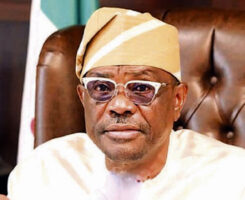
In March 2023, Wike took exception to Peter Obi’s suggestion that he had come out against him. His response was not a casual denial. He supplied a political genealogy of his relationship with Obi. “In 2019, ask Peter Obi, I was one of the teams that chose Obi to be the Vice Presidential candidate of Alhaji Atiku Abubakar.” He then recalled opposition from Ike Ekweremadu, Dave Umahi and Pius Anyim during the selection process and concluded: “Every blame was on me, why will I be the one that will say Peter Obi should go?”
The rhetorical architecture was clear. I helped put Obi on the ticket. Others opposed that choice. Why, therefore, would I subsequently become the person determined to remove him from the political equation? That was Wike’s 2023 discourse. Fast-forward to September 2026. The same Wike, recounting the 2023 presidential election in Rivers State, now says that the G-5 governors deliberately decided that Obi would not win there: “It was only Rivers State where we said, ‘No, we have a problem here in Rivers. Obi will not win here. If he wins, he will send a signal somewhere.’ We stopped it.”
And then comes the prospective declaration: “It is no longer the same scenario. I can tell you authoritatively now that Obi can’t win the South-South.” The political lexicon has shifted dramatically. “Why will I be the one…?” has become “We stopped it.” The individual ‘I’ has become the collective ‘we’. The rhetorical question has become a declarative assertion. The earlier denial of anti-Obi agency has become an explicit assertion of anti-Obi agency. And the retrospective narration of 2023 has acquired a prospective sequel for 2027. That linguistic transition deserves closer attention than the headline question of whether this is a “Freudian slip” or a “confession.”
A Freudian slip would imply inadvertent disclosure: an unintended revelation escaping through language. That does not adequately describe Wike’s statement. He was not apparently caught off guard by an accidental word. He was explaining what he says the G-5 strategy was. The utterance has a discernible argumentative structure: problem → strategic calculation → territorial differentiation → intended outcome → claimed success. Nor should the statement automatically be labelled a legal confession.
The statement, standing alone, does not establish that an electoral offence occurred. Political actors may legitimately campaign against candidates, mobilise supporters, build coalitions, persuade voters and seek to defeat opponents. The critical issue is therefore more precise: What does Wike mean by “we stopped it”? That question is semantic before it is partisan. “Opposed” is one thing. “Defeated” is another. “Stopped” is something else.
To oppose a candidate is to compete against him. To defeat a candidate is to prevail in an electoral contest. To “stop” a candidate from winning potentially suggests intervention directed specifically at preventing an anticipated electoral outcome. The mechanism matters. Was Wike referring to legitimate political mobilisation? Strategic coordination? Vote transfer? Elite persuasion? Party machinery? Or something more consequential? His statement does not specify. That is precisely why the verb requires scrutiny rather than either celebration or condemnation. The most accurate preliminary description may therefore be a ‘retrospective political admission’. But there is another phrase that captures its rhetorical flavour more sharply: ‘confessional boast’. It is “confessional” because it discloses agency that was previously denied. It is a “boast” because the disclosure is not framed as an apology or expression of regret. It is presented as evidence of strategic effectiveness. That distinction is important.
The 2023 statement cannot be understood without its 2019 prehistory. Wike’s account places himself among those who participated in selecting Obi as Atiku Abubakar’s running mate. Channels Television reported his recollection that Obi was invited while party leaders were meeting at Bukola Saraki’s residence and that Wike faced opposition from Ekweremadu, Umahi and Anyim. The political significance of that recollection lies not simply in whether every participant remembers the episode identically. It lies in why Wike invoked it in 2023. He was constructing a continuity of political loyalty.
His argument effectively ran: I was involved in Obi’s elevation. Therefore, the allegation that I had suddenly become his political enemy was inconsistent with my record. The rhetorical question—“why will I be the one that will say Peter Obi should go?”—performed the work of exculpation. It positioned Wike as an improbable antagonist. That is important because political discourse is not only about the propositions speakers make. It is also about the political identity they construct for themselves while making those propositions. In 2023, Wike constructed himself as: facilitator → supporter → aggrieved ally → reluctant antagonist of Atiku, but not of Obi.
In 2026, the construction is markedly different: strategist → member of a collective political bloc → actor capable of determining where Obi could and could not win. The question, then, is not simply whether Wike changed his mind.
Politicians can change their political positions. The question is: What changed in the discourse through which he represents his own political agency?
Wike’s 2026 account provides the answer or at least his version of it. He says the G-5 governors regarded Atiku and the strength of the PDP in the South-South as the principal strategic problem. Their solution, according to his account, was to allow Labour Party victories in some South-South states rather than allow Atiku to benefit from PDP strength. He specifically cited Edo and Cross River. This is where the language becomes especially revealing. The voters’ preferences are transformed into a strategic calculus among political elites: If PDP is strong, Atiku benefits.
If Labour wins instead, Atiku loses the benefit. Within that calculus, Obi’s success can therefore be politically useful in one place and politically undesirable in another. Rivers becomes the exception. Why? According to Wike: “If he wins, he will send a signal somewhere.” That phrase – “send a signal somewhere”- is arguably the most under-examined element of the statement. What signal? To whom? About what? Why would an Obi victory in Rivers have consequences beyond the state itself? And why would those consequences be sufficiently important to justify a different strategy there? The answer is not supplied. That missing referent is precisely where discourse analysis becomes useful.
Consider the sentence: “We stopped it.” Grammatically, the political elite occupies the subject position. ‘We’ = agent. ‘Stopped’ = action. ‘It’ = object. But what is missing? ‘The voter’. The electorate, the constitutional source of electoral sovereignty, is absent from the grammatical frame. This does not prove that the electorate was actually disregarded. Conversation routinely compresses complex processes. But in a political statement about deliberately preventing a candidate from winning an election, the omission becomes analytically significant.
The sentence foregrounds elite agency and backgrounds popular agency. That is classic CDA territory. Van Dijk’s work specifically directs attention to the relationship between discourse and dominance: how power is enacted and legitimised through communicative practices and how elite access to public discourse shapes social cognition. The question therefore becomes: Who gets represented as the maker of the electoral outcome? Wike’s sentence answers: We. The people who cast the votes are not syntactically visible. The candidate is the object of elite action. That is the deeper political significance of the pronoun: “I” versus “we”.
The pronoun shift deserves its own examination. In 2023: “Why will I be the one…?” In 2026: “We stopped it.” The first formulation individualises agency while simultaneously denying responsibility for anti-Obi action. The second collectivises agency while claiming success. This is a striking discursive transformation: I: denial of agency. We: assertion of agency. The difference is not merely grammatical. The collective ‘we’ also enlarges political capacity. “I stopped it” would attribute the outcome to an individual. “We stopped it” invokes an organised political structure. It transforms personal action into collective strategy. And that matters because the G-5 was not an imaginary political formation. It consisted of five sitting PDP governors – Wike, Seyi Makinde, Samuel Ortom, Okezie Ikpeazu and Ifeanyi Ugwuanyi – who opposed Atiku’s presidential candidacy and demanded, among other things, the resignation of PDP national chairman Iyorchia Ayu.
Wike’s current account therefore constructs the G-5 not merely as a protest bloc within the PDP but as a ‘strategic electoral actor’ capable of differentiating among presidential candidates across states. That is a substantial claim about the reach of elite political agency.
The documentary electoral record provides an important counterweight to the political narrative. INEC’s official 2023 presidential election results recorded Bola Tinubu with 231,591 votes in Rivers, Peter Obi with 175,071 and Atiku Abubakar with 88,468. Obi, therefore did not win Rivers on the declared result. That fact is not in dispute. What is newly consequential is Wike’s retrospective claim about ‘why’ Obi did not win. That distinction must be maintained rigorously.
The result is documentary evidence. Wike’s explanation is a political actor’s retrospective account.
The two are not epistemically identical. The result tells us ‘what INEC declared’. Wike tells us ‘what he says political actors did to produce or influence the political environment surrounding that result’. One should not be substituted for the other. This distinction also prevents an analytical error that frequently contaminates political commentary: turning an allegation, admission or retrospective claim into an established fact merely because it comes from a politically powerful speaker. Critical discourse analysis should sharpen that distinction, not dissolve it.
George Orwell’s famous concern with political language was not that politicians use rhetoric. All politics uses rhetoric. His concern was the capacity of language to make uncomfortable realities difficult to perceive. That problem is particularly acute when abstract nouns and strategic euphemisms replace concrete descriptions of action. “Strategy.” “Signal.” “Political calculation.”
“Stopping.” Each can compress a substantial amount of political activity into a single word. The analytical task is to unpack the compression. What happened inside the word? What actors disappeared inside the noun? What responsibility disappeared inside the collective pronoun? What mechanism disappeared inside the verb? Political language becomes most powerful when it makes a complicated chain of action sound like a single natural event. “We stopped it.” Three words. Possibly an entire political process concealed within them.
Shakespeare understood that political power and narrative power are inseparable. In Macbeth, political actors repeatedly manipulate the relationship between action and its representation. Euphemism, equivocation and strategic ambiguity become instruments through which responsibility is displaced or disguised. In Othello, Iago’s power lies not simply in falsehood but in his ability to structure another person’s interpretation of fragments of information. The relevance here is methodological rather than literal.
A political actor narrating an election after the fact is not merely recalling history. He is participating in the construction of its meaning. That is why the 2023 statement and the 2026 statement must be read together. The first constructs one political identity. The second constructs another. The contradiction or at least the tension between them is itself data. And that is where Part II begins: What happens when retrospective political agency becomes prospective political authority? Because Wike’s most consequential sentence may not be the one about what he says happened in 2023. It may be the one about what he says cannot happen in 2027.
•Prof Agbedo writes from University of Nigeria, Nsukka