Follow Us on Google

Beyond the initial frenzy over the pledge by Atiku Abubakar to reverse the policy of petrol subsidy removal of the President Bola Tinubu administration, with the prospect of lowering cost of energy, a certain reality appears to dawning on the suffering people of Nigeria, that, after all, the African Democratic Congress (ADC) presidential candidate might not be the expected Messiah. Apart from the fact that no clear road map has been shared with the voting public on how to return Nigeria on a path to sustainable affordable energy by Atiku and his policy team, the apparent and real weaponization of ethno-regional sentiments against President Tinubu as a means of ending up in Aso Rock in 2027 may have inadvertently re-awakened the North/South dichotomy in Nigeria’s politics of presidential elections.
In addition to being one of the most prominent advocates of energy security, who has consistently criticized the policy of removal of subsidy on petrol by the Tinubu administration, I am also an avowed left-leaning statist. This is because such social interventions as the funding of public schools system, healthcare, housing and subsidy on energy can only be realistically achieved under a state capitalist model of economic management, where the government will participate in the means of production, create commonwealth and use part of it to provide the aforementioned social services for the people. It must be understood that the removal of petrol subsidy is only a part of the neo-liberal economic management system, which had dictated the de-funding of public school systems, commercialisation of healthcare provision and privatisation of basic utilities such as electricity and water. Guided by the philosophy that government ‘has no business in business,’ the means of economic production is entirely transferred to the private sector, leaving government idle and broke, hence unable to meet its basic social responsibilities, including the provision of affordable energy through subsidization.
To return to the era of subsidy payment on petrol, as desirable and expedient as it is, will require a repudiation of the current neo-liberal economic orthodoxy that has dictated Nigeria’s economic policy decisions since the collapse of the Berlin Wall and the re-unification of East and West Germany, which resulted in the disintegration of the Soviet Union in 1991, signalling the triumph of liberal democracy and western-style capitalism over socialism. Atiku Abubakar, Nigeria’s former Vice President and one-time head of the National Economic Council of the Federal Republic of Nigeria, between 1999 and 2007, is not just a champion of neo-liberal economic orthodoxies but used his very influential position under the President Olusegun Obasanjo presidency to drive similar reforms as the Tinubu administration is doing today that set Nigeria on the unbending road to Washington. In addition to presiding over the transfer of public means of economic production through the largest privatisation exercise in Africa as chairman of the National Council on Privatisation, Atiku has been a vocal advocate for such policies as the floatation of the naira, removal of subsidies and privatisation of the state-owned oil company, the NNPC.
Whereas, Candidate Atiku has a right to change his mind on any issue, that change of mind must not be selective but a collective of ancillary policies that will make his vow to restore subsidy realistic and sustainable. Without repudiating neo-liberalism, rescinding of the fallacy of ‘government have no business in business’ and adopting a left-leaning statist ideology will be likened to Atiku pledging to make ‘halal’ the consumption of alcohol without first abandoning his Muslim faith. This is because both Atiku and Tinubu worship in the same chapel of neo-liberal economic orthodoxy and, without going the whole hog, any promise to restore subsidy on petrol is more a political promise than an economic policy proposition.
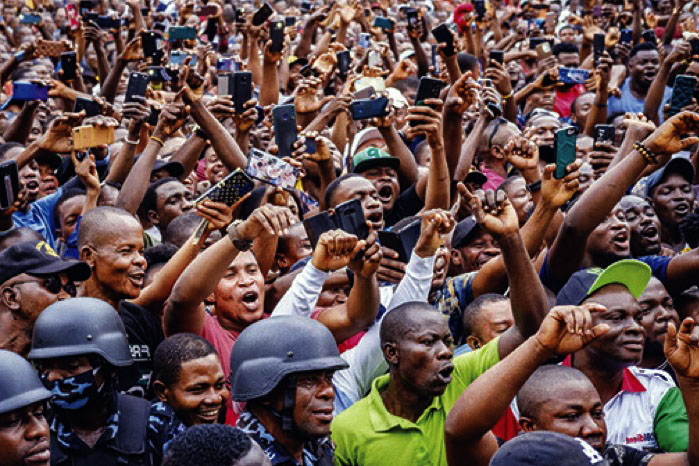
Atiku’s promise of restoring subsidy appears to have earned some mileage going into the 2027 presidential election, especially in his northern part of the country. However, a close scrutiny of the mass support for Atiku may have less to do with his phantom promise of subsidy restoration and more to do with ethno-religious and regional solidarity for a candidate that is considered ‘one of our own’ in Nigeria’s largest voting demographic, the Muslim North. And because Nigeria is a fragile compromise of the constituent peoples, where each made tremendous sacrifices to sustain the unity of Nigeria, the quadrennial attempt by the Muslim North to use their numerical strength to monopolise the highest office in the land poses an existential danger to the continuous existence of a united Nigeria.
By the established convention of power rotation between the former northern and southern protectorates that were amalgamated to form modern Nigeria in 1914, the period between 2023 and 2031 is the turn of the South and, if the North is unhappy with President Tinubu, there is a plethora of other southern candidates they can chose from as an alternative. In fact, if subsidy restoration is the desire, the only candidate with a clear-cut alternative to the prevailing neo-liberal economic orthodoxy, who has pledged to reduce the price of petrol from over N1,400 to N200 is Prince Adewole Adebayo, the SDP candidate, from southern Nigeria. And if the support for Atiku is only about his pledge to restore subsidy on petrol, then no candidate should have more support in northern Nigeria than the Ondo Prince.
While, it is a reality that President Tinubu’s reforms have worsened the socio-economic conditions of Nigerians, it must also be understood that the reform policies of the Tinubu administration are products of a national consensus that was forged in economic neo-liberalism and to which Atiku subscribed and campaigned for President in 2023. As a matter of fact, Nigerians voted for subsidy removal and floatation of the naira when they voted massively for candidates that pledged to implement those policies. While I remained firmly opposed to these policies before, during and after the 2023 presidential election, I conceded to President Tinubu that he is simply leading Nigeria along the economic lines of his ideological convictions.
The painful fallout of the reforms of the Tinubu administration has been evenly spread from his Yoruba-speaking SouthWest, where the first cry of “ebi’n pa wa” was heard, to the Hausa-speaking North where the #EndHunger protest broke out later, and the Igbo-speaking South East where the people are braving their unprecedented hardship with equanimity. Tinubu didn’t set out to deliberately impoverish the North, while enriching the South. Nigerians across regional, ethnic, religious and partisan affiliations are equally feeling the effects of Tinubu’s economic reforms; therefore, any form of regional exceptionalism in the 2027 election will be in bad taste and may convey to the rest of the country the impression of an insensitive use of numerical advantage to advance sectional interests, to the detriment of national unity.
A landlocked, oil-poor, impoverished, terrorized and pauperized region like northern Nigeria will better have its socio-economic interests advanced within a united Nigeria, where oil mineral resources will continue to flow to its 19 states, 419 local government areas and hundreds of emirates and chiefdoms to alleviate its desperate condition. Any breach of that unity on account of violating the zoning and rotation principle in Nigeria’s presidential poll by a hostile takeover of power when it is still the turn of South will put a strain on the already fragile state of the Nigerian state, at a time when the North is not materially ready for a costly divorce from the Southern Lady of Means. And to correct the current economic trajectory that has caused so much pain to Nigerians will require another national consensus abandoning neo-liberalism and adopting a left-leaning statist approach to economic management, while collectively putting pressure as some of us have been doing on Nigeria’s political leadership to take a left turn to get Nigeria to the right direction.