Follow Us on Google
Fred Ezeh, Abuja Abuja
For more than three decades, the Tertiary Education Trust Fund (TETFund) has stood as the lifeline of infrastructure development in Nigeria’s public tertiary education sector.
From iconic senate buildings and modern lecture theatres to cutting-edge laboratories, engineering workshops, digital libraries, medical colleges and student hostels, the Fund has reshaped the physical landscape of universities, polytechnics and colleges of education across the country.
In many institutions, TETFund interventions have become synonymous with development. New academic complexes, research centres, entrepreneurship hubs and ICT facilities bearing the agency’s signature in campuses nationwide, thus providing facilities that many institutions could never have built through their regular budgetary allocations alone.
Yet, despite the enormous investment, an uncomfortable reality has persisted. Across several campuses are abandoned or painfully slow-moving projects, buildings that have remained under construction years after groundbreaking ceremonies, laboratories awaiting completion, hostels standing idle and lecture theatres that should have been serving thousands of students but remain inaccessible because contractors have long left the sites.
Concerned by the growing trend, the Board of Trustees (BoT) of TETFund, last week, issued what may be its strongest warning since the agency was established. The BoT directed that institutions that fail to complete ongoing intervention projects will no longer be allowed to embark on fresh ones under the 2027 intervention cycle.
The decision, perhaps, marks a decisive shift in TETFund’s philosophy, from merely funding projects to demanding accountability, timely execution and prudent management of public resources.
WHY THE WARNING MATTERS
The warning from the BoT comes at a critical period for Nigeria’s higher education system. Because public universities, polytechnics and colleges of education continue to grapple with inadequate infrastructure caused by decades of underfunding, rising student enrolment and increasing demand for modern teaching and research facilities.
Over the years, TETFund has become the single largest intervention agency helping institutions bridge these deficits. Every allocation cycle brings fresh opportunities for institutions to construct new classrooms, laboratories, libraries, administrative blocks, innovation centres and health facilities.
The agency has also expanded its interventions beyond physical infrastructure to include academic staff development, institutional research, book development, ICT support, conference sponsorship, entrepreneurship education and medical training.
However, infrastructure remains one of its most visible and impactful contributions.
That, perhaps, explains why delayed or abandoned projects have become a source of concern not only for TETFund but also for students, lecturers and host communities who are denied the benefits of facilities already funded with public resources.
TETFund noted that every unfinished lecture theatre means overcrowded classrooms. Every abandoned laboratory affects practical learning. Every delayed hostel compounds accommodation shortages. Every incomplete medical facility limits the training of doctors and other healthcare professionals.
Ultimately, the greatest victims are students whose learning environment remains inadequate despite huge public investment.
FROM ECONOMIC CHALLENGES TO ADMINISTRATIVE FAILURES
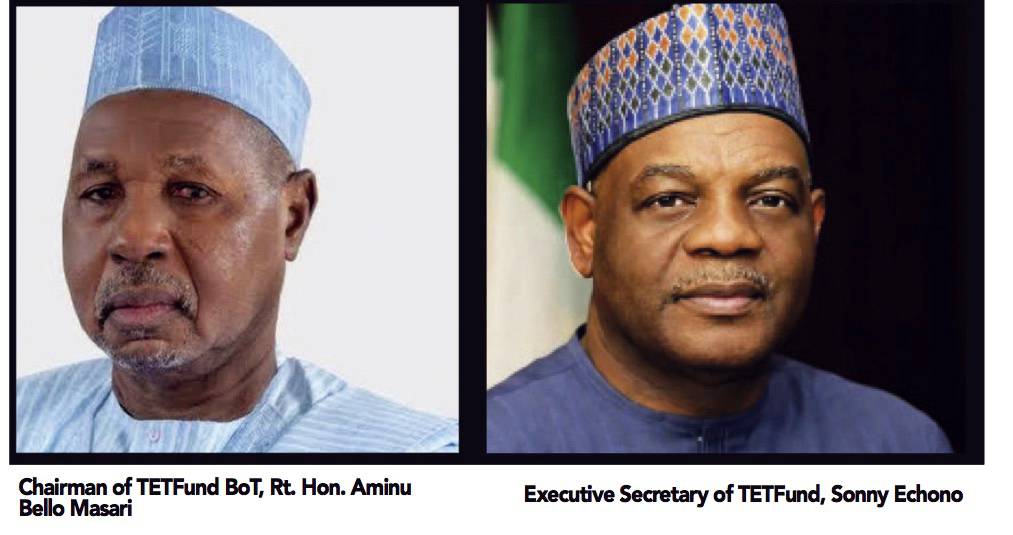
Chairman of the Board of Trustees, Hon. Aminu Bello Masari, said earlier delays were partly driven by circumstances beyond the control of institutions.
Undoubtedly, Nigeria’s economic challenges in recent years led to unprecedented increases in the prices of cement, reinforcement bars, roofing sheets, electrical fittings, sanitary wares and other construction materials.
Many contractors who had priced projects several months earlier found themselves unable to continue execution without additional funding. Recognising the problem, the Board in 2023 introduced a special intervention line dedicated solely to completing distressed projects. The initiative provided institutions with additional support to rescue projects affected by inflation and market volatility.
By the Board’s assessment, the intervention achieved encouraging results as several projects that had remained stalled for years were eventually completed after institutions received additional assistance.
However, despite that intervention, new cases of delayed project delivery have continued to emerge across beneficiary institutions.
For the Board, this suggests that rising construction costs are no longer the only explanation.
INSTITUTIONS SHARE THE BLAME
The Board believes the more persistent challenge now lies within the institutions themselves, and highlighted a number of administrative weaknesses responsible for the continued delays.
One of the biggest concerns is the lack of continuity whenever new vice-chancellors, rectors or provosts assume office. The BoT noted that instead of completing projects initiated by their predecessors, some institutional heads allegedly focus on launching fresh projects that can be associated with their own administration which often result is multiple unfinished projects competing for limited resources.
Another challenge identified by the Board was the delay in processing contractors’ payment certificates. Even where funds have been approved, bureaucratic bottlenecks within institutions sometimes delay payments, forcing contractors to suspend work or abandon project sites.
The Board also warned that internal politics, administrative rivalry and institutional bureaucracy should never be allowed to frustrate projects financed with taxpayers’ money.
Other News
Such practices, it noted, undermine public confidence and deny students access to facilities urgently needed for teaching, learning and research.
TOUGH SANCTIONS AHEAD
To end what it described as the recurring problem of distressed projects, the Board said it has approved a comprehensive package of reforms.
TETFund said every beneficiary institution has been directed to compile a detailed inventory of all projects that have exceeded their completion timelines by more than six months, insisting that institutions must explain the causes of each delay and propose practical strategies for completing the projects.
The institutions are also expected to rank the projects according to priority and submit updated cost estimates required for completion. Beyond documentation, institutions have been instructed to establish stronger project supervision mechanisms involving their physical planning and maintenance departments to ensure that projects are completed on schedule, within approved costs and according to prescribed quality standards.
The most significant directive, however, concerns future funding. TETFund said institutions with delayed projects will be required to channel their annual, zonal and high impact intervention allocations towards completing those outstanding projects.
It insisted that no approval will be granted for fresh projects from such institutions under the 2027 intervention cycle.
For many institutions that depend heavily on TETFund allocations to expand infrastructure, the sanction could have far-reaching consequences.
MONITORING TEAMS TAKE TO THE FIELD
To ensure that the new policy is not merely another administrative directive, the Board has approved extensive monitoring across the country.
Teams made up of Board members and technical officials of TETFund will visit affected institutions during August and September 2026.
The exercise will involve physical inspection of projects, verification of completion claims and assessment of proposals submitted by institutions on how they intend to complete outstanding works.
The findings will guide deliberations during the Board’s statutory meeting scheduled for October 2026, where projects eligible for the 2027 intervention guidelines will be considered.
The monitoring exercise is expected to provide the Board with a clearer picture of the actual state of intervention projects nationwide while helping distinguish institutions facing genuine financial challenges from those whose delays stem from poor management.
BEYOND INFRASTRUCTURE
Observers say TETFund’s latest decision represents more than an attempt to complete abandoned buildings. It signals a broader shift in public sector governance, where emphasis is increasingly placed on outcomes rather than expenditure.
For years, the success of intervention programmes was often measured by the amount of money released or the number of projects approved. Increasingly, however, attention is shifting towards whether those projects are completed on time, meet expected standards and deliver value to the public.
The Board’s latest directive also reinforces the principle that institutional leadership should be driven by continuity rather than personal legacy.
Projects belong to institutions, not to individual vice-chancellors, rectors or provosts.
Completing inherited projects should therefore take precedence over initiating new ones.
A MESSAGE BEYOND 2027
For institutions hoping to access fresh intervention funds next year, the message from TETFund is unmistakable: finish what has already been started before requesting additional projects.
The warning also reflects the agency’s determination to protect one of Nigeria’s most successful education intervention programmes from waste, inefficiency and poor project management.
If consistently enforced, the policy could significantly reduce the number of abandoned projects on campuses, improve value for money and ensure that scarce public resources translate into functional infrastructure that directly benefits students, lecturers and researchers.
Ultimately, TETFund’s latest stance is not merely a threat to withhold future approvals. It is a call for a new culture of responsibility in Nigeria’s tertiary education system, one in which accountability, continuity and timely project delivery become the benchmarks for accessing public intervention funds.
Whether institutions embrace that culture remains to be seen. What is certain is that the Board has drawn a clear for universities, polytechnics and colleges of education across Nigeria. Completing existing projects is no longer just good administrative practice; it has become the gateway to future TETFund support.