Follow Us on Google
By Henry Akubuiro
Fragments of memory, history, and lived experience morphed into layered visual narratives form the basement on which artist, Samuel Inalegwu mounts his exhibition.
Curated by Tribes Art Africa Gallery (TAAG), Inalegwu’s solo art exhibition titled Visual Storytelling: Autobiographical Fragments and Symbolic Memory, which showed on artsy.net Artsy, from March 29-April 30, 2026 brought together paintings that reflect the artist’s ongoing exploration of identity, home, and belonging within the contemporary Nigerian experience.
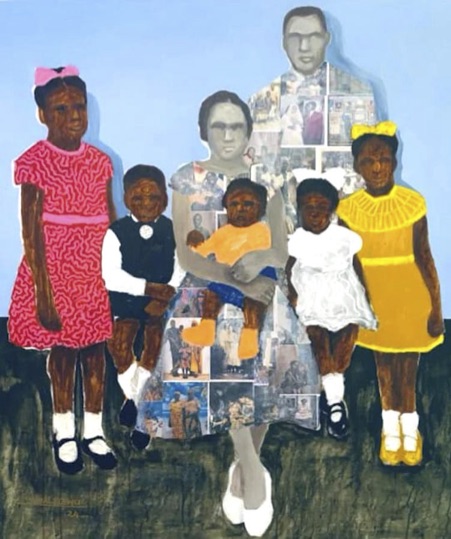
According to TAAG, central to Inalegwu’s approach is the integration of archival imagery and symbolic references, often embedded into his paintings through collage-like elements. The fragments act as visual echoes of the past, grounding the figures within layered histories while suggesting the persistence of memory across generations. The presence of mothers, children, and familial gestures evokes themes of protection, continuity, and resilience—suggesting that identity is not singular but constructed through shared histories and lived relationships.
In works such as ‘Sentinel of Guma’ series, the artist draws subtle connections between personal memory and broader social realities. The figures appear as quiet guardians of heritage and survival, standing at the intersection of past and present. Their presence speaks to endurance and the quiet strength embedded within everyday life.
Through a restrained yet emotionally resonant visual language, Inalegwu invites viewers to engage with painting as a site of reflection. His works do not merely depict moments —they reconstruct memory, assembling autobiographical fragments into images that resonate with universal human experiences.
In its Gallery Statement TAAG said the exhibition offers collectors and viewers an opportunity to encounter a powerful emerging voice in contemporary African painting. “In Inalegwu’s work, storytelling becomes more than representation—it becomes an act of preservation, remembrance, and connection. My artistic practice is rooted in the exploration of memory, displacement, and identity, drawing deeply from personal and collective experiences,” Inalegwu said in his Artist Statement.
He noted also: “Through painting, I reconstruct fragments of my past particularly my upbringing as an orphan and the transient nature of home as a way of archiving the emotional landscapes tied to movement, loss, and belonging.”
He explainex that his work often began with family photographs, oral histories, or objects tied to personal memory, which I deconstruct and reimagine through layered compositions, textured surfaces, and abstracted forms. Inalegwu disclosed that the process “allows me to blur the lines between reality and imagination, fact and feeling. I am interested in how home can exist as both a physical place and a psychological space how we carry it within us even as we move.”
Specifically on the artist’s current body of work, his experiment with the interplay of architectural motifs, domestic objects, and fragmented figures, were aimed to evoke the layered experiences of navigating multiple cultural contexts and shifting homes.
“Through these visual narratives, I aim to create immersive experiences that resonate with viewers on both personal and universal levels encouraging reflection on one’s own relationship to memory, family, and place. Ultimately, my practice is a way of making visible what is often intangible: the emotional residue of memory and the silent inheritance passed through generations,” be said.
Inalegwu (born in 1993), Benue State, Nigeria, but based in Lagos, has built his practice on works that emerge from recollections of childhood, family histories, and the emotional landscapes shaped by migration and displacement. Within his compositions, figures inhabit spaces that feel both intimate and symbolic—domestic interiors, maternal presences, and archival fragments woven together to form visual testimonies of personal and collective memory.
He holds a Higher National Diploma in Fine and Applied Arts from Benue State Polytechnic, Nigeria. Following his relocation to Lagos in 2020, his artistic journey took a significant turn towards anthropomorphic expression, influenced by the mentorship of Ikechukwu Ezeigwe.