Follow Us on Google
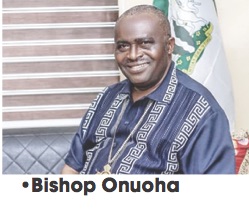
…Driven by passion to serve
By Henry Umahi
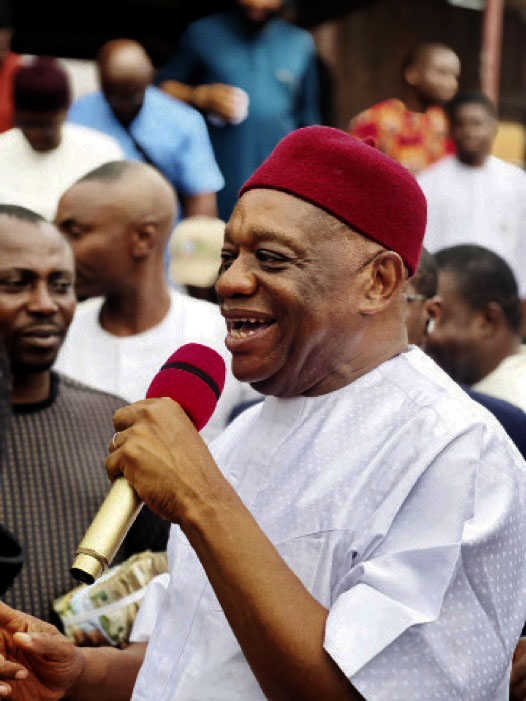
Bishop Dr. Sunday Ndukwo Onuoha could be described as a jewel of inestimable value. Like the most widely known man of letters in America, Ralph Waldo Emerson, Onuoha believes that the purpose of life “is to be useful, to be honorable, to be compassionate, to have it make some difference that you have lived and lived well.”
Born on March 22, 1964, in Item, Bende Local Government Area of Abia State, he has shown, over time, that he is a man among men. To put it differently, he is one in a million.
Onuoha, who is a sexagenerian today, having attained 60 years of age, is God-loving, people-caring and right-thinking. He has remained himself, a dignified personality with unblemished record and outstanding selfless service to mankind.
Onuoha is unassuming, amiable and audacious. He is indeed a man in whom many are well pleased because he is doing remarkable things, inspiring and influencing many.
Affectionately called Bishop of the masses, Onuoha is an entrepreneur, distinguished educationist, prolific writer, quintessential philanthropist, peacemaker, bridge builder, global citizen, great minister of undiluted gospel and perfect gentleman.
In fact, he is exemplary in character and conduct. Someone said that when he is counting his blessings, he counts him (Onuoha) twice.
Onuoha, who is the founder and president of Vision Africa International and the co-chair, Nigerian Inter Faith Action Association (NIFAA), was appointed as Special Assistant on Privatization by then President Olusegun Obasanjo in 2003.
His Vision Africa focuses on bringing networks of faith communities to share God’s love and empowering the grassroots which helps build Nigeria’s indigenous capacity to solve problems and cure society’s ills from the inside out. The group delivers empowering aid that heals the mind, body, and soul so that everyone they serve can experience God’s love and live abundant lives. They also believe that by listening to those they serve first and foremost, they are able to have the greatest impact physically, intellectually, emotionally and spiritually.
Vision Africa organises medical outreaches in parts of the country, attends to the needs of prisoners, offers scholarships to students and carries out enlightenment campaigns through its radio station, among others.
The Nigerian Interfaith Action Association (NIFAA), which he co-chairs, is the largest Christian-Muslim collaboration in history that provides a platform for inter-religious collaboration to end malaria in Nigeria. Considering the religious intolerance in parts of the country, the importance of the group cannot be over emphasized.
The NIFAA is a faith-based partnership, unique in its national reach and implementation. The NIFAA’s mission is two-fold: to train and empower Nigerian faith leaders to be at the forefront in the fight against poverty and disease, and to carry out advocacy regarding poverty reduction and disease control and eradication.
Launched in 2009, NIFAA harnesses the influence and power of Nigeria’s faith leaders as they help combat disease, improve health outcomes, and address development challenges throughout the country. NIFAA’s early work revolved around life-saving community outreach and behavior change messaging related to the fight against malaria. Currently the organization represents a faith-led, action-driven capability read to expand its efforts. Initial investments catalyzed a groundbreaking relationship between the government of Nigeria, the faith community, and development partners.
Onuoha is not a typical Nigerian minister of the gospel. He brings pragmatic approach to issues. He has been so consistent in Nigeria’s two sectors of religion and education, and a bit of politics. He is a voice for good leadership/welfare of the masses, human rights and a man of robust intellectual sagacity.
Though Onuoha is a man of faith, he doesn’t subscribe to laziness in any ramification. He also does not sit on the fence. He speaks truth to power. He is bold and fearless.
Last season, he threw his hat into the political ring. He was Abia State governorship candidate under the African Democratic Congress (ADC). He believes that his state of birth, just like Nigeria, deserves a better deal. He wanted to govern Abia State to “address the pains and sufferings of our people.”
While campaigning, Onuoha rolled out an 11-point agenda focusing on “security and social welfare, digital economy and information technology transformation, transparency and accountability, international relations/development agencies, job creation/youth and women empowerment, agriculture and rural development, participatory governance, education for sustainable development, accessible basic health for all, trade and commerce, and faith community for development.”
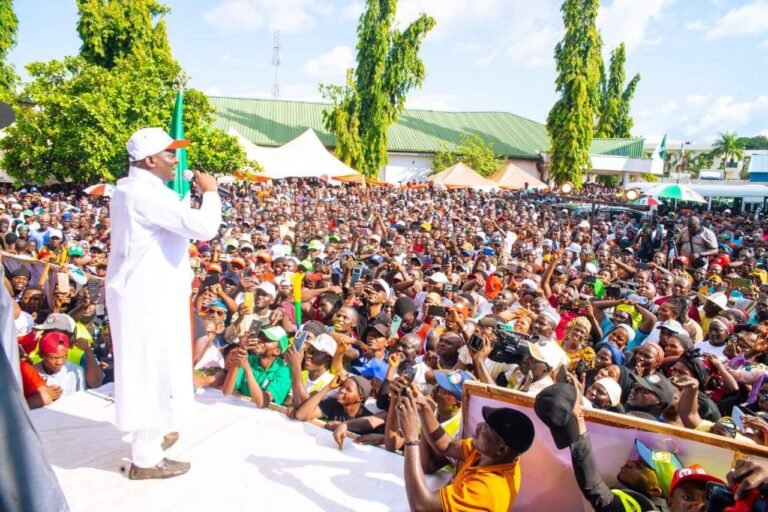
Indeed, in the run up to the election, he enjoyed massive support from not only the ordinary folks of Abia, but also stakeholders and groups yearning for a positive and impactful change in the state. Some groups even gave him ultimatum to join the contest.
An advocate of dialogue and engagement, Onuoha influences the political space by bringing leaders together from the fringes of the Sahara to the Atlantic Coastline to seek solutions to jaw jaw.
Worried by the level of insecurity, economic and socio-political hitches bedeviling the country, Onuoha’s Vision Africa, in collaboration with Global Peace Foundation (GPF) organised the ‘Inclusive Security Dialogue Retreat,’ in Abuja to seek lasting solutions to the problems. In attendance were former President Olusegun Obasanjo, Sultan of Sokoto, Sa’adu Abubakar 111 and Sheikh Ahmed Gumi.
Also present were the chairman, Middle Belt Forum, Dr. Pugo Bitrus; Secretary General, Ohanaeze Ndigbo, Okey Emuchay; former, Governor of Akwa Ibom State, Victor Attah, and Ankio Briggs, who is the chairperson of Niger Delta Self Determination Movement, among others.
At the event in 2022, Onuoha said: “The heinous acts of barbarism, corruption, violent extremism and the rise of ethnic militia groups that is enveloping our dear country, whether propelled by ethnicity, religious intolerance or sheer bigotry, will only lead to a meltdown (that will engulf all of us) unless some influential stakeholders and leaders with moral authority – like we are fortunate to have assembled here today – deliberately promote dialogue, national cohesion and hope.”
Onuoha advocated that deliberate steps must be taken to close the gap between the aggrieved and the leaders by identifying trusted, objective and reliable moderators who must coordinate the discordant tunes into a harmonious melody that will bring about peace and reconciliation.
Stressing that a hungry ‘man is an angry man’ as Nigerians are won’t to say, he insisted but in it lies the core of the many agitations, militancy and pockets of security crises facing the country today. According to him, the large army of unemployed able-bodied young men in the country could become veritable tools in the hands of agitators and non-state actors.
“There is anger, and hunger in the land. I fear for a country that will have to grapple with these untamed energies in the next five to 10 years,” he said.
In 1983, Onuoha was accepted into the ministry of the Methodist Church in Nigeria. He earned his Bachelor’s degree, served as a pastor, and was involved in mission and outreach in Nigeria.
In 1995, Onuoha completed his Master’s and Doctorate from Southern Methodist University’s Perkins School of Theology in Dallas.
He was consecrated as Bishop in the Methodist Church Nigeria in 2003.