Follow Us on Google
• 12 persons got shot, including those selling tomatoes’
By Ngozi Nwoke
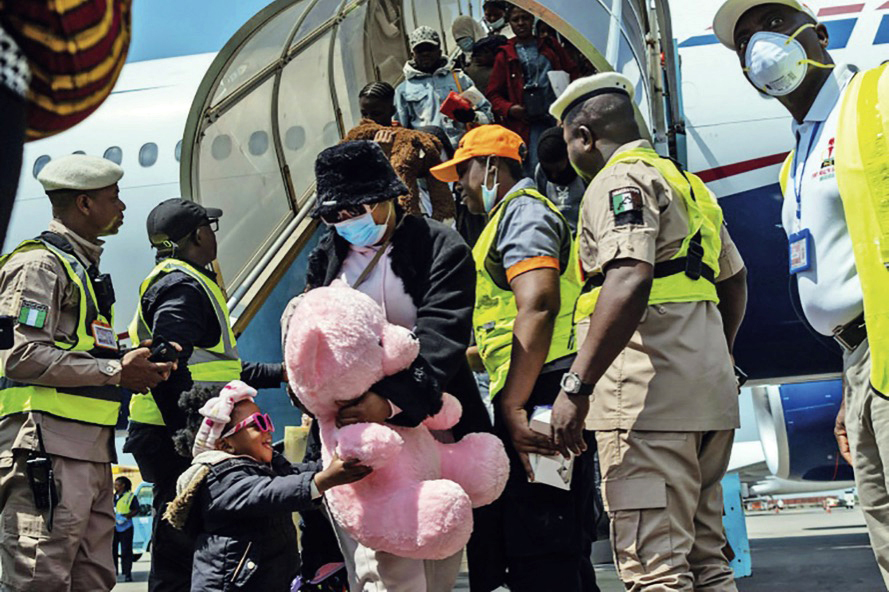
The Air Peace flight that brought them touched down at the Murtala Mohammed International Airport, Ikeja, Lagos about 10.30am on Thursday. They were the first set of returnees being brought back to the country following a wave of xenophobic attacks in the former apartheid enclave, in which unruly mobs, armed with dangerous weapons, unleashed hell on migrants, mostly Black Africans, especially Nigerians living in the country, claiming the foreigners were taking their jobs.
The South African government watched silently, taking no action as the thugs attacked, killed and maimed innocent migrants and destroying their businesses.
On arrival, some of the returnees shared harrowing accounts of how they were profiled, falsely labelled as criminals, and asked to leave South Africa.
A returnee said that his clothing shop was raided and looted by attackers who accused Nigerians of dealing in drugs. He recounted that he was beaten during the raid, even though he had only traded thrift clothes.
“They shot 12 people in my presence, including some Malawians who sold tomatoes. Everyone in South Africa owns a gun, including teenagers. They claim we are illegal immigrants, but I wasn’t. My children and I have our identification cards up to date.
“They don’t want to work. They are lazy and feel entitled. They question Nigerians for owning cars and doing well in their businesses. This xenophobic attack is all about envy and jealousy. For nine years, I sold fairly used clothes. I don’t work in their big companies, unlike those of them who work in Nigerian companies here in Lagos.
“A lot of Nigerians are still stranded at the Nigerian High Commission in Pretoria, waiting to be cleared for return, and a lot of Nigerians don’t have money to transport themselves to the high commission for registration.
“I thank the president for coming to our rescue. We thank Air Peace Airlines for bringing us back home in safety and comfort.”
Another returnee, simply identified as Christian, stated that it felt good to be back home in Nigeria, noting that if a country doesn’t want foreigners in their land, it’s best for the foreigners to return to their country especially when it involves the use of violence and threats to life.
Another returnee recounted that his 16-year stay in South Africa was full of struggle and restlessness. He noted that his landlord served him a 24-hour quit notice and accused Nigerian residents of being criminals who ruined the neighbourhood. He insisted that he had lived peacefully in the apartment all through his stay.
He disclosed that Nigerians were not allowed to work in South African-owned companies because they were hated.
One returnee said South Africans claimed Nigerians came to take the jobs and positions meant for them in their country. “They get jealous and envious of successful Nigerians,” he added.
Another stated that big companies are occupied by South Africans only, leaving migrants to menial jobs despite their qualifications.
While some returnees said they were happy to be back home, others expressed worry over their future in Nigeria.
In a pleasant development, the Imo State Government pledged to support each indigene of Imo State among the returnees with N1 million to aid reintegration and business restart. Officials said profiling of Imo returnees would commence immediately to ensure the cash support reaches them.
The current wave of xenophobic attacks in South Africa that forced the first batch of 262 Nigerians to be repatriated on Thursday, June 11, began weeks ago as anti-migrant protests intensified across the country with a renewed xenophobic attacks targeting foreign nationals in the country.
The evacuation flight, Air Peace Airlines was fully sponsored by the Federal Government of Nigeria, touched down at the Murtala Muhammed International Airport.
The Federal Government had earlier assured that it would continue to engage South African authorities to ensure the protection of Nigerians and prevent further escalation.
Vigilance groups, including “March and March”, organised demonstrations in April and May 2026 in Pretoria, Johannesburg, Durban, and other cities, demanding that undocumented foreigners leave by a self-imposed June 30 deadline. The protests quickly turned violent, with gangs armed with sticks, whips, and shields marching through townships, going door-to-door, intimidating, and beating foreign nationals.
The flare-up was allegedly fuelled by South Africa’s economic pressures. Unemployment exceeds 30 per cent, and protesters blamed foreigners for job losses and pressure on public services. The violence also coincided with campaigning ahead of November local government elections, making anti-immigrant politics more mainstream.
Ghana, Mozambique, and Malawi have already repatriated hundreds of their citizens in recent weeks.
In Nigeria’s National Assembly, Senator Adams Oshiomhole, representing Edo North, sparked a heated debate in May, when he called for Nigeria to retaliate economically against South Africa.
He urged the federal government to revoke the licences of South African companies operating in Nigeria, specifically naming MTN and MultiChoice/DSTV. The former Edo governor argued that Nigeria should “nationalise” MTN and withdraw its licence because the company “repatriates significant revenue while Nigerians face hostility in South Africa”.
Oshiomhole said such action would create opportunities for indigenous firms and serve as a deterrent to what he described as persistent attacks on Nigerians abroad. His stance was later backed by the House of Representatives, which asked the FG to review bilateral agreements with South Africa and temporarily suspend business permits for new South African companies.
South African authorities condemned the violence but pushed back on the “xenophobia” label. President Cyril Ramaphosa, in a televised address on Sunday, vowed to crack down on groups behind xenophobic violence.
He warned: “We will and must not allow groups to use the legitimate concerns of South Africans to destabilise our country through inciting lawlessness and violence.” Ramaphosa also announced measures including tighter border controls, dedicated immigration courts, and action against employers hiring undocumented workers.
Other News
His spokesperson, Vincent Magwenya, insisted “South Africa is not xenophobic. South Africans are not xenophobic”, arguing the protests reflect broader tensions around migration, crime, and unemployment rather than hostility toward foreigners as a whole. The government also condemned “fake videos and images” circulating online, saying they were intended to undermine South Africa’s reputation.
Minister of International Relations and Cooperation Ronald Lamola said “Acts of lawlessness, intimidation and violence against migrant communities have no place in our constitutional democracy”, while police vowed that those participating in xenophobic acts would be identified and brought before courts.
Nigeria’s Minister of Foreign Affairs, Ambassador Bianca Odumegwu-Ojukwu, took a firmer tone when she threatened that Nigeria might retaliate against South Africa for alleged attacks on its nationals. “This is a situation that we are considering; it is not off the table,” she told journalists in Abuja.
Odumegwu-Ojukwu accused the South African government of failing to respond firmly enough, she said: “Our citizens are being harassed. Our citizens’ properties are being looted. Criminal actions are being perpetrated, and the police refuse to do anything. The South African government has not come out strongly and firmly enough to condemn these incidents”.
She rejected claims that attacked Nigerians were illegal migrants, insisting “People who are doing legitimate business have their shops looted, their shops set on fire”.
The minister also cited Nigeria’s historical role in South Africa’s liberation struggle, saying the current treatment was “especially painful and unacceptable.”
She disclosed that President Bola Tinubu directed Nigerian missions in South Africa to set up a crisis notification unit for imperilled citizens and confirmed that evacuation flights were being funded fully by the Federal Government.
The Acting High Commissioner of Pretoria, Ambassador Temitope Ajayi was with the returnees.
The envoy said: “The people you see here today are our nationals, who have decided to come back to escape the irresponsible violence that has been taking place in South Africa. I want to say that they are in good spirits. They have been looking forward to being home since we started this process. I must say that, Minister, this afternoon you are receiving a total of 258 Nigerian returnees from South Africa, including women, men and children.
“I want to thank, especially Mr President, for having committed a lot of resources, both personal and otherwise, into this. Without the personal intervention of Mr President, we would not have been here. If I should take you through the road, the journey, how it started, Mr President started this process. Left to him, he would have wanted this to happen in April. That was when Mr President was so agitated and he wanted his people to return to Nigeria. It started first when the crisis happened in April. Mr President established what we call a hotline communication between himself, the Ministry of Foreign Affairs and the mission in South Africa.
“Through that, he was able to be briefed about what was happening, because Mr President wanted to know. He was so committed, so concerned about it, so every day he was on the phone asking the Minister and us what was happening on the ground and what he could immediately do to intervene. So he requested us, he directed us that we must be giving him an update every day, every minute.
“Moving beyond that, he now established what we call crisis monitoring units in the two missions, to daily apprise him with what is happening at the regions. We have nine regions in South Africa, and these demonstrations are happening sporadically at various regions there.
Mr President was put under tremendous pressure by the world leaders, even by the President of South Africa himself. He was asked to hold action on this, because of the image and the optics, the bad optics it has given to South Africa, because they don’t want Nigeria to go. The moment Nigeria made a pronouncement that we are going to repatriate our people, they were a bit jittery.
“So it got to a stage, he said, he’s no longer going to listen, that we should tell all people that wanted to come, voluntarily, that showed interest in coming back, they should start coming. So that was when we established what we call a coordination meeting with the South African Ministry of Foreign Affairs. So we were meeting on a weekly basis, two times at a time.
“So we sent notification to all the regions, for Nigerians to come forward, those that are willing to be repatriated. And I can tell you that we received a lot of interest. And going beyond that, Mr President directed the evacuation process itself.
“By establishing or creating, liaising with Air Peace, and making available five different flights to carry people from South Africa back home. This is the first batch that will be coming in, and as I mentioned, there are a total of 258 returnees. So the next batch will be coming in on Monday, which is on June 15.
“The third batch will be on June 18. The fourth batch will be returning on June 22. While the fifth and the last batch will be coming in on June 24.”
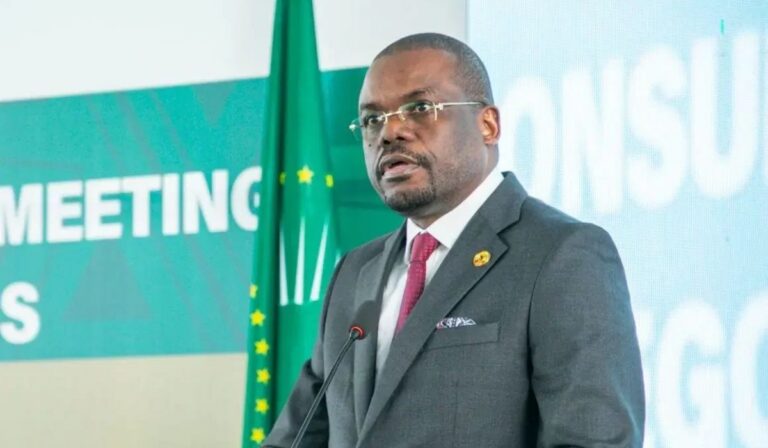
Also speaking, the Minister of State for Foreign Affairs, Ambassador Sola Enikanolaye also addressed the returnees.
His words: “It is with mixed feelings that I address you this afternoon, happy to welcome you. Just as the Acting High Commissioner has very ably pointed out. I’m a little bit not so happy because I know the kind of trauma that my people went through. Mr President has asked me to welcome you back home. Home is home. And to assure you that he is doing everything possible by way of various reforms to make the home good for all of us, such that Nigerians that travel abroad, they will be doing so out of wish for holidays. And migration has always been a part of history. We must live with that. And I am very happy to welcome you.
“Our job is to manage relations, even under the most difficult circumstances. We believe in diplomacy. We believe in engagement. We believe in dialogue. And we are confident that in this process, we will continue to engage South Africa to ensure that our nation is given better treatment. Going forward there are two mechanisms already in place for this to happen. First you have the Binational Commission between the two countries which covers the entire gamut of relations.
“And to address this specific concern, we have the warning mechanism that has just been put in place. I’m aware of some of the issues that have been raised with the latter. But I want to assure you we are going to activate these mechanisms, so that we can respond more quickly and in a more proactive manner to situations that may occur in the future.”
Chairman of Nigerians in Diaspora Commission, Hon. Abike Dabiri-Erewa was at the airport to receive the returnees.
Addressing journalists, she said: “The returnees are not criminals, but very hardworking Nigerians, who have lost everything they ever worked for in South Africa. Their only crime is being black and Nigerian.”
She added that the government had made adequate reception, documentation, and support arrangements for the returnees upon arrival.
“Their National Identification Number will be provided for them so they can register their sim cards and open bank accounts. The refugee commission will take over. We will continue to work with the private sector to follow the example of Governor Hope Uzodinma. They had to come back because lots of them were frustrated, and it became dangerous for them to remain there. The most important thing is that they are back home.”
As diplomatic tension rise, more flights are planned for the estimated 1,000 Nigerians who have registered to return home.