Follow Us on Google
Email: [email protected]
By Henry Akubuiro
Recently, the hall at Lesnes Abbey Woods in South East London opened its gate to an artistic community gathering. Children thronged towards the venue in advance, ahead of curious adults who walked in in a while. Though not billed as an upscale event, it resonated beyond its immediate geography, echoing the wider influence of art in our everyday lives and today’s world. “Storytelling as Therapy” was therapeutic beyond the telling.
The event was convoked by Jude Ukato, a British‑Nigerian social worker associated with families and young people but whose artistic predilection isn’t an overnight romance. Jude has published poetry and fiction works, including with Random House, before the iconic publishing house was absorbed into Penguin. His instinct for narrative, and his understanding of how stories can soften the edges of difficult experiences, shaped the tone of the afternoon. He moved through the hall with the ease of someone who understands both people and atmosphere, greeting families, adjusting chairs, and ensuring that the space felt open, warm, and unhurried.
Jude was joined by two artists whose practices, though distinct, share a commitment to emotional truth. Award‑winning writer Joshua Omeke opened the gathering with a storytelling session that drew children into a loose circle around him. He read with the calm assurance of someone who understands how to hold a room, his voice rising and falling with the rhythm of the narrative. The children responded instinctively — leaning forward, interrupting with questions, laughing at unexpected turns, and allowing themselves to be carried by the story’s movement. Parents watched from the edges, some joining in, others simply grateful for a moment in which their children were absorbed by words rather than screens. A few families walking through the park paused at the doorway, drawn in by the sound of Joshua’s voice. Some stayed. Some joined the circle. The hall became porous, open to anyone who wished to step inside.
Joshua’s stories were not merely entertainment; they were invitations. He read tales that blended imagination with emotional resonance, stories that allowed children to recognise themselves in characters who were brave, uncertain, curious, or afraid. His award‑winning craft was evident not in grand gestures but in the subtle way he allowed silence to settle between sentences, giving the children space to think, to feel, and to respond. It was storytelling as a connection — a reminder of how narrative can gather people, even strangers, into a shared emotional space.
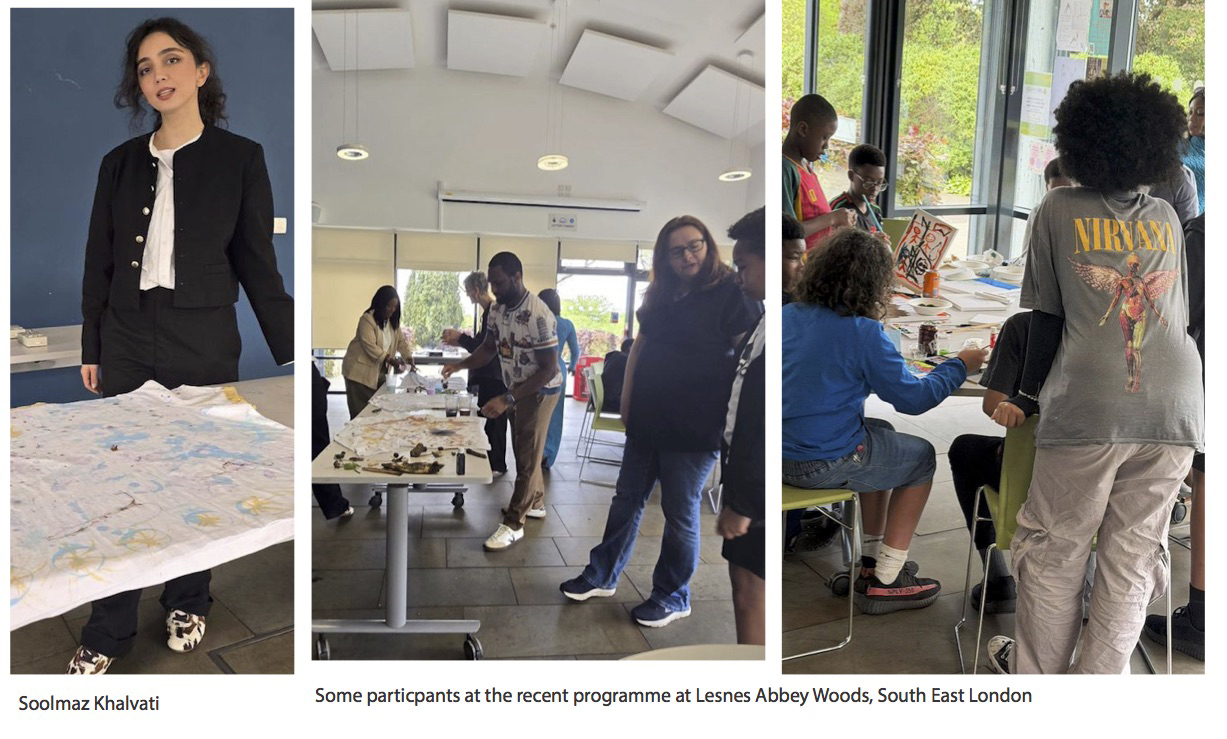
When the stories came to a close, the atmosphere shifted. Brushes appeared, colours were mixed, and natural materials gathered from the park were placed on the tables. This was the moment for Soolmaz “Suluk” Khalvati, an award‑winning Iranian jewellery artist whose work explores perception, memory, and the emotional life of materials. Her practice is rooted in the belief that creativity is not merely a skill but a form of emotional language, and she invited participants — children and adults alike — to explore that idea for themselves.
Suluk began with a quiet conversation about perception. She spoke about how we see the world, how our histories shape our responses, and how emotion can be translated into gesture and form. Drawing from neuroaesthetic and design research, she explained that perception is not passive but an active construction shaped by memory, emotion, and personal history. Jewellery, she said, is uniquely positioned to hold these internal states because it exists in direct relationship with the body — close to the pulse, the breath, the skin. It can carry memory, emotion, and psychological states in ways that other art forms cannot.
Participants stepped outside briefly to collect small objects that resonated with them: leaves, stones, twigs, fragments of bark. When they returned, the tables became a landscape of natural textures and pigments. White T‑shirts served as the canvas. Suluk asked everyone to express three emotional states — fear, hope, and happiness — using the materials they had gathered. Rather than representing objects literally, she encouraged participants to project internal emotional states outward, interpreting emotions through gesture, texture, and composition. The act of rolling, tapping, and immersing tools into colour became a form of embodied mark‑making, translating psychological states into visual outcomes.
Children painted freely, their colours bold and instinctive. They dipped leaves into pigment, dragged twigs across cotton, and pressed stones into fabric to create unexpected shapes. Their movements were unfiltered, expressive, and full of curiosity. Adults worked more slowly, dipping twigs into pigment, pressing leaves into fabric, dragging colour across cotton. The two groups influenced each other without realising it. A child’s splash of colour might inspire an adult’s quieter mark; an adult’s careful pattern might spark a child’s curiosity. The hall became a shared emotional surface, layered with traces of individual experience and collective expression.
What emerged was not a single image but a dynamic system of marks — a collective composition shaped by multiple cultural perspectives, varied emotional interpretations, and distinct personal histories. Individual gestures overlapped, visual dialogues formed between participants, and the work evolved into a layered group image. It was a reflection of how creative perception is both internal and socially responsive, how meaning emerges through process, and how art can become a bridge between people who might otherwise never meet.
The workshop mirrored the core stages of contemporary jewellery design, particularly within conceptual and narrative‑driven practices. Abstract emotional states — fear, hope, happiness — were translated into texture, structure, rhythm, and material interaction. Found objects became narrative tools, carrying meaning shaped by how they were selected, manipulated, and contextualised. The compositions created on the shirts could be reinterpreted as placements on the body, movement‑based structures, or layered wearable forms. Jewellery, in this context, became an intimate extension of the self — a wearable narrative shaped by perception, memory, and emotion.
What made the afternoon remarkable was not its ambition but its sincerity. Nothing felt staged. People moved easily between conversation and creation. Children painted while their parents reflected. Strangers collaborated without needing to speak the same language. The atmosphere was gentle, unforced, and deeply human. It was the kind of gathering that reminds a community of its own capacity for softness.
And it is here that the reporter’s mind inevitably drifts homeward — to Nigeria, to the cities and towns where community life is rich but often strained by economic pressure, social class divides, and the quiet erosion of shared spaces. One cannot watch children and adults creating side by side in a London hall without wondering what might be possible if practices like this were encouraged more deliberately in Nigerian communities. Not as grand programmes or government initiatives, but as simple, regular gatherings where people come together to listen, to make, to reflect, and to see one another without the armour of status or survival.
Events like this soften individualism. They loosen the grip of social hierarchy. They create a kind of horizontal space where a child, a parent, a stranger, and an artist can sit at the same table and contribute equally to a shared surface. In societies where class can dictate proximity, where people often move past one another without connection, such practices can become small but powerful. They build unity not through slogans but through shared experience. They create bonding communities, not imagined ones.
For those watching from afar — particularly within Nigerian and diaspora circles — the afternoon at Lesnes Abbey Woods offers a quiet but compelling lesson: community life is strengthened not only by infrastructure or policy but by the simple act of gathering with purpose. Children learned to name emotions through colour and story. Parents reconnected with creativity in a way that felt grounding rather than performative. Diaspora families saw themselves reflected in the voices leading the event. And for a few hours, a public hall became a place where people could slow down, listen, and make something together.
The collaboration between Jude Ukato, Joshua Omeke, and Soolmaz Khalvati worked because each brought something distinct. Jude brought the community and the literary grounding. Joshua brought the stories and the imaginative spark. Suluk brought the emotional and sensory depth of art. Together, they created a space where creativity felt natural, accessible, and quietly transformative.
In a time when many societies — Nigeria included — are searching for ways to rebuild trust, reduce isolation, and strengthen communal bonds, the afternoon at Lesnes Abbey Woods stands as a gentle reminder: sometimes all you need is a story, a handful of colours, a shared table, and the willingness to create together.