Follow Us on Google
By Merit Ibe
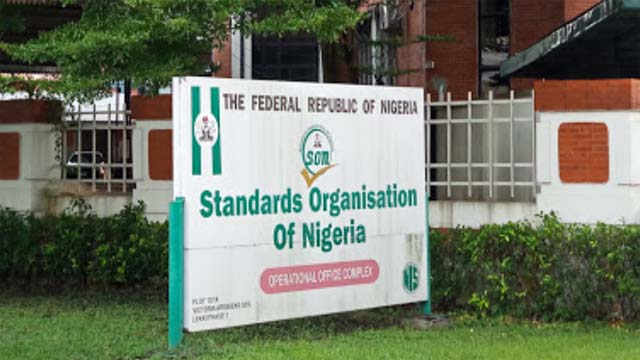
The Standards Organisation of Nigeria (SON) has charged Micro Small and Medium Enterprises (MSMEs) to up their ante on standards needed to attain the goal of home-grown economic agenda of the Federal Government.
The Director General of the organisation, Mallam Farouk Salim, who made the remark yesterday at the general sensitisation and training for MSMEs, themed: “Products Competitiveness: Driving Home-Grown Economy Via Standardisation,” noted that competition is what drives the world today, as in every sphere of life, there is serious competition going on and so if anyone has to compete, it means one must be ready, prepared and equipped to compete actively, effectively and profitably.
Charging participants that the ball is rolling in their court towards harnessing the benefits of the Free Trade Zone, Salim pointed out that the county require local products that are borderless; products that Nigerians in the diaspora, millions of them, can patronize; standard and quality products that are acceptable and competitive anywhere across the world, particularly in Africa. “Now that we are preparing for the common market- African Continental Free Trade Agreement (AfCFTA), Nigeria, the giant should not ‘carry last’ in AfCFTA.”
He explained that product competitiveness requires that the particular product must have been manufactured or produced in accordance with good manufacturing practice.
“The product must have undergone strict adherence to standards and quality assurance benchmarks and international best practices. We, in SON, ‘talk the walk and walk the talk’ of standardisation and quality control. We are promoting industrialisation and home-grown economy through standardisation.”
He emphasised that sub-standard products pose grave danger not only to lives and property but to the economic development of any country, noting that the reasons SON insists on standards adherence for MSMEs across the country are because
“standardisation results in industrial and economic growth, global acceptability and competitiveness of locally made products a.k.a made in Nigeria products and overall national development and security, among others.
In his goodwill message, Chairman, Nigerian Association of Small and Medium Enterprises (NASME), Adams Adebayo, applauded the program, saying this is the time the country needs standardisation, so that products can be widely accepted. “We need to be up and doing. Home grown economy could be achieved by us via standardisation.”
For his part, President, Association of Micro Entrepreneurs of Nigeria (AMEN), Iche Saviour, siad there cannot be standardisation without money, small businesses need loans with low interest rate to thrive.
“MSMEs have been neglected in the country. Government is going around the world canvassing for foreign investors, while local businesses are not encouraged. The MSMEs are in comma and need to be resuscitated.”
Vice Chairman,Nigeria Association of Small Scale Industrialists (NASSI) Lagos, Gertrude Akhimien, said MSMEs were going through a lot now.
She lamented that many small businesses have produced new products in the market that were not familiar with Nigerians and pleaded with SON to reach out to them and help develop standard for these new products as we move on to AfCFTA.
Akhimien also made case for SON to provide SMEs desk at the SON office for easy access, adding that SON should be an enabler for the SMEs to succeed.
She pointed out the need for industrial hubs to help small businesses to upscale production.” We need SON to talk to government to give us hubs. Industrial hubs where groups come together to produce products that are competitive. With the hubs, production can be upscaled.”
Other speakers made their points on promoting export and products competitiveness via quality labelling and package materials; Standardisation as an important tool for industrial development. They also threw more light on the theme of the day.
•