Follow Us on Google

•Nigerian youth shun apprenticeship, artisanal skills for quick money
By Oluseye Ojo
In recent years, Nigeria has witnessed a disturbing trend that poses a significant danger to its future prosperity. It seems that the calamity is inevitable, based on the value system that has taken a new dimension, especially among the youth, who are the leaders of tomorrow.

The conventional value system has always been that brilliant students, after their secondary school education, would proceed to tertiary institutions, while those that do not have the mental capacity to cope with rigorous tertiary academic activities would have to learn a trade in order to be relevant in the society.
As gathered, brilliant students, whose parents or guardians could not afford to sponsor for further learning after secondary schools also fall into the category of those that have been learning some trades.


The trade include carpentry, bricklaying, vulcanising, tailoring, car rewiring, panel beating, and those learning to become auto technicians, which is popularly known as mechanics.
Saturday Sun toured some workshops to know if young Nigerians that could not proceed to higher institutions have been learning some trades to become artisans, apart from millions of young Nigerians sitting for the Unified Tertiary Matriculation Examination (UTME) every year..

It was observed that a growing number of boys and young men who are unable to attend tertiary institutions have abandoned traditional paths to success. Many of them have turned to commercial motorcycle operators (Okada riders) and internet fraud, otherwise known as Yahoo Yahoo as means to make quick money.
Internet fraud, commonly known as “Yahoo Yahoo,” has evolved into a phenomenon that has engulfed the Nigerian society. The allure of fast and easy wealth draws young individuals away from their communities, education, and potential careers in the labour market.
The Nigerian youth, seeing the gap left by their unsuccessful parents and the lack of formal opportunities, use their computer skills to exploit unsuspecting victims globally.
The rise of the illicit activity is not only compromising the integrity of Nigeria’s technological landscape but also highlighting the urgent need to revive and prioritise technical and vocational training schools in the country.
At many of the workshops visited by Saturday Sun, it was lamentations galore by master artisans, who said they did not have apprentices that could learn and take over the trade after them.
Mr. Bayo Gbadeyanka repairs and fixes tyres in Akobo, Ibadan, Oyo State. He lamented that the job was gradually going into extinction, as young men were no longer interested in becoming vulcanisers.
His words: “Five years ago, I had up to seven apprentices.. But today, II have only one apprentice who is a secondary school pupil. He would join me here at the workshop when he returns from school. It is only on Saturday that he always come in the morning and leave in the evening. I don’t open on Sundays.
“With the ways things are going, car owners should go and learn about vulcanising because they will have to be fixing their tyres by themselves in the next five to 10 years. I don’t have any apprentice again. We vulcanisers have an association and we often talk about the lack of apprenticeship these days.
“From my own findings, two things have been drawing the young people away from undergoing apprenticeship. They are okada riding and ‘yahoo-yahoo’. They want quick money. In my workshop here, before I make N1,000, a commercial motorcyclist could have made N4,000. They make a lot of money in okada riding. But they make more money in ‘yahoo-yahoo’.
“We that are doing the job are getting old. There are no younger ones that we can hand over to. It is a major issue that Nigerians may not notice now. But a time is coming when the reality will hit us in the face, when the reality will dawn on us. From me, vulcanising is a tedious work. I am getting old. I cannot jack up vehicles to remove tyres the way I used to do. This means I must quit vulcanising as soon as possible. I am already gathering money to go into poultry business.”
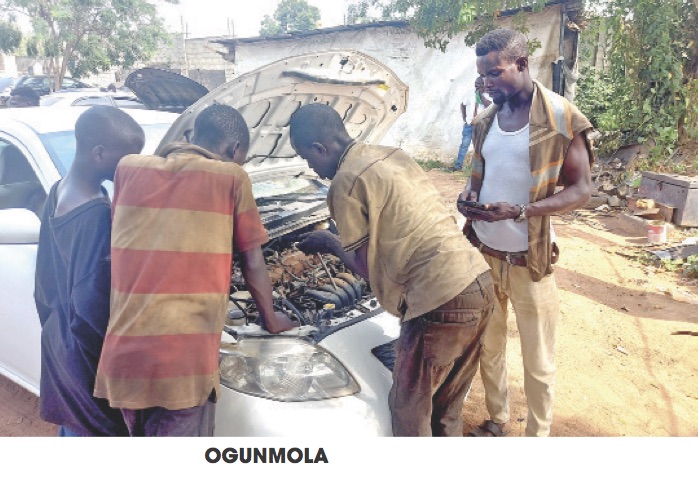
A motor mechanic, Emmanuel Ogunmola also told Saturday Sun that he was lucky to have up to five apprentices at the moment. He added that he fixes cars majorly for car dealers, which attracted some parents to send the children to his workshop to learn the trade.
“I have been in this job for 20 years. When I was an apprentice, we were up to 15 in my master’s workshop. But I have many of my colleagues too that did not have a single apprentice. They do what they have to do by themselves. This often delays jobs. They have to abandon whatever they are doing if they want to buy materials in the market. What kind of future do we have as mechanics? Gradually, we are phasing out. I don’t know how car owners will be able to fix their vehicles by themselves in the nearest future.”
The story is the same for a panel beater and auto rewiring technician, Sunday Osigwe, and Jelili Adisa. They expressed worries over the future of panel beating and rewiring in the country.
According to Osigwe: “I am a panel beater. But things are not moving the way it used to be. It is like drivers are being more careful on the road. On some occasions, I would not make up to N2,000 from morning till evening in my workshop.
“I used to have two apprentices. One of them spent two months, and did not come again. The next time I saw him, he has become a commercial motorcyclist. The second person just spent three months and said he has mastered the work. I said no. But he has also absconded. The next time I saw him, he was riding a good car. At that point, I discarded my initial thought that he would come back to complete the training. I gave up.. Now, I don’t have any apprentice again. I do everything by myself.”
Mr. Dapo Oladipupo, is another vulcaniser at Challenge in Ibadan. His story and thoughts were in line with the positions of other master artisans. He also said he was getting old and he has started to find it difficult to cope.
“I have been saving up to get a shop and stock it with tyres. I will just sit down in the shop and people will come and buy tyres. As a vulcaniser, I operate by the roadside.
“But one thing is very important. Some of us, we took after our fathers. But I cannot allow my children to take after me as a vulcaniser. I am sending them to school. They too should be educated. I want them to secure white-collar jobs. I want a good life for them.”
Mr. Yusuf Olaniyi is a welder that has been in practice for decades. He said: “When I was an apprentice learning welding, my master had 25 apprentices. We were all committed to learning the job then. We just wanted to be trained, get our freedom and start our own workshops. I learnt the job and I know it inside out.
“After my freedom from my master, I set up my own workshop. Initially, I had up to 10 apprentices. But about five years ago, the apprentices were just about five. Today I have one and a half apprentices. This is so because I have two apprentices, but one always comes regularly and the other one is a truant.
“What have seen is that the younger generation lack patience and endurance. They want quick money on daily basis. This is why they go into motorcycle riding for commercial purposes or they learn and become internet fraudsters.
“The danger is that if things continue like this, there may not be enough welders in the country very soon. Younger persons are no longer coming to learn and we are getting old.”
In the same vein, a carpenter, Mr. Amos Akinleye, said he was number 21 among the apprentices of his master when he was undergoing carpentry training.
His words: “I used to have three apprentices about three years ago. But today, I don’t have any apprentice again. I am the only one doing this job. The younger persons that came to learn were not serious. One of them left to ride motorcycle for commercial purposes.
“When I was an apprentice, our master used to give us money based on his discretion. But one of the boys that was brought to learn carpentry earlier this year asked me how much I would be giving him daily. Immediately, I knew he was only looking for quick money and not to learn welding or anything.”
Mrs. Ayobami Oyewo, a fashion designer at Bibilari, Bashorun, Ibadan, said she did not have any apprentice at the moment. She added that those that were brought to learn tailoring were not ready because they preferred quick ways to make money to the traditional path to success.
“I don’t know what is wrong with the youth of nowadays. Majority of them do not have patience, endurance, determination, and commitment to learn tailoring again. Majority of people that we see that have been coming to learn are graduates that want to have skills,” she said.
But the situation seems to be different somewhere else. A visit to the auto spare parts market at Agodi Gate in Ibadan revealed that many young boys and children under-18 children are apprentices in different clusters of shops in the place.
One of the auto spare parts sellers, Mr. Sikiru Egunjobi, said: “We are not in short supply of apprentices here. We have both the young and old coming to do apprenticeship here. There is no how you will be an apprentice here and you will not be making money daily. It depends on you. You will surely get some spare parts that you will pick and sell.
Elder Ajibola Alamu, a car upholstery maker, said he began the job in 1977. In his days, he informed, he, like others, was serious about learning then. “But today, things have changed. Majority of the youth that we have today do not want to work and they want to spend money. Here, I don’t have any apprentice. I do everything by myself
Mr. Bashir Abdullahi, the Chief Executive Officer, Excel 4891 Aluminium and Steel Company, Ibadan, stated that his company deals in fixing of sliding windows and welding. He said 15 years ago “when I was leaning the trade, I was apprentice number 25 in our master’s workshop.
“About 12 years ago, I became my own boss and I had three to four apprentices then. Now, I have three apprentices. Often, we would sit down in the shop for two weeks and no customer would patronise us. But we have the patience and the perseverance. But we are sure that whenever a contract comes, we will make a lot of money from it.”
Also, Mr. Taiwo Ogundiya, a bricklayer, said: “I am my own boss. I don’t have any apprentice. This is a tedious work. Many youth are running away from it.
“When I was leaning this business as an apprentice, we were seven with our master then. Now, I don’t have an apprentice. I move around. We bricklayers, we move around. You may hear that we are in Ibadan this month, and by next month, you may hear that we are in Makurdi or Asaba.”
Chief Mukaila Akintunde is a commercial motorcyclist and a fashion designer. He told Saturday Sun: “I am a tailor and I have my shop at Iyana Agbala, in Ibadan. But I live in Olorunda, after Akobo Oju-Irin. I have a motorcycle that I take to my workshop. But I was forced to start using the motorcycle for commercial operations when I would sit down in the shop and there might not be customers for three to four days.
“So, I started using my motorcycle for commercial purposes. I do the okada business every morning. When it is 12noon, I will go back to my shop. I would also leave by 5pm to make little money before going home. I have no apprentice. I do whatever I can do on my own.
“The crave for quick money is not solely the fault of our young ones. They have many responsibilities. They have dependants to take care. I have heard cases of parents taking their children to where they would be taught how to make quick money. Some parents depend on their young children to feed. The economy is also bad. It is a complicated matter.”
Mr. Ibrahim Yekini, an auto mechanic, recalled that he was one of the 15 apprentices that learnt the job from his master. After standing on my own, I still had a number of them. But about five years ago, I had seven apprentices. Today, I have two apprentices.
The government can assist us. We mechanics, we don’t have any stable place that we use as workshop. We can be driven out of our workshop at any time. This is also discouraging the youth to learn the work, apart from the crave for quick money. So, government should allocate land to us in different places as our workshops and we shall be paying necessary dues on the land.”
Mr. Ayodeji Adebayo, an electrical engineer, who was encountered at a vulcaniser’s workshop, said Nigeria would not have met itself in this type of situation if the government had been serious about running technical and vocational schools in the country.
His words: “There is no doubt about the fact that Nigeria will have problem in regards to shortage of artisans within five years. I can afford to buy a gadget to pump my car tyres if they go flat. But how do I fix the tyres when sharp objects have pierced them? How do I fix my car when it has mechanical fault? Then, maybe we shall be patronising companies that will charge us exorbitant amounts.
“But we should not have found ourselves in this position in Nigeria. If the federal and state governments have not been paying lips service to standardising technical schools in the country, the schools would have produced technicians and artisans that would have been contributing to the growth of the economy.
“If you opt for technical school, instead of completing your secondary school, stigmatisation is awaiting you. Pupils that are not too brilliant are often regarded as candidates for technical school. It may not be so in many instances.
“Another aspect that must be looked into is whether the existing technical schools are being funded to have required personnel and equipment to train our younger ones on their desired work.
“By and large, I will submit that the government should hand over running of technical schools to selected non-governmental organisations that have the wherewithal and technical know-how to operate technical schools. The government cannot run them very well. Federal and State cannot handle technical schools very well. The government has many things on its burner, such as fixing of roads, providing funding for the healthcare system, salary payment and so on. Nothing is free again in this country.”
Education and training, according to experts, play a crucial role in shaping an individual’s future. However, with limited places in higher education, institutions and a lack of financial support, a significant number of young Nigerians are left with limited options.
Vocational and technical training programmes offer a feasible solution. Empowering these individuals with the necessary skills to excel in various trades and professions would no doubt have a positive effect on the future of the youths and on the economy of the country.
A sociologist at the University of Ibadan, Dr. Oludayo Tade, noted that technical and vocational training schools hold immense potential for Nigeria’s youth. These schools, he said, equip students with hands-on skills, promoting technical proficiency, entrepreneurial spirit, and the cultivation of a productive work ethic.
He stated that by promoting vocational training, Nigeria could address the skill gap that plagues various industries, while creating a pool of skilled professionals capable of driving economic growth.
“To combat the rising tide of internet fraud and redirect the potential of Nigeria’s youth, a concerted effort must be made to enhance the status and relevance of technical and vocational training schools in the country.
“By overhauling and investing in these institutions, the Nigerian government can provide young individuals with alternative avenues for success and encourage them to pursue legal and productive career paths.
“The Nigerian government must prioritise the revitalisation and modernisation of technical and vocational training schools. This can be achieved by ensuring adequate funding, engaging qualified instructors, and offering current and relevant training programmes.
“Additionally, partnerships with the private sector and international organisations can provide resources, expertise and linkages to employment opportunities, further enhancing the value of vocational education.
“To counter the stigma associated with vocational training, public awareness campaigns must be carried out to educate parents, students, and society at large about the significance and enormous potential of vocational education.”
Tade said highlighting the success stories of individuals, who have prospered through vocational training, could inspire and encourage young Nigerians to consider these opportunities.
As Nigeria grapples with the rising menace of internet fraud, many have stated that the urgency to redirect the nation’s youth toward vocational training cannot be overstated. The government, alongside relevant stakeholders, must prioritise and invest in technical and vocational training schools to foster a skilled workforce capable of driving economic growth, they noted.
“By providing alternative pathways to success, the society can regain the trust and integrity that has been tarnished by the prevalence of internet fraud. Only then can Nigeria secure a brighter future for its young generation and propel the nation towards sustainable development,” Dr Tade stated.
In a recent study, entitled: ‘Technical and Vocational Education in Nigeria: Issues, Challenges and a Way Forward’, Prof Reko Okoye and Maxwell Onyenwe Arimonu, of the Department of Vocational Education, Nnamdi Azikiwe University, Awka, Nigeria, noted that technical education, as enshrined in the Nigerian national policy on education, is concerned with qualitative technological human resources development, directed towards a national pool of skilled and self reliant craftsmen, technicians and technologists in technical and vocational education fields.
They stated further that in Nigeria, the training of technical personnel has witnessed many challenges, ranging from policies, which have no bearing with the country’s problems, curriculum that has little or no relationship with workplace and social needs, embezzlement of funds meant for education development purposes, lack of teacher motivation, inadequate facilities, inadequate funding, brain drain, poor staff training , bribery and corruption.
The study noted that too much emphasis is being laid on university education in the country, which has always reduced the economic opportunities of those who are more work-oriented than academics. They added that not everybody needs a university education. The study revealed that many of the so–called ‘expatriate engineers’, receiving huge sums of money in dollars for road construction in Nigeria, are graduates of vocational colleges. They decried a situation whereby in Nigeria, the issue of technical and vocational education is not taken seriously.
“Technicians and all who pass through the technical-oriented institutions should be adequately and equitably remunerated. The dichotomy in the civil service between holders of ‘General Studies’ certificates and technical certificates must not only be eradicated as a matter of policy but in the thinking and attitude of government official. Technicians or technologists are not inferior to their counterparts. It is a matter of choice and we should make this known to our children right from the primary schools.
“There is an urgent need to overhaul the educational system in Nigeria. Investment in vocational and technical education and skill training must be accorded priority attention, since no country can favourably compete in the emerging global market place with poorly and unskilled labour.
“The Nigeria lawmakers, stakeholders in the education sector need to learn from the international experience as we struggle to establish a more responsive Technical Vocational Education (TVE) system as to meet the ever evolving demands of Nigerians towards our technological development.”