Follow Us on Google
From Juliana Taiwo-Obalonye, Abuja
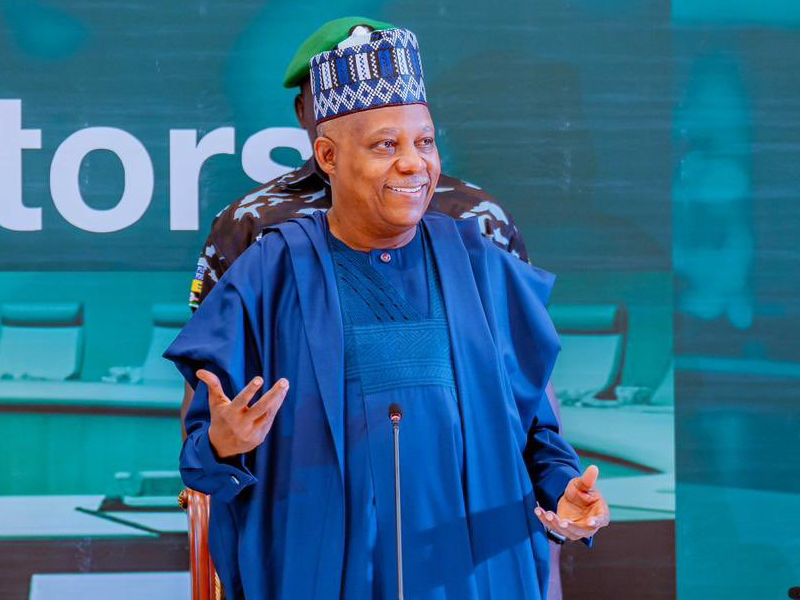
Vice President Kashim Shettima has warned about the state of Nigeria’s forests and its economic implications.
Speaking at the summit organised by the Presidential Committee on Economic and Financial Inclusion (PreCEFI) Secretariat, Office of the Vice President, Shettima said over 90 percent of Nigeria’s original forest cover has been depleted and over 400,000 hectares lost annually. “This is not just an environmental crisis; it is an economic emergency,” he said during the Nigeria forest economy summit 2025, themed: “Sustainability of Nigeria’s Forests: Unlocking the $2 billion potentials for economic and financial inclusion.”
The Vice President, who was represented by Deputy Chief of Staff to the President (Office of the Vice President), Ibrahim Hadejia, stressed that the country was at a crossroads, where neglecting forest resources directly impoverished the nation and its people.
“We cannot underestimate the importance of our forests. They are a treasure trove of biodiversity, timber, medicinal plants and other valuable products that underpin agriculture, trade, health, climate resilience and finance. Yet, this vast potential remains largely untapped,” he said.
He illustrated the global opportunities Nigeria risks missing if it fails to act decisively. “Look at Vietnam, earning over $15 billion yearly from forest exports. Brazil’s Amazon contributes 15 percent of their GDP from forests alone. Ethiopia has generated 350,000 jobs through reforestation and value chains. Nigeria should not only replicate these successes but lead Africa’s forest industrialisation,” he stated.
Shettima warned that ignoring the challenge was not an option. “Our forest depletion threatens economic stability, livelihoods and our global trading position. The European Union’s upcoming regulations forbid imports from products sourced on lands deforested within five years. Nigeria risks losing access if we do not embrace sustainable forest management now,” he said.
On the social front, the Vice President said: “Over 70 percent of non-timber forest product collectors are women and youth. By empowering women-led cooperatives and youth enterprises, we democratise economic opportunity and scale millions of jobs out of poverty.”
Revealing the governmental focus, he announced efforts “to align multiple agencies managing over 1,169 documented forests, 70,000 square kilometres of national parks and reserves, and initiatives like the Great Green Wall. By harmonising efforts and attracting investments, starting from $500 million, we expect to unlock up to $3 billion in forest economy potential.”
Shettima also called for innovation and inclusion, saying, “Embedding financial services in forest-based livelihoods will improve credit access, savings, insurance and digital tools crucial for the 30 million Nigerians, who remain financially excluded, especially women and girls.”
He envisioned a future where, “eco-industrial parks dedicated to bamboo, shea butter, medicinal plants and carbon verification emerge as economic pillars. Let us turn trees into trillions and forests into futures. This summit must be remembered not just as another policy dialogue, but as a turning point where we invest, innovate and industrialise our forest economy for sustainable national progress.”
The Vice President concluded by reiterating, “Our forests are not remnants of the past. They are the blueprint for our future. The time for bold action is now. We must protect, build with and invest in our forests for Nigeria to flourish.”
Founder and CEO of Netzence Sustainability Limited, Sadiq Sani, addressed the crucial role his company is playing, saying, “Netzence is contributing to providing the technology needed to unlock the potential of our $2 billion for Nigerian forestry. Our goal is to provide technology that allows us to measure emissions, the greenhouse gases (GHG) in our environment, and see how we can realise carbon credits for the environment as well. That is our fundamental aim.”
Expanding on the ways they achieve this, Sani said: “We are using our technology built for the forestry environment. We’re currently building models regarding forest composition and decomposition. This lets us understand emissions and greenhouse gas levels in the forestry environment, and also the amount of carbon credit it can realise. We are combining our technologies to build models that give us a true picture of emissions and their value in that environment.”
In response to questions about partnerships, Sani affirmed: “Absolutely, we are currently working with the Federal Government across the presidency and several ministries, like Livestock Development and the Ministry of Environment, plus agencies under the Ministry of Environment, etc. Together, we analyse the composition of greenhouse gases and monetise carbon credits in these environments.
“It’s not just about the environment, the impact is economic and societal for the people and in knowledge. We can’t do this without the support of the government and stakeholders across economic sectors.”
Minister of Livestock Development, Idi Maiha, in his goodwill message highlighted the critical need to align livestock development with sustainable forest management to foster economic growth and environmental resilience.
He emphasised that livestock is a crucial sector that must be addressed with renewed focus and collaboration.
Other News
Reflecting on the government’s initiatives over the past year, the minister noted, “Exactly one year ago, this administration unlocked the potential of the livestock sector by establishing the Ministry of Livestock Development for all Nigerians. Similarly, the Vice President is working to unlock the economic value of our forest resources. These twin unlocking events complement each other and are vital for our national agenda.”
Maiha outlined a comprehensive list of priorities to guide the sector’s growth. These include improving water quality through sustainable rangeland and forest management, reducing conflicts over grazing resources and water access by fostering peaceful coexistence and promoting climate-resilient, large-scale livestock production systems that safeguard the environment.
He stressed the need for expanded access to climate finance, carbon markets, credit, insurance and other financial services tailored for small-scale farmers, encouraging innovative and green financing models to support sector development.
Aligning with Nigeria’s commitments under the Paris agreement, Maiha reaffirmed his ministry’s focus on modernising systems to reduce pressure on forests, supporting the creation of pasture farms that harmonise with forest conservation efforts and promoting climate-sensitive practices designed to enhance productivity, while lowering emissions.
Further, he called for integrating digital technologies into landscape monitoring, forest supply chain management and livestock tracking to boost efficiency and sustainability. “Facilitating public-private partnerships and inclusive financing is key to empowering farmers and transforming the livestock sector,” he added.
Issuing a call to action, the minister urged all stakeholders to explore how sustainable forest management can improve the livelihoods of livestock farmers and pastoralists. He encouraged the development of policies that integrate forest and land management with livestock productivity and conflict prevention and stressed the potential of collaborative financing models to mobilise resources for joint forest conservation and livestock initiatives.
Maiha also highlighted the vital role of digital tools in ecosystem monitoring, early warning systems and extension services to support the sector’s resilience.
Closing his message, he assured participants of the ministry’s unwavering commitment to implementing the actionable recommendations emerging from the summit. “By working closely with relevant ministries, partners, private sector players and communities, we can transform Nigeria’s forests and livestock systems into engines of sustainable development, financial inclusion and national prosperity,” he said.
He appealed to the audience, saying, “Let us unite under the shared vision of a green, inclusive and prosperous Nigeria, where our forests are preserved, our natural sectors thrive and our people are empowered.”
Technical Advisor to the President on Economic and Financial Inclusion and Secretary of the Presidential Committee on Economic and Financial Inclusion (PRICIFI), Nurudeen Zauro, explained the broader government vision, “One part of Mr. President’s agenda is inclusivity. PRICIFI’s duty is to identify untapped opportunities; areas that have been silent and unlock them so we can achieve this goal.
“The essence of this meeting is to unlock economic potentials that exist in our borders. That’s why we brought together the ecosystem, the Border Community Development Agency, WEN Synergy, and local and international stakeholders, to expose the potential of our forests for sustainable economic and financial inclusion, in line with Mr. President’s renewed economic agenda.”
Zauro addressed concerns about representation, specifically for border communities. “The Border Community Development Agency is a composition of 21 states. Partnering with them gives us a single communication point, with all the governors involved. Almost half of these states are represented here. We believe these communities, which often feel excluded, must be included in renewing the national agenda. There’s so much economic potential and activity in these communities and bringing them into the ecosystem is essential,” he said.
Asked to clarify the financial figures, Zauro said: “I mentioned Nigeria’s journey to a $1 trillion economy by 2030; that’s the President’s target. The $2 billion refers specifically to the untapped potential within Nigeria’s forestry sector. That’s why we’re moving in this direction.”
Executive Secretary of the Border Communities Development Agency, George Kelly, spoke on the wealth of Nigeria’s Forests, saying, “Nigeria has over 10.6 million hectares of forest, natural, planted and reserves. We’re looking to convert that to wealth rather than let it go to waste, through carbon financing. The potential is more than $2 billion annually. Properly managed, it could approach $5.3, even up to $6 billion annually. That kind of revenue can fund several states. If we unlock that, we’ll achieve meaningful economic and financial inclusion at the rural and sub-national levels, lifting communities out of poverty. That is what we are aiming for.
“The next step is to bring together all government agencies related to forestry to get more precise data and take action on this opportunity.”
Chairman of Wen Synergies Nigeria Limited and fellow of the Nigerian Institute of Architects, Danny Sokari, emphasised the purpose of the summit, saying, “The awareness about how to generate that $2 billion is not yet there. Maybe the current approach to the green agenda needs adjusting. That’s why WEN Synergy organised this summit to raise consciousness, bring in stakeholders and collectively ask, ‘What can we do?’ We’ve seen ideas that were never thought of; people already have solutions at their fingertips. It brings a new consciousness on how to start.”
He underlined his point, saying, “If you just know about diamond but don’t know where to find it, and then someone tells you exactly where to drill and how much you can sell it for, you suddenly have the zeal to pursue it. What we’ve done is expose how to reach this $2 billion opportunity at the grassroots. In fact, $2 billion is too small; it is a conservative estimate. The potential can go as high as $10 billion, but we use $2 billion for prudence. Just consider: $2 billion is about ₦3 trillion. How many Nigerian states have ₦3 trillion annual budget? None.”