Follow Us on Google
From Adesuwa Tsan, Abuja
As Nigeria prepares for the 2027 general elections, an increasing number of sitting senators are either openly declaring ambitions for their states’ governorship seats or being strategically positioned by party stakeholders and grassroots groups as frontrunners. This accelerating migration from the legislature to the executive branch signals their evolution in political career pathways, an attempt to harness national legislative prominence to attain state executive leadership.
Daily Sun gathered that by January 2026, investigations revealed that at least 11 senators across different geopolitical zones with discernible ties to 2027 governorship ambitions. These senators are leveraging their legislative experience, strategic committee leadership, national visibility, and deep grassroots connections to build competitive bids.
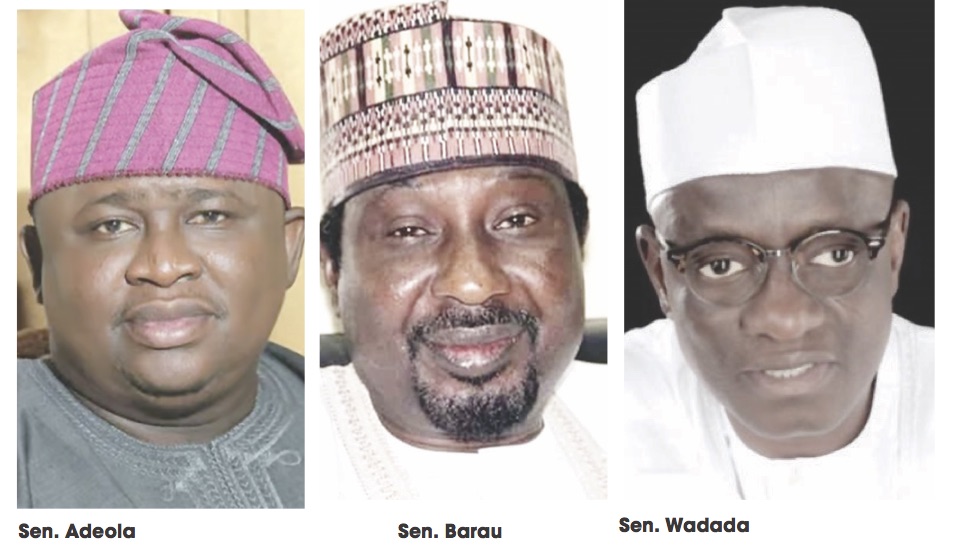
Barau Jibrin (Kano North) Deputy Senate President
In Kano State, the aspirational trajectory of Senator Barau Jibrin provides a clear example of how legislative leadership is being translated into state executive ambition. As Deputy President of the Senate, Barau occupies one of the most powerful legislative positions in Nigeria’s federal system, giving him significant national visibility and influence within the All Progressives Congress (APC). Barau’s supporters in Kano, including former local government chairmen, youth organisations, civic networks, and political pressure groups, have consistently been mobilising support publicly to spur him in the race for governorship in 2027. In rallies and stakeholder meetings across the state’s 44 local government areas, constituents have highlighted his exceptional interventions in health, education, security and youth empowerment as evidence of leadership capacity beyond the senate.
These appeals reflect grassroots energy rarely seen in Kano’s political landscape. Advocates have explicitly highlighted his extensive scholarship programmes, investments in health infrastructure such as the Aminu Kano Teaching Hospital’s specialised facilities, and security support such as donations of equipment to community policing units to signal readiness for executive responsibilities.
Crucially, this broad base of support comes amid indications of cracks in the dominant intra-state force, the Kwankwasiyya movement, a factor that political analysts suggest could sharpen Barau’s appeal, should he go ahead in his quest for APC standard-bearer. While he has not formally declared, the scale and depth of organised backing position him as one of the strongest senatorial contenders in northern Nigeria for the 2027 governorship cycle.
However, the recent defection of Governor Abba Kabir Yusuf from the All Nigeria Peoples Party (ANPP) to the APC appears to have thrown a big spanner in the wheel of his ambition.
Barau had risen through the APC ranks nationally, culminating in his current leadership post. A first-time gubernatorial attempt in 2027 would mark a significant career pivot, transitioning from federal legislative leadership to a state executive race.
Solomon Olamilekan Adeola (Yayi) – (Ogun West)
In the South-West, Senator Solomon Olamilekan Adeola, widely known as “Yayi”, also of the APC, is a legislative powerhouse loved by his people. He represents another high-profile example of this legislative-to-executive shift. His political voyage spans roles in the Lagos State House of Assembly, the House of Representatives for Alimosho, and two senatorial districts, first Lagos West and, as of 2023, Ogun West. Such geographic and legislative mobility reflects a long game in Nigerian politics: building broad visibility and influence before a major executive bid.
As Chairman of the Senate Committee on Appropriations, Adeola holds a powerful leverage point in federal budgetary oversight, which has further raised his profile both within the APC and in his home state. Political stakeholders have interpreted this as a precursor to a governorship bid.
Support within Ogun for his desire to take over from Governor Dapo Abiodun has come in varied forms. Prominent party chieftains such as Chief Bode Mustapha have publicly endorsed Adeola’s 2027 campaign, emphasising his community development records, from road interventions to solar street lighting, as evidence of his readiness for executive leadership. Those endorsements have framed him as a bridge-builder across the state’s three senatorial districts and as a unifier capable of inspiring broad support.
State political activists and media coverage increasingly refer to Adeola as the “incoming governor,” a phrase that reflects both optimism from supporters and perceived momentum within APC power corridors. In this context, both party elites and civil society figures have underscored his grassroots networks and unifying appeal as strategic assets in a competitive governorship race.
Adeola’s career across different legislative chambers and states has established him as a veteran lawmaker. If he contests in 2027, it will be his first formal bid for governor, and one strongly backed by tangible organisational support and endorsements.
Aliyu Ahmed Wadada – Nasarawa West
In North-Central Nigeria, Senator Aliyu Ahmed Wadada of Nasarawa West has actively signalled his intention to become governor of Nasarawa State in 2027. Unlike some figures whose ambitions are largely speculative or stakeholder-driven, Wadada has publicly articulated his goals in media interviews, framing his pursuit as a long-held aspiration anchored in his legislative experience and service record.
Chairman of the Senate Committee on Public Accounts, Wadada’s visibility in financial oversight has bolstered his reputation as a reform- minded legislator. His return to the APC, the dominant party in Nasarawa, from the Social Democratic Party (SDP), is to further his governorship prospects, a move interpreted by political analysts as a strategic repositioning for greater electoral competitiveness.
Wadada’s Senate career marks his first explicit pursuit of the state’s executive office, though his sustained public visibility and active engagement with party structures suggest a well-orchestrated build-up to the 2027 campaign.
Other News
Bauchi’s dual contestants: Shehu Buba Umar and Abdul Ahmed Ningi
In Bauchi State, the 2027 succession landscape is marked by two senators from opposing political parties, each garnering attention as a potential gubernatorial candidate.
Senator Shehu Buba Umar of Bauchi South, an APC stalwart and Chairman of the Senate Committee on National Security and Intelligence, has been widely discussed as a possible successor to the incumbent governor, Sen. Bala Mohammed. Analysts and political dispatches indicate that his role in security oversight and national legislative leadership has positioned him as a credible contender within the APC, especially amid strong support from party elites and grassroots mobilisation efforts.
On the other hand, Senator Abdul Ahmed Ningi of Bauchi Central, on the platform of the Peoples Democratic Party (PDP), emerges from a different political pedigree. A former Senate Leader and one of the most experienced lawmakers in the 10th Senate, Ningi has deep party networks, cumulative legislative experience, and regional recognition. These factors are frequently cited in identifying him as a likely PDP governorship aspirant.
Both senators’ movements highlight how intra-party competition will play out in states where cross-party dynamics, not just between parties, but within each party’s internal factions, could determine governorship outcomes. Neither Umar nor Ningi has previously held executive office, meaning 2027 would represent their first formal bids for governor.
Kwara’s dual contestants: Saliu Mustapha and Suleiman Sadiq Umar
Kwara State’s succession calculus is distinctive. Senator Saliu Mustapha of Kwara Central and Senator Suleiman Sadiq Umar of Kwara North have both surfaced in credible political mapping as potential heirs to Governor AbdulRahman AbdulRazaq’s seat. Mustapha, known as the Turaki of Ilorin, has a reputation for grassroots activism and significant support among youth and business networks, while Umar’s strategic alignment with the incumbent governor may give him a smoother path through party machinery.
Both figures reflect important state-level dynamic: the interface between senatorial ambition and existing executive politics, particularly in states where zoning, an internal party norm about rotating power among geopolitical zones, plays a role in shaping aspirants’ viability. Neither has previously contested a governorship, making their emergence part of a broader trend of first-time gubernatorial bids among senators.
Oyo’s contest: Abdulfatah Buhari and Sharafadeen Alli
Oyo State is another theatre where senatorial ambition dovetails with local political calculations. Senator Abdulfatah Buhari of Oyo North has publicly confirmed his intention to contest the governorship in 2027 and signalled that he will not return to the senate after his current term.
Meanwhile, Senator Sharafadeen Alli of Oyo South is widely mentioned in political reporting as another potential governorship contender. While Alli has not formally made a public declaration, his legislative work and extensive local engagements, including empowerment programmes and community interventions, have fuelled speculation that he is building substantive grassroots support ahead of 2027.
Oyo’s politics is also shaped by ongoing debates around zoning, particularly the demand for rotation of the governorship among different sub-regions within the state, which adds an additional layer to how senatorial ambitions may translate into electoral success or failure. Both are of the APC.
Emerging figures and broader trends
Beyond the core cluster of senators identified above, other senators including Mohammed Tahir Monguno and Kaka Shehu Lawan in Borno State, and Barinada Mpigi in Rivers State, have also been linked to governorship bids in 2027. Unlike others, these aspirations are often currently reflected more through supporter mobilisation and analysts’ discussion rather than formal declarations.
One of the most striking trends in the 2027 succession landscape is how legislative experience is being recast as executive credential. Senators, by virtue of committee leadership, national policy engagement, and constituency networks, are positioning themselves as candidates with both technical policy experience and broad public engagement, countering the historically common narrative that legislative leaders lack executive empathy.
Intra-Party competition and zoning dynamics
Intra-party conflicts and zoning discussions will play key roles in succession strategies. For instance, Ogun West’s long-standing agitation for political balance and rotation has helped build momentum for Adeola’s candidacy. In Oyo, zoning concerns about equitable representation across regions are influencing how contenders like Buhari and Alli are perceived. In Kwara, the interplay between Mustapha and Umar reflects strategic negotiation of power zones within the APC. These dynamics showcase how sub-state political norms interact with national legislative positioning to shape competitive landscapes.
Notably, most of the senators linked to governorship ambitions in 2027 are first-time gubernatorial aspirants. While some had nursed ambitions before, for many of them, there have been open declarations for the 2027 contest.
Whether these figures who will bring legislative gravitas, national networks and organisational resources to state-level aspirations ultimately translate them into victories at the polls will depend on intra-party negotiations, grassroots mobilisation, zoning arrangements, and the broader national mood as 2027 draws nearer.