Follow Us on Google

• Bamidele says 32 state assemblies okay amendment
From Adesuwa Tsan, Abuja
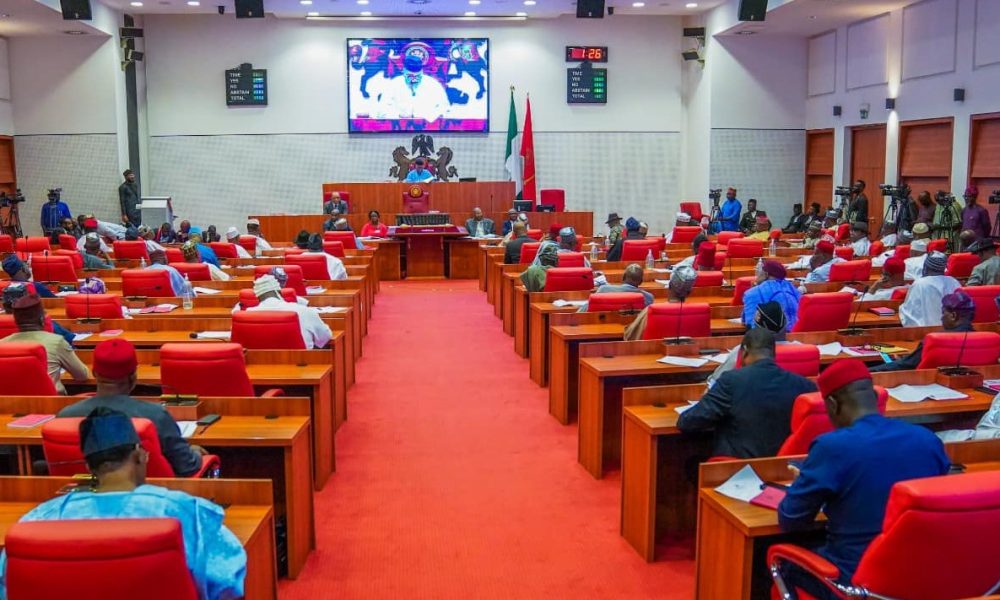
Senate Leader, Opeyemi Bamidele, has said the National Assembly will transmit the State Police (Constitution Alteration) Bill, 2026, to President Bola Tinubu for assent this week, following its approval by 32 State Houses of Assembly.
Bamidele said the legislature had secured more than the constitutionally required number of state approvals and would proceed with the amendment process irrespective of whether the four outstanding assemblies submitted their reports.
He spoke on Friday night while receiving The Sun Senator of the Year Award at Eko Hotels and Suites, Victoria Island, Lagos, describing the development as a breakthrough after more than 15 years of unsuccessful attempts to reform Nigeria’s policing system.
Under Section 9(2) of the 1999 Constitution, the proposed amendment requires the support of at least two-thirds of all members of each chamber of the National Assembly and approval by at least 24 of the 36 state assemblies. The 32 approvals announced by Bamidele exceed the state-level requirement by eight.
The Senate Leader said the National Assembly expected reports from the remaining assemblies as lawmakers prepared to resume on November 17, but maintained that the outstanding responses should not delay further action.
“This is a responsibility we must consciously discharge on behalf of our constituents and in the interest of national peace, progress, and stability,” he said. The latest figure represents an increase from the 30 approvals Bamidele announced during Senate plenary on November 4. At that sitting, the Senate gave the six assemblies whose responses were outstanding until November 15 to communicate their positions.
The proposed amendment seeks to replace Nigeria’s exclusively centralised policing arrangement with a framework allowing state police services to operate alongside the federal police.
Section 214 of the existing Constitution establishes the Nigeria Police Force and prohibits the establishment of another police force for the federation or any part of it, making constitutional alteration necessary for the proposed arrangement.
However, completion of the constitutional amendment would not automatically bring state police formations into operation.
According to the Presidential Working Group on the National Policing Bill, participating states would still require their own enabling laws and certification that their services meet national minimum standards. The proposed National Policing Bill is intended to provide the operational framework covering standards, certification, inspections, information sharing, complaints, accountability and transitional arrangements.
The Policy and Legal Advocacy Centre has also identified sustainable funding, protection against political interference and effective oversight as critical to the proposed system. It has urged the National Assembly to publish a consolidated record of authenticated state resolutions and clarify the bill’s transmission status.
Bamidele said the proposed system was not intended to create ethnic or state armies, but community-based policing structures operating within clearly defined constitutional safeguards.
He described the reform as part of the legislature’s commitment to anticipating national challenges rather than responding only after crises had occurred.
“I believe in proactive lawmaking. I believe Nigeria must move from reactive governance to proactive governance. I believe our laws must be evidence-based, efficiently implemented, effectively monitored, periodically reviewed, and ultimately measured by their impact on citizens,” he said.
Bamidele received the award from the Founder of The Sun Publishing Limited and Chairman of the South East Development Commission, Senator Orji Uzor Kalu.
Other News
He dedicated it to God, President Tinubu, the 108 other senators and his constituents, saying the recognition reflected the collective efforts of the 10th National Assembly rather than a personal accomplishment.
The Senate Leader, who was accompanied by serving and former senators, governors and political associates, said the legislature’s effectiveness should be measured by the impact of its laws rather than the number of bills passed.
He cited the student loan law, saying the Nigerian Education Loan Fund had disbursed more than N204 billion to applicants in 89 colleges, 108 polytechnics and 126 universities.
According to him, access to interest-free loans had helped students remain in tertiary institutions and reduced the risk of dropping out because of financial difficulties.
He also listed legislation on social investment, the minimum wage, tax reform, investments and securities, elections, insurance and regional development commissions among the major interventions of the current National Assembly.
The insurance legislation is the Nigerian Insurance Industry Reform Act, 2025, which Tinubu signed into law in August last year.
On relations between the legislature and the executive, Bamidele said separation of powers should not be interpreted as requiring hostility among the arms of government.
“Separation of powers is not about hostility, but synergy; not grandstanding, but collaboration; not dissension, but interdependence among the arms of government,” he said.
He maintained that he had discharged his legislative responsibilities independently while engaging constructively with other arms of government in the interest of national development, peace and security.
Bamidele also called for a collective response to what he described as the irresponsible use of social media, expressing concern over character assassination, blackmail and the deliberate circulation of false information.
While reaffirming his support for press freedom, an open parliament and engagement with journalists, he urged media organisations to help define standards for responsible information dissemination.
“We have seen characters assassinated. We have seen public institutions blackmailed. We have watched people deliberately distort facts. We have seen people unjustifiably peddling lies. We cannot fold our hands and allow this illegality to continue,” he said.
Bamidele, who said he had also been a victim, asked media stakeholders to consider whether digital platforms should remain unregulated despite their influence on public life.
“The urgent questions are: Should we leave unregulated this space that defines our lives in the decades to come? Or do we prefer a space where characters are assassinated daily, lies peddled, and public institutions unjustifiably discredited?” he asked.
He specifically urged the Newspaper Proprietors’ Association of Nigeria, Broadcasting Organisations of Nigeria, Nigerian Guild of Editors and Nigeria Union of Journalists to contribute to the discussion, saying information should be disseminated objectively and responsibly across traditional and digital platforms.