Follow Us on Google
By Adesuwa Tsan, Abuja
The amendment of the Senate Standing Orders last week may have been presented as just another routine legislative housekeeping exercise, but inside the Red Chamber, few senators were under any illusion about what was truly at stake. They understood the changes were about power, about a bid to control the 11th assembly. Indeed, the amendments turned the Senate rules into a leadership chessboard ahead of 2027.
But while the lawmakers were very clear on this, confusion built-up in the public on what the amendments meant. As reports emerged that senators-elect would be prevented from voting for presiding officers before taking their oath of office, the deeper significance of the amendments was lost – the quiet tightening of eligibility rules for Senate leadership positions ahead of 2027 and the continuing tradition of outgoing or sitting assemblies adjusting parliamentary procedures to shape succession battles within the National Assembly.
The controversy that followed the amendments exposed not only the political anxieties already building ahead of the next electoral cycle, but also the deep mistrust that usually accompanies any attempt by lawmakers to tamper with internal rules governing leadership emergence.
Clarity on rescinded amendment
Many reports misrepresented the altered rule that was reversed by the lawmakers; the now-rescinded provision that appeared to require senators-elect to first take their oath before participating in the election of Senate President and Deputy Senate President.
The interpretation sparked immediate outrage because it represented a sharp departure from parliamentary tradition dating back to the return of democracy in 1999, where senators-elect first elect presiding officers under the supervision of the Clerk of the National Assembly before taking their oath of allegiance.
Sensing the backlash, the Senate quickly retraced its steps. Leading the motion for rescission, Senate Leader Opeyemi Bamidele acknowledged the legal sensitivity surrounding the issue.
According to him, making oath-taking mandatory before voting “may give rise to constitutional inconsistencies and unintended tensions” with provisions of the 1999 Constitution, which provides that they may vote in their leaders before oath-taking. To clear the coast, the Senate must also amend section 50 of the 1999 Constitution of the Federal Republic of Nigeria, as amended.
The Senate therefore reversed only that aspect, allowing senators-elect to continue participating in the election of presiding officers before taking their oath. But while public debate focused on whether the reversal was in bits or wholesome, another amendment with far-reaching political implications quietly survived scrutiny And that provision may ultimately shape who becomes Senate President in 2027.
The clause that changed the game
Buried inside the revised Standing Orders is a new eligibility threshold for anyone seeking to become Senate President or Deputy Senate President.
Under the amended Rule 3(3), a senator cannot contest for presiding office unless he has “been elected and served as a Senator for at least two full terms of eight years, one term of which shall immediately precede such election.”
The language may appear technical, but politically, it redraws the battlefield and defines its players. Before now, being a ranking lawmaker simply meant prior membership of either the Senate or the House of Representatives, with the former ranking higher. Former House members who crossed into the Senate were regarded as ranking and could aspire to principal offices depending on party negotiations, zoning arrangements and political influence but the new amendment changes that equation.
Under the revised rule, being a former senator or House member alone is no longer sufficient. What now matters is continuity inside the Senate itself.
Consequently, only senators currently serving in the 10th Senate who successfully return in 2027 would qualify to contest for Senate President or Deputy Senate President in the 11th Assembly.
Incoming senators in 2027, including politically influential former governors, ministers and House members, have effectively been shut out of the race for the Senate presidency, thus creating an exclusive political corridor for returning members of the present Senate. Inside the chamber, lawmakers immediately understood what that meant. The race for 2027 had quietly begun.
For close observers of the National Assembly, the latest amendment is not novel. Previous assemblies have historically adjusted Standing Orders, especially close to transition periods, in ways that shape future power arrangements.
Sometimes the changes are subtle. Sometimes they are direct, other times, they are allegedly clandestinely done. But the underlying objective is often the same: protect institutional interests, preserve internal power blocs and prevent disruptive leadership contests.
The 8th Senate under former Senate President Bukola Saraki remains the most remarkable example. Emerging the Senate President in 2015 against the preference of the ruling APC leadership, Saraki presided over one of the most turbulent executive-legislative relationships in recent history. The 8th Senate repeatedly accused the executive of undermining legislative independence, while the Presidency viewed the Saraki leadership with suspicion.
During that period, amendments to Senate procedures became part of a broader institutional struggle over autonomy and control. His ascension to the leadership was largely believed to be hinged on a secret amendment procedure. He was alleged to have forged the Senate Rules which allowed the elections of the Senate President and the Deputy Senate President to be done via secret ballot in a bid to protect his supporters who were going against the wishes of his then party, APC, to vote for the preferred Ahmad Lawan, as Senate President.
During the 7th Senate, the rule was that the election could only be done openly via division, but overnight, it was alleged that Saraki connived with some people to change it without following the appropriate procedure of amending the Senate rules. So, when the then senators-elect of the 8th Assembly were to be sworn in, a brand new Senate rules book surfaced which slackened quorum and ranking requirements, in addition to the secret ballot voting system.
His successful rise to the position of Senate president altered the balance of power within the National Assembly for four years and since then, party leaders and parliamentary managers have planned ahead of the next leadership cycle. That determination partly explains the obsession with tightening internal procedures governing leadership emergence.
The 9th Senate under former Senate President Ahmad Lawan also introduced changes in the rules but they were procedural adjustments designed largely to ensure stability and alignment between the legislature and the executive.
Under Lawan, the Senate leadership prioritised internal cohesion, party discipline and predictable legislative processes. The scars of the Saraki era remained fresh, and many within the APC hierarchy preferred a tightly managed chamber to an unpredictable one.
Other News
The latest amendments under the 10th Senate therefore did not emerge in isolation. They are part of a continuing parliamentary culture where Standing Orders are regularly recalibrated to shape future leadership equations.
For many senators in the current Assembly, the amended rules offer something more valuable than procedure. They offer protection. Several former governors are already positioning for Senate seats ahead of 2027. Some are eyeing leadership positions as landing platforms after leaving office. Others see the Senate as a strategic centre of influence in post-governorship political life.
Ordinarily, such heavyweight entrants could dramatically alter the balance within the chamber and the new rules complicate those ambitions. Even if a powerful governor enters the Senate in 2027 with massive political backing, the amended Standing Orders would still render him ineligible for Senate President or Deputy Senate President as only returning senators from the current Assembly qualify. For incumbents, that is a major strategic advantage.
The amendment therefore strengthens the political value of re-election for current senators. Winning a return election in 2027 now comes with more than legislative continuity. It comes with eligibility for the highest offices in the Senate, if other hurdles are crossed.
That reality is already influencing political calculations across party lines. Within both the APC and PDP, conversations have quietly intensified around which senators are likely to return, which zones may produce future presiding officers and how current alliances inside the chamber could evolve ahead of inauguration in 2027.
Yet the substance of the amendments was not the only issue that unsettled lawmakers. The process itself also triggered discontent. Several senators privately complained that the amendments were rushed through without sufficient debate or consultation.
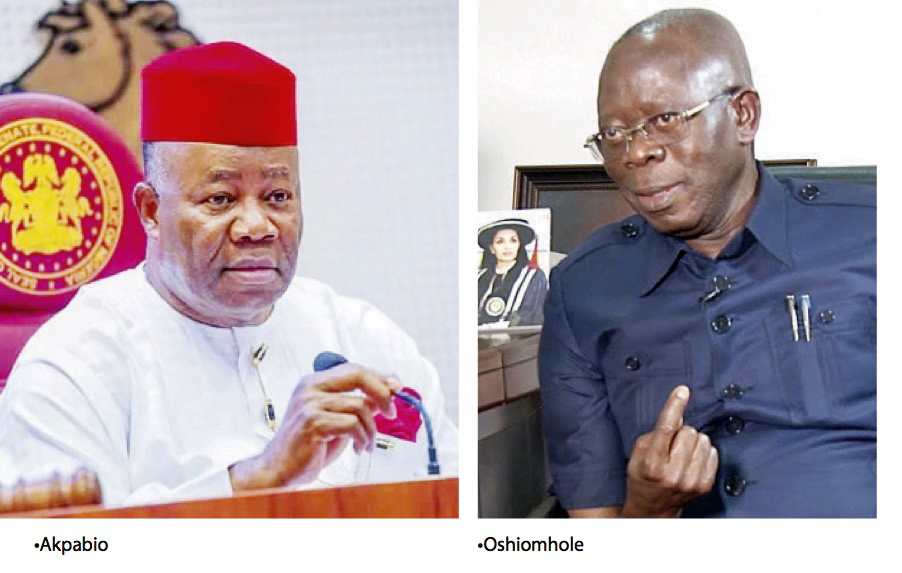
However, former Edo State governor and senator representing Edo North, Adams Oshiomhole, openly expressed concern over the amendment process, cautioning against hasty amendments to the Standing Orders which the Senate must avoid in order not to create rules capable of generating future controversy.
His intervention reflected broader unease among senators who felt shut out of discussions on amendments with long-term political consequences.
Inside the chamber, some lawmakers were particularly uncomfortable with the speed at which sensitive provisions were adopted. For them, altering rules governing leadership eligibility required deeper consultation and fuller debate, especially given the perception that the amendments appeared tailored toward specific political outcomes.
That frustration exposed an enduring contradiction within the Senate. They voiced their dissent when Akpabio called for voice votes to affirm their decision contained in the votes and proceedings with a loud nay but at the end of the day, the ayes had it.
While lawmakers often speak passionately about transparency and democratic procedure in national governance, internal parliamentary reforms are frequently handled through elite negotiations dominated by leadership blocs and influential caucuses.
The result is that Standing Orders often become instruments of strategic political engineering rather than purely neutral administrative rules.
14 days deadline for oath-taking
Even though the Senate eventually reversed the oath-before-voting provision, the initial amendment triggered anxiety for a reason. Had the provision survived, it could potentially have altered the dynamics of Senate inauguration.
Under the traditional process, all senators-elect participate in electing presiding officers before taking their oath. But if oath-taking became a precondition for voting, questions immediately arise over who controls the swearing-in process, who determines eligibility and what happens in cases involving pending litigation or disputes over certificates.
Critics feared the possibility of strategic exclusions.
A senator-elect facing unresolved litigation or administrative delays could theoretically be prevented from taking the oath early enough to participate in the leadership election itself. That fear explains why the backlash was swift and intense. By reverting to the old order, the Senate effectively neutralised a looming constitutional and political crisis.
Still, another amendment survived with relatively less attention but significant implications.
Under the revised rules, any senator-elect absent during inauguration has only 14 legislative days within which to take the Oath of Allegiance and Oath of Membership. Failure to do so may lead the Senate to declare the seat vacant and notify INEC for a fresh election.
Supporters say the provision is necessary to prevent prolonged vacancies caused by litigation, delayed appearances or political disputes but critics argue that Nigeria’s volatile post-election environment makes rigid timelines potentially problematic.
Election petitions sometimes drag for months. Court orders may delay inaugurations. Security crises can disrupt appearances. The Senate attempted to protect itself legally by inserting a caveat stating that any declaration of vacancy remains “subject to the provisions of the Constitution.”
Even so, lawyers are already divided on how the provision would survive judicial scrutiny if challenged in court.
Inside the National Assembly, rules are rarely just rules. They are signals, sometimes about succession plans, sometimes about elite anxieties, sometimes about protection and edging opponents aside.
For younger politicians In the race hoping to rise quickly through the parliamentary hierarchy, the new rules lengthen the waiting line. Last week’s amendments therefore tell a larger political story which will continue to unfold as the 10th Senate slowly winds down for 2027 election preparations.