Follow Us on Google
•FG admits N30trn revenue shortfall in 2025
From Adesuwa Tsan, Abuja
The Senate has expressed displeasure over Federal Government’s practice of implementing multiple budgets within a single fiscal year, describing the situation as unacceptable and unsustainable.
The lawmakers also directed the Federal Inland Revenue Service (FIRS) to increase its 2026 revenue projection from N31 trillion to N35 trillion, even as the Federal Government admitted a massive N30 trillion shortfall in its 2025 revenue target.
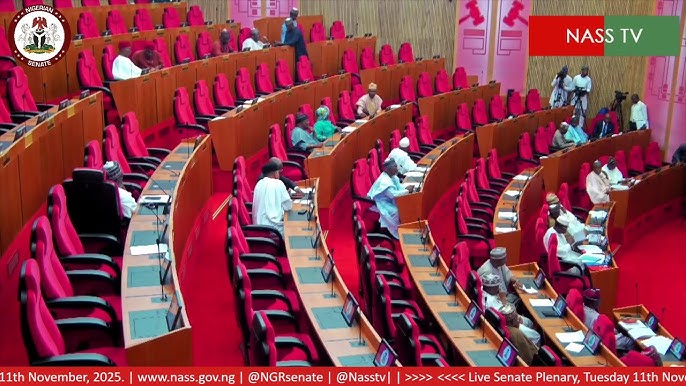
The concerns were raised during an interactive session between the Senate Committee on Finance and key economic managers over the 2026–2028 Medium Term Expenditure Framework (MTEF) and Fiscal Strategy Paper (FSP), yesterday.
Chairman of the committee, Sani Musa, presided over the session, which had in attendance the Minister of Finance and Coordinating Minister of the Economy, Mr. Wale Edun; Minister of Budget and Economic Planning, Senator Atiku Bagudu, Minister of State for Petroleum Resources, Senator Heineken Lokpobiri and Chairman of FIRS, Mr. Zacch Adedeji.
Explaining the revenue performance of recent budgets, Edun told the committee that while the Federal Government met its revenue projections for the 2024 fiscal year, the same could not be said for 2025.
According to him, out of the N40 trillion revenue target for 2025, only about N10 trillion had been realised so far, leaving a shortfall of N30 trillion.
“Funding for the capital component of the 2024 budget was achieved, with total revenue of N26 trillion realised. However, the 2025 budget has suffered significant revenue shortfalls.”
Edun added that the revenue gap had forced the government to roll over about 70 per cent of capital projects captured in the 2025 budget into the 2026 fiscal year.
The disclosure triggered sharp reactions from members of the committee, who decried what they described as a growing trend of multiple budget implementations in a single year.
Former Senate president pro tempore, Senator Danjuma Goje, said the practice was unacceptable to Nigerians and must be halted.
“This ugly situation where we are implementing two or even three budgets in one year must end. It is not acceptable. Things must be normalised from next year,” Goje said.
Similarly, Senator Olalere Oyewumi urged the executive to present only realistic and achievable revenue projections.
“The budget is not imposed on government by the people. If the proposals are not realisable, we will continue to see poor implementation and rollovers into subsequent years,” he warned.
Senators Victor Umeh and Ireti Kingibe questioned why revenue gaps were not being addressed through borrowings earlier approved by the National Assembly.
They wondered why such approved facilities failed to translate into improved funding for capital projects.
In his response, Senator Musa assured his colleagues that steps were being taken to normalise budget projections and implementation from the 2026 fiscal year.
He disclosed that the committee would set up a three-member ad hoc committee to liaise with the Minister of Finance and the Accountant-General of the Federation to ensure the settlement of outstanding payments to local contractors for projects executed under the 2024 budget before its expiration on December 31.
On revenue mobilisation, the committee chairman tasked FIRS to work towards a N35 trillion revenue target for the 2026 fiscal year, instead of the N31 trillion earlier proposed.
In his presentation, FIRS Chairman, Zacch Adedeji, disclosed that the agency generated N20.2 trillion in 2024 and N25.2 trillion in 2025.
However, he noted that the gains recorded by FIRS and other revenue-generating agencies, including the Nigeria Customs Service, were being eroded by repeated budget rollovers and multiple implementations within a single fiscal year.
Minister of Budget and Economic Planning, Senator Atiku Bagudu, and the Minister of State for Petroleum Resources, Senator Heineken Lokpobiri, defended the macroeconomic assumptions underpinning the proposed N54.4 trillion 2026 budget.
The parameters include an oil production benchmark of 1.84 million barrels per day, an oil price benchmark of $64.85 per barrel, and an exchange rate of N1,512 to the dollar.