Follow Us on Google

The coronavirus pandemic, like every national emergency or natural disaster, has thrown up many multi-faceted security challenges in every country around the world, thereby exposing certain unpalatable nuisances inherent among security services the world over, especially in Nigeria.
It is understandable that when there is a national emergency or disaster, government would use one of its forceful tools to address security issues that concern members of the public, especially when it affects civil regulations. A situation where security personnel suddenly turn bestial, hostile and wicked to their own fellow countrymen and women beats every sense of decency.
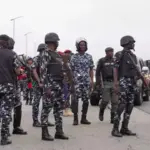
Hours after the presidential directive that three states: Lagos, Ogun and Abuja, the Federal Capital Territory, should be locked down while all residents in these states should be confined to their homes for 14 days, all the security agencies, the Nigerian Army, Nigeria Police and Civil Defence Corps and the Federal Road Safety Corps, were drafted to the streets and highways to implement the directive. To many observers, it looked as if some of the security agents were already thirsty for such assignment to be positioned where they had been dreaming and fantasizing on having a “clash” with members of the public.
Although none of the policemen and soldiers involved in the messy altercation with members of the public has been named yet, it is on record, and they must have read the story, many of such, where the police and army drafted to handle either student demonstrations or public demonstrations turned violent and later resulted in bloodbath.
They must have read stories of how their colleagues would drink themselves to stupor or smoke plenty lndian hemp before hitting the roads armed with live rifles to confront innocent harmless protesters. Of couse, they must have read also how the institutions never prosecuted defaulters, only to transfer them out of the state of incident, away from nosy reporters.
If all the reported unfortunate incidents and clashes in some parts of the country, sequel to the “Presidential Shutdown” were anything to be analyzed, one thing is apparent: there are relevant courses clearly omitted from the training syllabus in these security institutions. There is the urgent need for a total review of their syllabus to effectively inculcate the role for security personnel and other agencies to achieve their desired results or goal towards humanity. In a published article, Messrs Gary Lynch Wood and David Williamson both explore the impact of civil regulation on environmental behaviour. It shows that although civil regulatory pressures are generally subdued, and that conventional regulation continues to be an important driver of behaviour, there are circumstances where civil pressures nevertheless produce a ‘regulatory’ stimulus.
Where they do, it appears that civil regulatory pressures tend to derive from stakeholders pursuing relatively narrow self-interest (rather than public interest) mandates; and they normally target particular issues rather than ‘social responsibility’ in any broad sense.
The article further explores the impact of civil regulation on the environmental behaviour of people. It shows that, although civil regulatory pressures are generally subdued, and that conventional regulation continues to be an important driver of behaviour.
Where the crack became noticed in the presidential lockdown was the non-fulfillment of the promised palliative to the ordinary citizen. This crack, which is the concern of the people who are daily hustlers in the Nigerian society, generated a feud between the aggrieved citizens and the government who directed security agencies to be deployed to ensure full compliance.
The security pressure mounted at the begining of the exercise attracted public odium.
No wonder when President Muhammadu Buhari, the Commander-in-Chief, heard about the highhandedness of some of the security personnel deployed for the lockdown operation, he expressed dismay at the inhuman attitude of these security agents when he spoke through the Secretary to the Government of the Federation when he said, “No Nigerian should, on account of these rules, suffer any harm or pains during this period or any other time in our national life.”
Even the head of the Presidential Task Force found it very necessary to appeal to law enforcement agencies to deploy tact and caution in the course of enforcing the rules, even in the face of provocation.
Why it is worrisome is that politicians who are not initiated in security circuit are the ones spotting faults in an operational order. As if that is all, the cry of battered Nigerians rose to the Inspector-General of Police, just like the blood of Abel cried to God, when he issued a stern and strongly-worded statement, cautioned officers and men of the Nigeria Police Force deployed for the enforcement of the lockdown and social restriction orders to ensure that the rights of Nigerians are not infringed upon under any pretext.
Apart from all the coronavirus sermon from the office of the IGP, Nigerians believe that, with his pedigree as a former vice president of the International Police ( INTERPOL) his discipline and exposure should be brought to bear on the Nigeria Police.
These incidents should afford the police the rare opportunity to evict these bad eggs from the institution and such an exercise should be ongoing in the police in full public glare to serve as a deterrent to other twisted security personnel still lurking in the agencies. Report such incidents to the nearest police station.