Follow Us on Google
By Stephanie Omoarebun
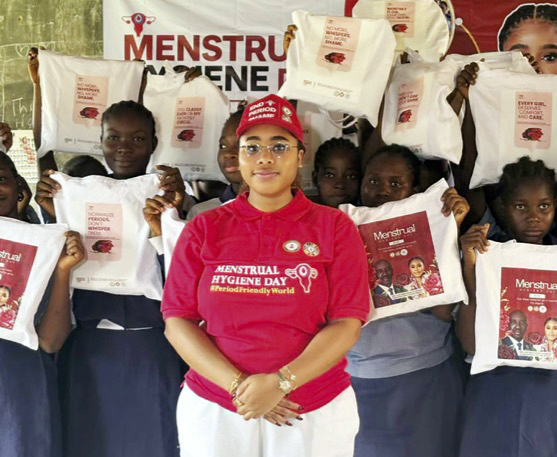
Since her appointment in January 2025 as Special Adviser on Sustainable Development Goals (SDGs), Sally Suleiman has made menstrual hygiene one of the most consistent, measurable and human-centred pillars of her public health advocacy. In less than two years, her interventions have reached over 10,000 schoolgirls across Edo State, beginning with the distribution of 5,000 sanitary pads during the Menstrual Hygiene Awareness Day on May 28, 2025, and followed by an additional 5,000 sanitary pads on May 28, 2026, in commemoration of Global Menstrual Hygiene Day.
But the numbers only tell part of the story. In several rural schools, teachers and facilitators reported that many girls previously relied on cloth, rags, toilet tissue, or improvised materials during their menstrual cycles. In some cases, girls missed school entirely for up to three to five days each month, not because of illness, but because of shame, discomfort, or lack of access to sanitary products. During one menstrual hygiene outreach and pad distribution exercise led by Sally Suleiman, students opened up to her, admitting that they would wrap themselves in old fabric and avoid standing up in class until school hours ended. These testimonies, shared in closed circles, underscored a reality often hidden from policy conversations: menstrual poverty is directly tied to absenteeism and low self-esteem.
Through Sally Suleiman’s intervention, this narrative has begun to shift. Girls who once stayed home during their cycles are now returning to school consistently. Teachers in selected participating schools have reported improved attendance records during menstruation weeks, alongside increased participation in classroom activities. In one school session, a student described receiving sanitary pads for the first time as “the moment I stopped being afraid of school every month.”
Beyond distribution, her approach integrates structured menstrual health education into school outreach programs. These sessions are designed to break silence, correct misinformation, and normalize conversations around menstruation. Girls are taught hygiene practices, pain management awareness, and the importance of self-care, while teachers are encouraged to sustain the conversation beyond the intervention days.
Other News
Her work is also data driven. By mapping schools and communities with the highest reported cases of absenteeism linked to menstruation, interventions are now more targeted, ensuring that resources are directed where the need is most urgent. This shift from general distribution to evidence-based planning marks a quiet but important policy evolution within grassroots SDG implementation.
Yet, Sally Suleiman has remained consistent on one point: government intervention alone is not enough. She has openly called for stronger private sector participation, urging corporations, manufacturers, and philanthropic organizations to treat menstrual health as a long-term development investment rather than periodic corporate social responsibility. In her framing, menstrual dignity is not charity, but infrastructure for human capital development.
What is emerging is a gradual but visible transformation: from silence to conversation, from improvisation to access, from stigma to dignity. For thousands of girls across Edo State, menstruation is no longer a monthly disruption that isolates them from education. It is becoming a manageable, supported, and dignified aspect of their lives.
And in that shift, a deeper truth is taking hold: when girls are supported through menstrual health, they do not just stay in school, they stay in their future.
•Omoarebun, a medical laboratory scientist and founder of The LabCoat Agency, writes from Abuja, FCT