Follow Us on Google
ν Why young Nigerians embrace killing for rituals
ν Ritual killing not part of traditional religion – Ifa priest
By Vivian Onyebukwa
In May this year, there was outrage when some vigilante operatives busted a native doctor who allegedly buried several people alive in a sewage pit in Umumba Ndiagu, a community in Ezeagu Local Government Area of Enugu State, purportedly for ritual purposes.
The suspect identified as Onyeka Obu, popularly known as Ozo Ezeani, as well as E dey play, E dey show, had the sewage pit located at an ongoing building site near his residence. He is also referred to as a ‘billionaire native doctor’.
The heinous acts, allegedly committed by the native doctor, was uncovered when two boys working for him abducted a 13year-old girl in the community. The girl (names withheld), narrated how the boys bundled her and zoomed off on their motorcycle in the presence of her father who could not pursue or trace the abductors. Her father was said to have reported the incident to the community’s vigilante group, thinking that his daughter’s abductors were kidnappers. Some vigilante operatives later spotted the boys holding the girl on their motorcycle and traced them to the native doctor’s apartment.
The native doctor initially attempted to deceive the operatives by expressing surprise over the incident before trying to bar them from entering his apartment, but the operatives forced their way into his ongoing building site when they heard the girl’s persistent cries. They searched the place and found her in the soak-away pit. Also discovered in the pit was the body of a pregnant woman, among several bodies.
Upon hearing the news, the chairman of Ezeagu Local Government Area, Enugu State, Vitalis Ndu, visited the native doctor’s apartment and saw the sewage pit. He was said to have reported the incident to the Enugu State Government for action, which led to the demolition of the native doctor’s apartment.
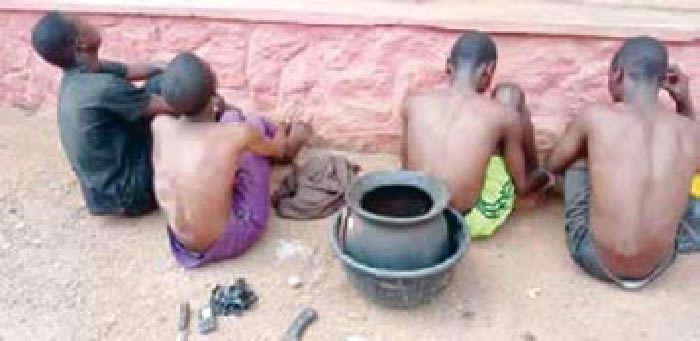
Also arrested by the police in Enugu in collaboration with local vigilante personnel and vigilant community members were three suspects linked to the incident.
In an attempt to evade arrest, the native doctor tried to flee the country on a motorcycle before he was arrested by the men of Nigeria Immigration Service (NIS) at the Badagry-Seme Border Area of Lagos State. He has since been handed over to the police.
Across the states, a rash of ritual killings
Onyeka Obu’s incident is not the only case of suspected ritual killings in Nigeria. Recently, there has been an increase in reported cases of ritual killings across the country.
In January this year in Nasarawa State, Timileyin Ajayi, who was said to be a gospel singer, allegedly murdered a 24-year-old lady, Salome Adaidu, and dismembered her body. He was caught carrying the severed head of his victim in a bag. When he was arrested by the police, other dismembered parts of the deceased’s body were recovered from his home. The deceased was identified as a member of the National Youth Service Corps who was serving in Abuja.
Also, in Kwara State, a final-year student, Hafsoh Lawal, was lured and killed by Abdulrahman Bello, a self-proclaimed cleric, and her boyfriend whom she met on Facebook. The suspect dismembered her for alleged ritual purposes at a location in the Olunlade area of Ilorin.
The headless corpse of a pupil was discovered by the roadside in Jikas-Dabaja village, Gwaram Local Government Area, Jigawa State. The body was mutilated, with the private parts removed, prompting the police to launch an investigation into the circumstances surrounding the gruesome act. They later arrested a 45-year-old suspect in connection with the crime. The suspect, a teacher of the deceased, was apprehended and detained following a tip-off.
There was also a case in Kagura, Rafi Local Government Area of Niger State where the police arrested four people in connection with the murder of a 13-year-old son of an Islamic scholar. The suspects reportedly lured the young boy to a secluded area where they removed his intestines and other vital organs after he had been murdered.
Why horror killings persist
Dr Stephen Nkwocha Elem, a lecturer at the Ebonyi State University, Abakaliki said the issue of ritual killings in Nigeria is no longer something that is far-fetched. “It is now staring us in the face and the sad part of it is that young people in their teens and early 20s are now the major players. It is no longer just about old men doing rituals in their village shrines. No, this generation has turned it into something else entirely. It has been normalised, almost fashionable. You now hear things like, “Na small thing remain make money show,” and they are not talking about business. They are talking about blood. They are talking about killing somebody to become rich overnight.”
Elem attributed the problem to internet fraud, known in local parlance as Yahoo- Yahoo. He lamented how it has destroyed more young people than even drugs in the country. He regretted that it has now grown into something more dangerous called Yahoo Plus (Yahoo mixed with rituals). According to him, these boys go to native doctors, spiritual men, fake prophets, and herbalists and they are told to use their girlfriends, mothers, brothers, even strangers, just to ‘fortify’ their accounts. “They are made to believe that if they use blood, their scam will work faster, or their ‘clients’ would be hypnotised to send them money.”
While describing it as heartbreaking, he noted that some of them do not do it because they are wicked, but because they are desperate to survive, to belong to a certain social class or to escape the poverty they were born into. Rising poverty levels and unemployment are also some of the identified reasons some youths commit such atrocities.
“A graduate who made first or second class upper is roaming the streets with brown envelopes, submitting CVs, trekking from one gate to another in the hot sun. Nobody is calling him. Nobody is giving him a chance. Then his old classmate who dropped out in 100 level is now in Lekki, Lagos, snapping pictures in a Mercedes Benz, spraying money at parties. What do you expect the serious one to think or to feel? Society does not celebrate hard work anymore. Society claps for anybody that has money; even if the person killed to get it,” the don pointed out.
Elem also blamed the trend on the use of social media.
“Every time a young person opens an Instagram or Snapchat account, what do they see? Pictures of boys wearing designer clothes, snapping in hotels, with big iPhones and half-naked girls around them. They post comments like ‘We no dey explain,’ or ‘God no go shame us.’ Meanwhile they are doing blood money. Some of them are not even up to 20 years old, but they are already living like drug lords. And because our young people are now addicted to validation and praise, they want that life too. Nobody wants to be called broke. Nobody wants to look like they are still struggling. So they start looking for shortcuts; and the most available shortcut now is ritual.”
While pointing out that the country has failed a lot of young people, Elem said that when there are no jobs, social welfare, affordable education, no working system, people would find a way to survive by force.
“The cost of living is high, but the opportunities are very low. Parents are crying, families are broken, some children are now the breadwinners of their homes, and they are doing all sorts of things to put food on the table. This is the reality. That is why when someone tells them that they can ‘blow’ overnight by just sacrificing a human being, they do not even think twice. They go ahead and do it. Not because they are evil from birth, but because they feel they have no choice.”
He went further to blame native doctors for their contribution to the menace by posting videos online, advertising all kinds of charms such as, “get rich in seven days; bring one finger and get ten million naira. Some of them are now on TikTok, openly calling on boys to ‘come and do the needful. It is so bad that even if a boy was not thinking of doing rituals before, these people are planting the idea in his head. What makes it worse is the fact that it sometimes works. That is the bitter truth. Some of them actually see money after doing it, and that success becomes a testimony that attracts others. It spreads like wildfire.”
To him, even churches have their own share of the blame. “If you go to some churches in slippers, they do not recognise you, but come with a car, wear agbada, and suddenly the pastor is calling you ‘our brother in Christ.’ They give you the microphone to share your ‘testimony,’ even if everyone knows the source of your money is questionable. So what message does that send? That it is okay to do evil, as long as you pay tithe. That it is okay to kill, as long as you can donate one million naira to the church building fund.”
He equally blamed some politicians and men in power as part of the problem. He said, before elections, one begins to hear cases of human sacrifices, missing children, and cases where they say a candidate was caught with a native doctor or human parts. “Why? Because they believe that killing someone will give them power or help them win the election. So if those at the top are doing it, how do you expect the ones at the bottom to behave? People are just following examples.”
Security agents are not left out in the blames. He called the justice system weak, pointing out that some suspects could be arrested today, and the next day they are released.
“Even when some boys are caught with human parts, and you think they will go to prison, the next thing you will see is that they are posting pictures again, smiling, because someone paid their way out. That gives other boys the confidence to try it too. They believe they will never be caught, and even if they are caught, they will come out in a few weeks. Ritual killings are not just about wickedness. They are also about a broken system; a nation where the poor are crying, and the rich are deaf.
“Until we start to fix the root causes – poverty, unemployment, social media pressure, failed parenting, poor religious teachings, bad governance, and lack of justice, this thing will keep happening. And it will get worse. We need to bring back value for human life and teach contentment again. We need to start celebrating integrity more than wealth, and make honesty fashionable again.”
Similarly, Dr. Emman, Usman Shehu, director, International Institute of Journalism, Abuja, blamed the trend on a number of factors. They include lack of education and widespread superstition, poverty and the desire for quick wealth as well as weak or inefficient criminal justice systems. He also noted that society has allowed these crimes to thrive by failing to adequately deter and prosecute perpetrators.

“Meanwhile, a modern consumerist ethos that emphasises luxury and admiration has fuelled the desire for rapid wealth, leading some to seek illicit means, including ritual killings. It is crucial to emphasise that ritual killing is a criminal act and a severe violation of human rights. While it may be rooted in distorted interpretations of traditional beliefs, it is widely condemned and does not represent the diverse and generally peaceful practices of African traditional religion.”
Other News
Again, Dr. Adeola Yusuf, a media consultant, said people go into ritual killings because of desperation and lack of contentment. According to him also, some are influenced by deterioration of society and humanity values.
“Some desperate individuals go into it because of peer pressure and lack of fear of God. They see it as an easy way to make quick money,” Yusuf added.
A soft skills trainer and tourism consultant, Ebele Enemchukwu, noted a number of things that contribute to the uncomfortable rise in the cases of ritual killings. Some of them include what she called an entitlement mentality, lack of staying power, loss of the virtue of patience to start something small, nurture it painstakingly to maturity, and the loss of hope.
Others, she said are lack of positive examples and role models, influence, pressure from ostentatious social media display, and the inability to discern the existence of the falsehood therein.
“As an example, and as humorous as some of the skits on social media are, a good number of them inadvertently encourage, or normalise ritual killings, such that the negative reaction from the mere mention of the word, ‘rituals,’ which before now would make one cringe, has almost become democratised and part of playful social media lingo.”
Enemchukwu, a one-time Mrs. Tourism UN pageant, perceives it as an irony that a person would believe that to achieve survival, which means to live and thrive, he/she has to snuff life out of another individual. “What better way do you describe how warped a thinking can be? It is sad, but beyond sad, is that it is disturbing, especially given the level of rampancy.”
She equally mentioned laziness as a factor, questioning how one can achieve a bountiful reward without making an effort.
“Peer pressure, the desire for power and influence, even if fleeting, greed, and a lack of contentment are factors. Impaired judgment and a weak moral compass are reasons that the repercussions of these heinous acts are not weighed. If they were, they would, to a large extent, serve as a deterrent. It’s easy to blame such vices on economic hardship, but truth be told, a person with strong moral values will less likely be swayed into vices, than those lacking in such foundations.”
She advised that patience is a virtue, asking people to trust in God’s promise of a better tomorrow, then back that faith up with diligent work in whatever one’s hands find to do, and even if it takes time, be assured that success will come.
Jevic Chukwuchebem Agbatu, highlights several factors contributing to ritual killings. They are poverty and economic inequality which can drive individuals towards desperate measures, including criminal activities. Others include the erosion of traditional values and the persistent belief in the efficacy of ritual killings, particularly in certain regions, which further fuel this heinous practice. According to him, the inadequacy of law enforcement, including underfunding, under-staffing, and corruption within the criminal justice system, hinders effective investigation and prosecution.
In combating ritual killings, Agbatu a fashion designer, said it requires a multi-pronged approach. This includes strengthening legislation with harsher penalties, enhancing law enforcement capacity through increased funding, training, and resources, and improving prosecution rates by providing greater support to prosecutors and witnesses.
He suggested that the government should actively engage with traditional healers, religious leaders, and community elders to address the underlying beliefs and practices that may contribute to ritual killings. The government should also establish and strengthen comprehensive support services for victims of ritual killings and their families.
A youth corps member serving in Ogun State, Emmanuel Njoku outlined the causes of ritual killings as poverty and desperation. He said many people facing extreme poverty believe ritual killings will bring quick wealth, power, or success, especially where job opportunities are scarce.
He also mentioned belief in superstition and traditional practices as causes, where some communities still hold strong beliefs in witchcraft or juju, thinking human body parts can bring protection, prosperity, or supernatural power.
Weak law enforcement, poor policing, corruption, or slow justice systems which can embolden perpetrators, who feel they can get away with it are all part of the problem.
Others, according to him include influence of some spiritualists and ritualists, fake prophets, witch doctors, or occult practitioners sometimes manipulate desperate individuals by promising miracles in exchange for human sacrifices, desire for political or social power and some belief that human sacrifices would give them influence, especially during elections or major business deals.
Comrade Emeka Anozie, an activist and youth leader, also blamed ritual killing on poverty and dwindling moral values system to the point that even seeing some parents support their children committing exam malpractices, Yahoo Yahoo, money rituals, prostitution, etc.
“For as long as they’re bringing in the cars, gifts, monies and building mansions all over the place, correcting them is no longer the norm. Some parents don’t ask questions about their children’s sources of sudden wealth until perhaps they are discovered to be criminals.”
Psychological perspective
Dr Eze Ogbonnia Eze, Department of Psychology Ebonyi State University, Abakaliki, looked at the psychological perspective on causes and motivation of ritual killings in Nigeria.
According to him, it has becomes essential to move beyond mere cultural and economic explanations to investigate the cognitive, emotional and behavioural processes that drive individuals to commit such heinous acts.
He said that ritual killings that involve the murder of individuals for spiritual or supernatural gains are not only criminal but also psychological phenomena that reveal a society’s collective mindset, identity crises, and distorted value systems. “My view on the rationale behind the surge in rituals killings and why people go into it is organised in five points. They include cognitive distortions and magical thinking. One of the major psychological explanations for ritual killings is the prevalence of magical thinking, a belief that one’s desires can be fulfilled through supernatural means, often bypassing logical reasoning.
“Individuals who commit ritual killings may hold cognitive distortions, such as over generalisation and illusory correlations, leading them to associate human sacrifice with wealth or power. These beliefs are often reinforced in early development through storytelling, cultural myths, and reinforcement from significant authority figures like spiritual leaders or community elders. From a psychological standpoint, such distorted thought patterns can be classified under irrational beliefs”
Views from a medical doctor cum Ifa priest
A medical doctor who doubles as an Ifa priest cum traditional medicine practitioner, Dr Oluseyi Atanda, has declared that ritual killing is not part of Yoruba customs and tradition.
“I stand to be corrected that the majority of ritual killers they have caught are fake. There is nothing like that in traditional religion, nothing like using human parts for ritual in Yoruba religion.”
Fondly referred to as Doctor Babalawo, Atanda noted that some of the people who believe in using human parts for ritual, comes from the biased minds of those who want to promote their home videos.
“I have been in this profession for over 40 years and I know the right and left. The person who says human parts are part of ritual should come out and prove me right. People who committed offence and were condemned to death have been killed by government. Their bodies are not returned to their families. Those killed by shrines too, their bodies are not returned to their families. Have people come out to question the government or shrines why they do that. We are not involved in the use of human parts for rituals. Some of the Muslims caught with human parts, the majority of Muslims have come out to say that they are fake Alfas. So also some of the pastors caught with human parts, majority of the Christians have come out to say that they are fake pastors.”
Police efforts in taming the tide
Sometime last year, the Force Public Relations Officer, Olumuyiwa Adejobi called on community leaders and traditional institutions to take a bold step in tackling the menace of ritual killings in the country. In a statement on his verified X handle, Adejobi emphasised the need for collective action to address the rising cases of ritual murders that have left many families devastated.
He drew inspiration from the successful collaboration with traditional institutions in combating the Badoo rituals in Ikorodu, Lagos. He stressed the need for community leaders and traditional institutions to be involved in the fight against ritual killings, as it is a spiritual issue that requires a holistic approach.