Follow Us on Google
By Omoniyi Salaudeen
These are not the best of times. The economic indices are grim and staggering. Worse still, there is no hands-on solution to the depressing situation the Nigerian masses have found themselves in. It is not peculiar to the Nigerian state though, the present government is particularly more challenged by the myriad of accumulated problems successive governments had left unattended to either for lack of capacity for innovative reforms or absence of political will.
But as the new administration of President Bola Ahmed Tinubu came on board and hit the ground running, people now hold a great deal of expectation for the change of narrative. This is more so with the new reform initiatives that have continued to receive applause both from within and outside the government circle.
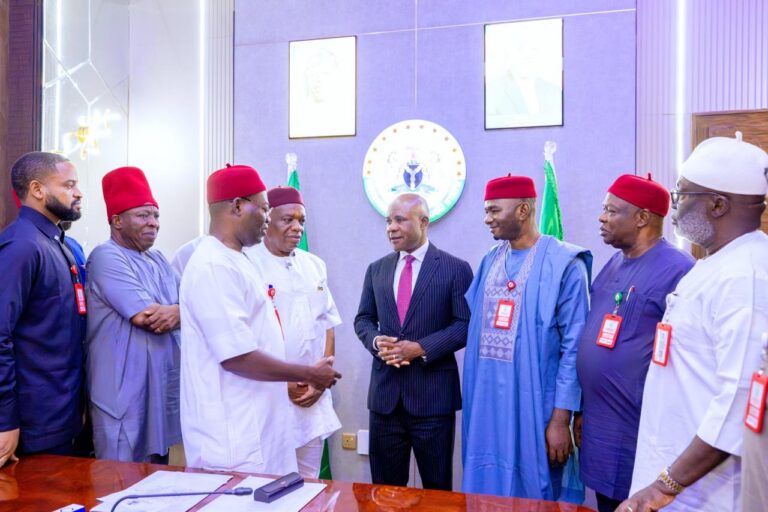
One of these is the constitution of the new National Economic Council (NEC) headed by Vice President Kashim Shettima. Some prominent members of the team include the group CEO of the Nigerian National Petroleum Company Limited (NNPC), Mele Kyari; the acting governor of the Central Bank of Nigeria, finance ministry chiefs, as well as the Accountant General of the Federation.
Due to the exigency of the time of its inauguration, therefore, the immediate task before the team is how to manage the new regime of fuel subsidy removal without the risk of dragging more people into poverty.
As the World Bank report already alerted, at least 7.1 million Nigerians may enter extreme poverty if the Federal Government fails to provide palliative measures after the fuel subsidy removal amid the prevailing economic challenges.
On assumption of office, Tinubu introduced fuel subsidy removal and foreign exchange window unification to shore up the revenue-generating capacity of the Federal Government. This has inadvertently resulted in a hike in the cost of transportation, as well as the prices of goods and services.
By projection, a whopping sum of N400 billion is expected to be saved monthly from subsidy removal, while the economic team is also looking at savings of about N2 trillion in six months (N333 billion monthly) from the recent changes in the FX rate used by Customs to calculate import tariffs, as well as gains from the big adjustment in the FX rate used to calculate receipts from crude oil exports.
All the same, there is a strong warning from the world financial institution of the likely consequences of not providing appropriate cushion measures for the rising 22.41 per cent inflation, adding that insecure households may lose at least 5,700 in income monthly subsequently. “The poor and economically insecure households will face an equivalent income loss of N5,700 per month, and without compensation, an additional 7.1 million people will be pushed into poverty”, the report stated.
It further explained that “many of the newly poor and economically insecure households will likely resort to such coping mechanisms as “not sending children to school, or not going to the health facilities to seek preventative healthcare or cutting back on nutritious dietary choices.”
With the threat of deepening poverty, the onus is also on the governments at all levels to work in synergy with the National Economic Council to liberate the people from the scourge.
President Tinubu made this appeal to the governors and council bosses to join hands together to achieve the goal of a vibrant economy. “You and I asked for it. We campaigned for it. We even danced to it. So, we have no reason to complain. Members of this country are behind us. They want reforms and they want it quickly. You here are stakeholders… Collaboration is not a crime. Please, let us do so,” he said.
Some prominent economic experts, who spoke with Sunday Sun, expressed optimism that the President’s signals would motivate the Economic Council to work for the actualization of the objectives of the reform policy of the administration to restore the country back to the path of growth and stability.
Prof Segun Ajibola, in his analysis of the outlook of the economy, described the coming of the Tinubu administration into the saddle as the dawn of a new era, expressing confidence that he would bring his corporate world experience to bear on the task of governance.
He maintained that with the right leadership, the economic team would deliver on its mandate. “It is the signal from the leadership as represented by the president that will dictate what happens at other levels. When the signal shows commitment, drive, action, political will, and courage to change things, it will simmer down. In this part of the world, fortunately, and unfortunately, people look up for direction. So, it is the body language of the man at the top and the capacity to work the talk that determines what happens subsequently.
“From the little we have seen so far, I am not sure that anybody who wants to be part of this administration must be ready and committed to moving with jet speed to do the right thing and to flow along with the leadership. So, if we are talking about the national economic team, we are talking about a team that is looking up to the direction of the leadership represented by the president with a signal that is showing light on the right path. The team does not have any other option than to perform and live up to expectations and be accountable for its task and responsibility,” he said.
Making further comparative analysis of the immediate past administration, he insisted that there would be a departure from the previous experience where the economic team constituted by former President Muhammadu Buhari was literally left idle for eight years without any clear-cut policy direction.
“It is difficult sometimes to compare personalities. If you look at the background, somebody that has been in the corporate world, somebody that has seen it all and knows what it is to drive strategy, you cannot expect the posture and the attitude of the past to this kind of assignment to remain the same. That is a major plus for the country at the moment. Whosoever is prepared to be part of the administration whether as an economic team or ministerial will have it at the back of his mind that it can no longer be business as usual in Nigeria again. I am quite hopeful that we would see a new dawn,” he posited.
An Economic policy analyst and CEO, Flames Academy and Consulting Limited, Mr. Orji Udemezue, decried the attitude of the previous administrations in treating the advice of the economic team with reckless abandon and said the outlook of the economy under President Tinubu looked promising.
His words: “For me, having an economic team is not new in Nigeria. Even during the tenure of former President Muhammadu Buhari, we had an economic team headed by Vice President Yemi Osinbajo. But it became irrelevant in the scheme of things because the President always had a different plan from what the economic team would give him. You can have the best economic team, if you have a bad leader, the team can do little or nothing.
“Having said that, it is a good thing to note that the current president, Bola Ahmed Tinubu, has also put together an economic team headed by the Vice President, who is also a very well-known banker. In terms of competence, Nigeria does not lack the capacity to formulate policies. What remains to be seen is how much of the policies the president will faithfully adhere to and execute.
“To give it to this current president, the few policies he has taken, even though they are coming at the same time, worsening the condition of Nigerians, these are policies that ought to have happened in the past. Now, it looks like they are hitting the ground running, showing that Nigeria is ready to reform. In view of the recent reforms we have seen vis-à-vis subsidy removal and the attempt to bridge the gap between the official and parallel market rates, we can now begin to see an end to the big racketeering where people would do nothing but use their contacts to buy dollar from the Central Bank at N460 and there and then sell at N750, making almost N300 million from every $1million dollar they are able to get.
“Though the policies have brought some untold hardship to Nigerians, I plead that they (Nigerians) should bear the brunt a little more and see if things will straighten up. In the medium to long term, FX market will improve and over time, dollar to naira exchange rate will stabilize over time.
“If they are able to get good ministers and other political appointees in place, where mediocrity is put down and excellence is promoted in whatever appointment they make, I think there is a positive outlook for this economy in the medium to long term.”
However, to cushion the effect of the subsidy removal on the populace, he advised the government to immediately work out palliatives that would reduce the current suffering.
“I beg this government to approve allowances for civil service workers to enable them to cope with the high cost of living. Right now, people are hungry, people are suffering, people are depressed and people are getting frustrated. So, help needs to come immediately to reduce the suffering. I must also add that the difficulty being experienced is not peculiar to Nigeria alone, it is a global issue occasioned by political issues here and there. But Nigeria needs to do something to ameliorate the hardship people are going through right now,” he added.