Follow Us on Google
From Ndubuisi Orji
However, the House of Representatives descended into chaos yesterday, as it rescinded its earlier position by now rejecting the mandatory electronic transmission of election results in the amendment of the Electoral Act 2022. This sudden change of position led to members of the opposition political parties staging a walkout from the plenary.
The House also approved direct primary and consensus as the only methods of nomination of candidates by political parties, against indirect primary, direct primary or consensus prescribed by the Electoral Act 2022.
The Green chamber, in December 2025, passed the Electoral Amendment Bill, making real time electronic transmission of election results mandatory. Nonetheless, the Senate rejected mandatory electronic transmission of results. Ironically, amid calls for the Conference Committee set up to harmonise areas of differences to adopt the House version of the Electoral Act Amendment Bill, the Green Chamber jettisoned its earlier position on mandatory transmission of election results.
Indication that the House was headed for a heated session emerged early in the day, following a sharp disagreement over a motion for the rescission of the Electoral Act 2025, with lawmakers taking positions along party lines.
The speaker, Tajudeen Abbas, at the resumption of plenary yesterday had told lawmakers that the session was called to enable lawmakers to attend to issues relating to the Electoral Act Amendment because of its importance.
Thereafter, Abbas called on the chairman, House Committee on Rules and Business, Francis Waive, to move a motion for the rescission of the Electoral Amendment Bill 2025, passed by the House last December. However, when the speaker subjected the motion to voice vote, the majority voted against the rescission of the bill.
But, Abbas ruled in favour of those in support of the rescission of the proposed electoral law. The ruling led to an uproar with members shouting at themselves and stalling proceedings for several minutes.
After efforts to calm down the agitated members failed, the speaker directed that the House revert to an executive session at about 11.36am.
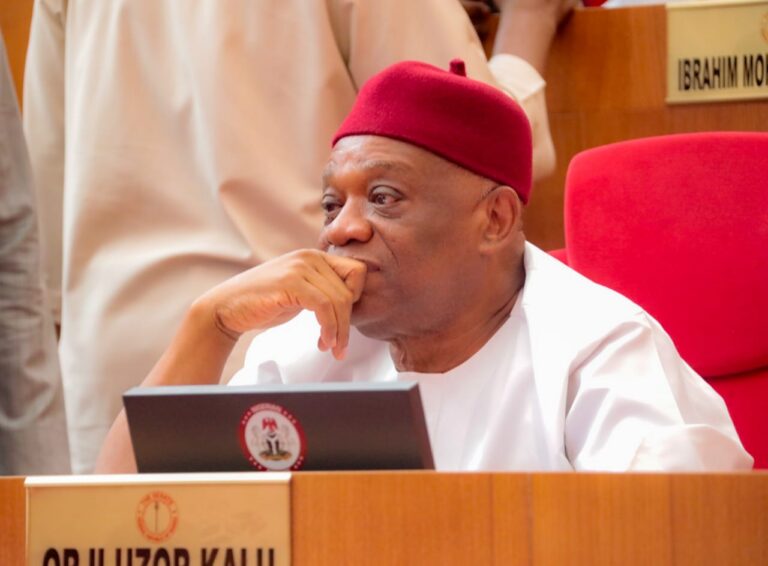
However, when the House resumed plenary at about 1.19pm, members had become calm, with the House reverting into the Committee of the Whole. Not long after, the House descended into chaos again, as lawmakers insisted that the deputy speaker, Benjamin Kalu, who chaired the Committee of the Whole should take the bills one clause after another.
Kalu, at the inception of the consideration, had grouped the clauses beginning from clause one to 20 and thereafter, clauses 20 to 40. The deputy speaker later succumbed to pressure and started taking the bill on a clause-by-clause basis.
Other News
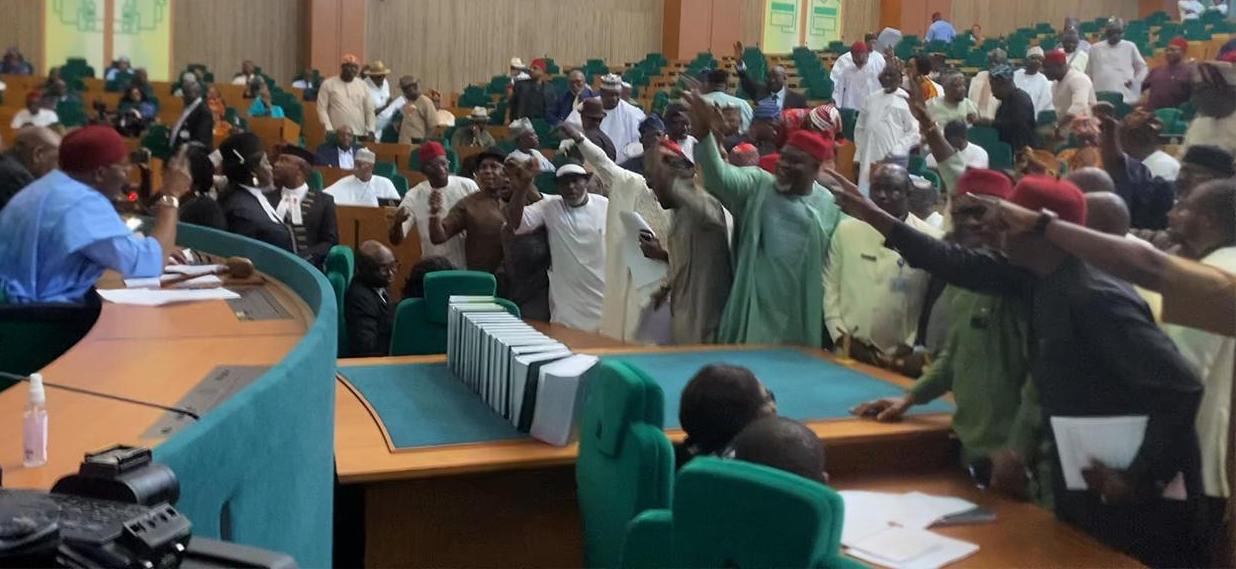
The House became charged once again, when it got to clause 60. Immediately Kalu got to clause 60, there were shouts of ‘no’ and ‘carried,’ with lawmakers across party lines, getting up from their seats and gathering in front of the deputy speaker’s seat.
As tension mounted, the opposition lawmakers started chanting, “APC ole. APC ole,” with members of the All-Progressives Congress (APC) retorting “opposition, ole.” The development stalled the consideration of the bill for several minutes.
The bone of contention is Clause 60(3), which provides that, “the Presiding Officer shall electronically transmit the results from each polling unit to IREV portal and such transmission shall be done after the prescribed Form EC8A has been signed and stamped by the Presiding officer and/or countersigned by the candidates or polling agents where available at the Polling Unit.
“Provided that if the electronic transmission of the result fails as a result of communication failure and it becomes impossible to transmit the result contained in form EC8A signed and stamped by the Presiding Officer and countersigned by the candidates or polling agents, where available at the polling unit, the form EC8A shall remain “the primary source of collation and declaration of the result.”
When normalcy returned, the lawmakers divided themselves, with members of the ruling party sitting on one side of the chamber and opposition lawmakers sitting on the other side. When the question on Clause 60 was eventually posed by Kalu, the majority voted in favour of the clause.
Subsequent moves by the opposition lawmakers to propose amendments to Clause 60(3) was shut down by the members of the ruling party. In reaction, the opposition lawmakers staged a walkout from the chamber, while the APC lawmakers sat back and continued the consideration of the Electoral Act Amendment Bill.
The minority leader, Kingsley Chinda, told journalists, after the walkout, that the position of the opposition remains that election results should be transmitted electronically, saying they were against any proviso that would give room for mutilation of results and rigging. Chinda added that the minority caucus also have reservations over Clause 84, which restricts political parties to direct primary and consensus as the means of nominating their candidates for elections.
According to him, “Our position is that elections shall and should be transmitted electronically. We are against any clause that will give leeway for any untoward act. Again, there is also Section 84, which has to do with the primary elections. Our position remains that the method of selection of candidates should be an internal affair of parties. Political parties should be allowed to determine what method they want to adopt.”
The spokesman of the House, Akin Rotimi, while briefing journalists on the outcome of the plenary, said the divergent views by lawmakers on some aspects of the Electoral Act Amendment Bill were not unusual in a democracy. He said there was nothing to fear about Clause 60(3) of the proposed Electoral Law.
“If you look very carefully at the provisions and the way it was worded, it is such that if we have stable internet and IT infrastructure, if we have everything working well, then we don’t have anything to fear. And I think that the media plays a role in also making Nigerians understand that. It’s only a fail-safe position that was created in the event that it doesn’t, but if it does pass, if it does transmit, then we don’t have any reason to have any concern,” he stated.