Follow Us on Google
By Haliru Ali Musa.
The Cartography of Collapse and Resurrection
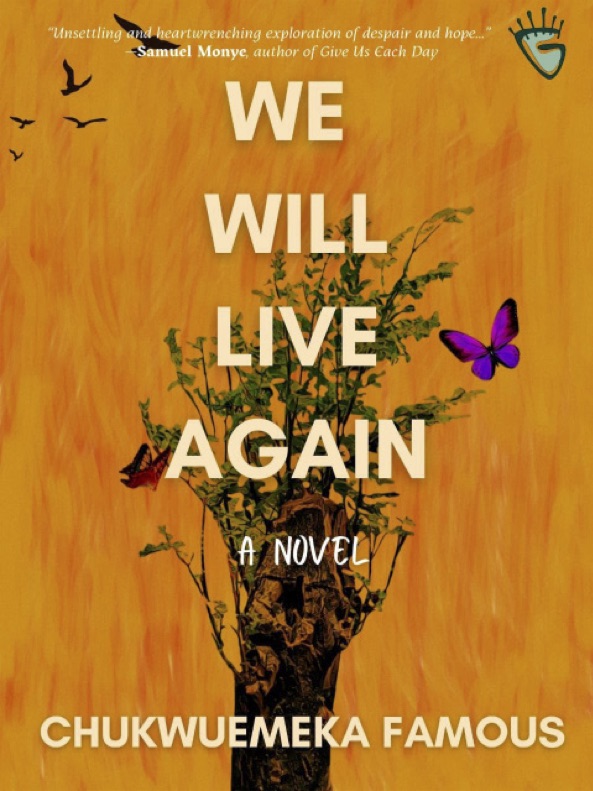
Chukwuemeka Famous’ We Will Live Again operates as both intimate family chronicle and national allegory, mapping the intersections between personal trauma and collective memory in post-Biafran Nigeria. Within postcolonial African literature, authors frequently write back against colonial narratives, yet Famous achieves something more complex —he excavates the spiritual and psychological archaeology of a family caught between competing cosmologies, tracing how war’s aftermath manifests not merely in broken infrastructure but in fractured belief systems.
The novel’s architecture mirrors its thematic preoccupations. Opening with Papa’s death and closing with his burial, Famous creates a structural ouroboros that suggests cyclical time rather than linear progression. This temporal design reflects Igbo cosmological concepts whilst interrogating Western narrative conventions —a technique that positions the work within contemporary African literary discourse that challenges Eurocentric storytelling frameworks.
The palimpsest of faith
The novel’s most sophisticated achievement lies in its treatment of religious syncretism as both survival mechanism and destructive force. Papa’s transformation from evangelical preacher to broken patriarch traces a theological trajectory that encompasses three distinct phases: fervent Christianity (pre-war), crisis of faith (during conflict), and complete moral collapse (post-war). His final prophecy—”butterflies will come”—functions as the novel’s governing metaphor, suggesting resurrection while simultaneously invoking fragility.
Famous demonstrates remarkable psychological acuity in depicting how trauma manifests across generational lines. Papa’s forced execution of a prisoner during the war becomes the novel’s pivotal moment, shattering his evangelical certainty and precipitating his descent into alcoholism and domestic violence. This scene operates on multiple symbolic registers: the corruption of spiritual authority, the impossibility of moral purity during wartime, and the ways in which violence becomes hereditary.
Mama’s pivot towards traditional Igbo spirituality represents not mere reversion but strategic adaptation. Her collaboration with Nmachi in blood rituals and divination practices reveals how colonised subjects navigate between imposed and indigenous belief systems. The novel’s treatment of these practices avoids both romantic idealisation and dismissive condemnation, instead presenting them as complex responses to Christianity’s failure to provide adequate protection or meaning.
The topography of trauma
Famous excels in his portrayal of how national crisis permeates domestic space. The Biafran War functions not as a distant backdrop but as an invasive presence, seeping into family dynamics and reshaping intimate relationships. The novel’s movement through various locations—from Owerri to Kano to refugee camps to ancestral villages—maps both geographical displacement and psychological fragmentation.
Particularly striking is Famous’ rendering of the refugee camp experience. His descriptions of kwashiorkor-afflicted children and international aid workers capture the dehumanising aspects of humanitarian intervention whilst avoiding simplistic victimisation narratives. The presence of photographers documenting suffering introduces meta-textual commentary on the commodification of African trauma for Western consumption.
The ancestral compound in Mbaise serves as a crucial symbolic space, representing both refuge and entrapment. Famous skillfully employs the physical decay of the mud house to mirror the family’s moral deterioration, yet the space retains sacred significance, becoming the site of both Papa’s burial and Woha’s final assertion of inheritance rights.
The dialectics of memory and witness
Woha’s role as narrator presents the novel’s most complex interpretive challenge. His apparent passivity—frequently criticized as frustrating—actually functions as a sophisticated literary strategy. His position as witness rather than active participant reflects the psychological fragmentation experienced by child survivors of collective trauma. His inability to intervene in domestic violence scenes captures the paralysis that often accompanies overwhelming crises.
The novel’s treatment of witnessing aligns with African literary theory’s engagement with resistance discourse, though Famous complicates traditional narratives of heroic opposition. Woha’s resistance manifests not through direct confrontation but through memory preservation and narrative reconstruction. His final departure from the compound represents not defeat but the assertion of alternative authority—the power to tell the story differently.
Linguistic texture and cultural translation
Famous demonstrates considerable skill in rendering Igbo cultural concepts accessible to broader audiences without sacrificing authenticity. His incorporation of indigenous spiritual practices, kinship systems, and cosmological frameworks creates rich cultural texture whilst avoiding ethnographic exposition. The novel’s code-switching between English and Igbo terms creates linguistic authenticity without alienating non-Igbo readers.
The butterfly metaphor deserves particular attention for its cultural specificity and universal resonance. In Igbo cosmology, transformation and rebirth operate according to cyclical rather than linear models, making the butterfly an apt symbol for the novel’s exploration of death and renewal. Famous deploys this metaphor with restraint, allowing it to accumulate meaning across the narrative rather than imposing heavy-handed symbolism.
Critical Limitations and Textual Tensions
Despite its considerable strengths, We Will Live Again exhibits certain structural vulnerabilities that prevent it from achieving unqualified critical success. The novel’s middle sections occasionally succumb to repetitive pacing, particularly in depicting Papa’s domestic violence. Whilst these scenes serve important thematic purposes, their frequency risks dulling emotional impact through over repetition.
The novel’s treatment of gender dynamics, whilst generally sophisticated, occasionally relies on conventional gender binaries. Mama’s transformation from submissive Christian wife to empowered practitioner of traditional religion follows somewhat predictable patterns, though Famous complicates this trajectory through her complicity in Papa’s final humiliation.
More significantly, the novel’s conclusion, while thematically resonant, feels emotionally under-developed. Woha’s decision to leave the compound deserves deeper psychological exploration. His final thoughts about butterflies and resurrection suggest hope, but the emotional register remains curiously detached, potentially limiting reader engagement with his ultimate fate.
Contemporary relevance and literary positioning
We Will Live Again contributes meaningfully to contemporary African literary discourse by examining how postcolonial subjects negotiate between indigenous and imposed cultural systems. The novel’s exploration of religious syncretism speaks to ongoing debates about cultural authenticity and hybrid identity formation in postcolonial contexts.
Famous’ treatment of the Biafran War avoids both romantic nationalism and complete historical pessimism, instead focussing on the war’s psychological aftermath and its effects on family structures. This approach aligns with recent trends in African literature that prioritise personal experience over grand historical narratives whilst maintaining awareness of how individual trauma connects to collective memory.
The novel also engages productively with questions of literary form, employing circular narrative structure and symbolic repetition in ways that challenge Western literary conventions whilst remaining accessible to diverse readerships. This formal experimentation positions the work within contemporary African writing that seeks to develop distinctive aesthetic approaches rather than merely adapting European models.
Conclusion: The grammar of renewal
We Will Live Again succeeds as both literary achievement and cultural document, offering nuanced exploration of how families and communities reconstruct meaning after devastating loss. Famous’ butterfly metaphor ultimately transcends mere symbolic ornamentation to become the novel’s philosophical centre—representing not naive optimism but the difficult possibility of transformation through acknowledgement of damage.
The novel’s final image deserves extended consideration: Woha walking away from his ancestral compound whilst villagers whisper about family destruction, yet carrying within him the memory of his father’s prophetic words about butterflies returning. This moment encapsulates the novel’s sophisticated understanding of survival—not as simple endurance but as the capacity to imagine alternative futures whilst bearing witness to irreparable loss.
Famous has created a work that honours the complexity of postcolonial experience without succumbing to either romantic nostalgia or despairing nihilism. We Will Live Again demonstrates that the most profound resurrections occur not through miraculous interventions but through the patient work of memory, imagination, and the stubborn persistence of hope in the face of overwhelming evidence for despair. In this delicate balance between fragility and resilience, the novel finds its deepest truth and its lasting value.
*Haliru Ali Musa is the inaugural winner of the Alex Nderitu Prize for World Literature. He manages ‘The Long View,’ a weekly column for Naira Magazine where he expresses cultural truths through introspective essays. He has been published in the Akpata Literary Magazine, Naira Stories, Kalahari Review, The African Griot Review and the Asian Journal of Literature