Follow Us on Google
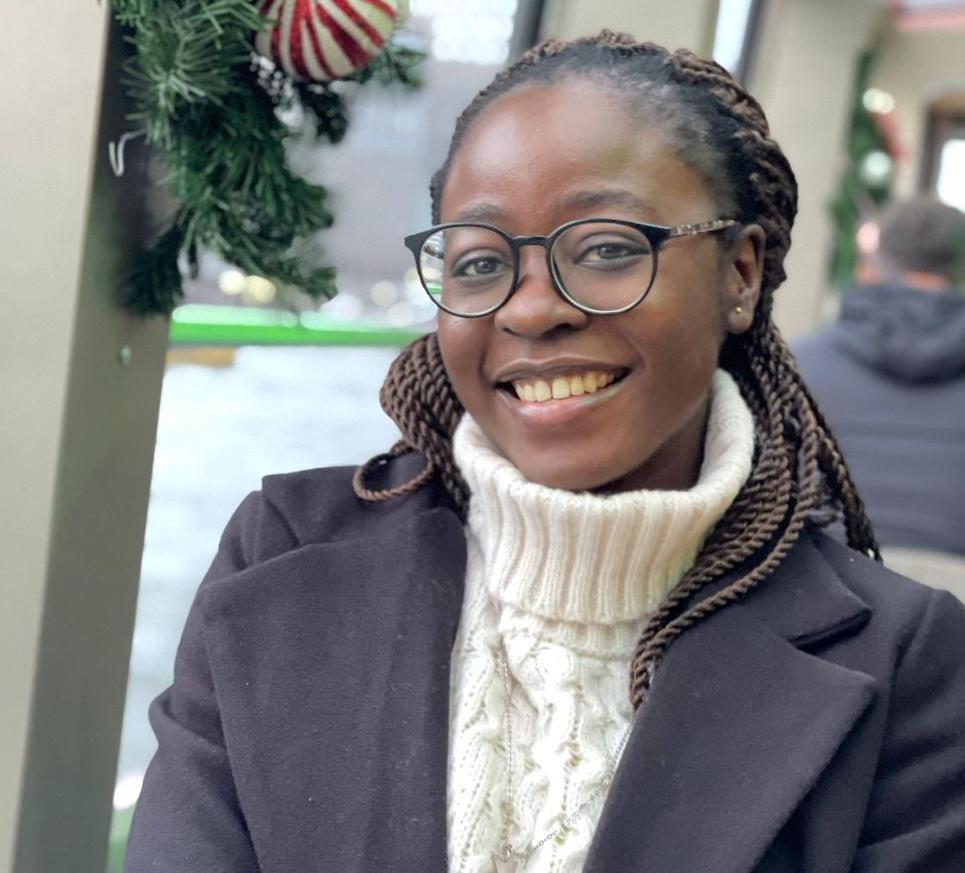
By Kareem Islamiyat
In the ever-evolving landscape of television and film, few visionaries have managed to leave an indelible mark like Nisola Jegede, a distinguished scriptwriter, editor, and dramaturg whose work has reshaped the way stories are told.
With over a decade of dedicated craft, her journey is a testament to how passion, resilience, and innovation can push the boundaries of storytelling—a journey that is both rooted in tradition and revolutionised by daring creativity.
From the early days of her career,
Nisola Jegede exhibited an extraordinary talent for creating awe-inspiring narrative, revealing the raw essence of human experience. Her scripts are celebrated not just for their compelling plots, but for their depth, authenticity, and social consciousness. Also, her storytelling style seamlessly weaves together the personal, social, cultural, and political, giving voice to those often unheard, and inspiring audiences to see the world through new lenses.
Her remarkable talent has earned her numerous awards and critical acclaim. She has been behind several acclaimed TV drama series and films—each project a testament to her signature approach: stories that are rooted in cultural consciousness, yet revolutionary in their scope and impact. Her work challenges stereotypes, questions conventions, and invites viewers into worlds that are both familiar and utterly transformative.
As an editor, Nisola Jegede is renowned for her meticulous craftsmanship.
So, how did it all began, her journey into dramaturgy and creative writing? You asked.
“I grew up surrounded by several forms of storytelling especially films,” she enthused.
“I was fascinated by the way moving images could hold an audience captive, but I also noticed how rarely I saw African stories on screen that reflected the richness I knew from where I lived. I remember watching movies that shaped global culture and thinking, where are our stories? That is, movies that truly reflect us. That question pushed me to write.”
“Dramaturgy and other forms of storytelling came naturally as part of that process,” she added, noting that her inspiration has always been rooted in African traditions.
But what drew her to cross-cultural narratives and African traditional stories is the tension and beauty in how stories shift when carried from one context into another.
African traditions are full of layered myths, philosophies, and humour that I wanted to re-imagine for the screen, as living, breathing narratives. Film allows me to merge those with contemporary storytelling techniques, giving both African.”
Among her several credits as a scriptwriter and dramaturg include ‘Voiceless’ and ‘Conversations In Transit’, to which she contributed significantly. Speaking about ‘Voiceless’, which was released in 2020, she recalled how she was deeply involved in script development and dramaturgy, adding that she worked on restructuring Act II to tighten the midpoint and ensure the story’s tension escalated logically towards the climax.
“I rewrote scenes to sharpen character motivations and revised the climax dialogue so that the emotional confrontation carried both dramatic intensity and cultural authenticity. I also cut and re-ordered certain sequences to improve pacing, ensuring the narrative moved with urgency but without losing its emotional depth. Part of my work involved writing continuity notes and character bibles so that the emotional through-lines were sustained across multiple drafts.
Because the story was based on insurgency-era experiences, I paid close attention to dialogue, redrafting exchanges to avoid sensationalism and to reflect the reality of speech patterns in northern Nigeria. The process was both demanding and rewarding; it challenged me to integrate script mechanics with ethical storytelling, balancing craft with responsibility.”
On Conversations In Transit (shot in 2022 and released in 2024), she noted that her role leaned more toward script editing, dialogue refinement, and beat-sheet support.
“Since the entire film was set on a moving train, I worked on condensing exposition into natural, flowing conversations, ensuring each arc carried a distinct emotional turn within the confined space. I also restructured some transitions between couples’ scenes so the narrative felt seamless despite being constrained to one location. This required constant coordination with production logistics, as the timing of train stops and camera placement influenced how scenes could be staged. My task was to make sure the script was practical for shooting but still emotionally engaging, giving the dialogue rhythm and charm to carry the story forward.
“It was a highly collaborative process that demanded precision, brevity, and adaptability, and it was one of the most technically challenging yet enjoyable projects I have worked on.”
Speaking further, she added that, ‘Voiceless’ and ‘Conversations In Transit’ represent very different creative processes.
‘Voiceless’, according to her, was a socially charged insurgency drama with high stakes rooted in survival, reintegration, and dignity under trauma. The script was expansive, covering multiple locations and a broad canvas of conflict, and demanded careful pacing of danger and release. My focus was on constructing a story that felt authentic to its northern Nigerian context, ensuring the characters’ voices resonated with lived experience and that the drama carried weight without exploitation. It was heavy with research, rewriting, and structural fine-tuning.
By contrast, ‘Conversations In Transit’ was a contained ensemble drama. Rather than relying on external conflict, it focused on the ebb and flow of dialogue between characters as they journeyed together on a train. The creative challenge was entirely different: instead of escalating danger, the story relied on rhythm, humor, and tenderness. The script’s energy came from conversations themselves, so precision in dialogue, careful beat-mapping, and tonal balance were central to the work. It was a lighter piece in tone, but more demanding in terms of maintaining momentum within a restricted space.”
She added that what makes ‘Conversations In Transit’ distinct from my other work is the discipline it demanded as a single-location film.
“The script had to be carefully mapped beat by beat so that every conversation justified its place and ended on a strong pivot or revelation. Unlike productions where one protagonist dominates, this project required equal attention across multiple arcs, each needing its own rise, conflict, and resolution. I had to balance the emotional journeys of different characters while keeping the dialogue concise and engaging.
“Another difference was the tonal quality: while many of my past projects have been rooted in darker or socially urgent themes, this film required me to write with warmth, brevity, and charm without slipping into superficiality. The unique combination of logistical precision, ensemble balance, and tonal lightness made Conversations In Transit one of the most distinctive and technically demanding scripts I have worked on.”
Jegede further stated that one of the challenges she has faced trying to bridge different cultural perspectives in her work, is how layered Nigeria is.
“We are many tribes like Yoruba, Igbo, Hausa, Tiv, Efik, and so many others. Each tribe with carry their own rhythm, humour, and worldview. I am always aware of the responsibility
“When I try to bring those into film. I often asks questions like how do I honour a tradition without flattening it into something generic? How do I make sure one tribe’s truth does not get mistaken as the only Nigerian truth? I address it by leaning into a story’s emotional core. For example, a Yoruba proverb might not translate word-for-word for someone who is Igbo or Hausa, but the emotion, whether it’s longing, caution, or pride, is universal. I work to let the audience feel that through the characters’ choices, gestures, or the visual language of the film.
That way, even if the detail is specific, the resonance is shared. For me, the goal is to make every tribe breathe uniquely while still reminding us of the threads that connect us. Film gives me the space to do that. It gives us the space to show the intimacy of each culture while also revealing the humanity that ties them together.”
Talking about her creative process, and how she incorporates traditional narratives and contemporary themes, she said:
“My process always begins with a question. For ‘Kanaani’, the question was what happens when love collides with desperation. Once I have that question, I start listening for the cultural textures that can carry it. In Nigeria, those textures might be the switching between English, pidgin, and Bini, or the way a prayer can sound like both a warning and a blessing. Those details become the frame of the story.
“I map the structure next. That comes from my dramaturgical training. I break down the journey of each character, scene by scene, making sure the arc is strong enough to carry both the local and the universal. At this stage, I bring in traditional narratives not as decoration but as part of character choice. For example, if a proverb appears, it has to shift the direction of a scene. If silence falls, it has to reveal more than words could.
“Once the traditional layer is in place, I ask where it meets the present. Contemporary themes like migration, gender, or ambition become sharper when they stand beside cultural memory. I don’t see them as separate. In Nigerian life, tradition and the present exist side by side every day, and my process reflects that.
“The final stage is testing rhythm. I read the dialogue aloud, I watch for where a pause feels natural, and I check that every scene still speaks to audiences beyond Nigeria. If the emotional heartbeat comes through, then I know the story has found its balance between tradition and the contemporary.”