Follow Us on Google

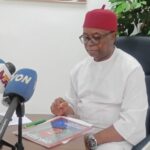
…Maduka, Chairman, Coscharis Group
By Romanus Okoye
The Chairman, Coscharis Group of Companies, Dr. Cosmas Maduka, has said that current economic recession has opened abundant investment opportunities for Nigerian businessmen as he urged Nigerians to take advantage of it instead of complaining.
Maduka, who was the keynote speaker at the end of the year lecture organised by Anambra League of Professionals (ALP) said: “Looking at this, what I see are the abundant opportunities that lie in agricultural industry. We have 34 solid minerals presently discovered, 84 million hectares of vegetative land. Nigeria has the 9th largest gas reserve in the world. We have an urbanisation rate of 3.5 per cent per annum, a population of about 177 million people with a growth rate of 2.7 per cent and average age of 18.
“Nigeria also has an unemployment rate of 13.3 per cent, inflation was at 17.6 per cent in August 2016, the highest figure since October 2005 as cost of housing and utilities, food and transportation rose at a faster pace. We recorded a trade deficit in Q1 2015, which can be attributed to a 56 per cent year to date decline in earnings from exports of crude oil and finally a GDP growth rate of 2.7 per cent y/y in 2015, representing an all time low in GDP growth rate in the last five years,” Maduka said.
He pointed out that Nigeria’s economy contracted by 2.06 per cent in the second quarter of 2016, compared to a 0.36 per cent per cent drop in previous period. “This is the first contraction in 20 years due to a decline in oil prices.”
According to the industralist, “all of these can be classified under challenges or opportunities depending on your outlook and perspective. Remember that entrepreneurial success requires optimism. In the face of this economic situation, where do you see opportunity that falls in line with your passion. What problem have you taken upon yourself to provide a solution? It has been proven that money follows service and consumers are on a daily basis becoming more demanding.
“Now, I am not here to tell you what to do, as I do not have all the answers but rather to provoke you to start asking yourselves those difficult questions. Today, we have seen as a country that we cannot solely rely on oil and have started the process of diversification. Promising industries such as agriculture, trade, ICT, entertainment are lying fallow waiting for young minds to spring up solutions,” he said.
Maduka gave personal notes on the challenges: “In the early 1960s, Nigeria was in a leading position with several export crops including groundnut, cocoa, cotton and palm oil. However, by the mid 1980s, due to the oil boom era, agricultural exports collapsed and the country shifted towards petroleum exploration. By the 1990s, Nigeria’s share in world exports of agriculture had declined to less than 0.1 per cent from excess of 1 per cent. Today, we are net importers of basic goods. It is sad to say that today Nigeria spends N1 trillion annually on massive importation of food, especially rice, wheat, sugar and fish. Looking at this, what I see are the abundant opportunities that lie in agricultural industry.
“This is why at Coscharis we are not just folding our arms and complaining, rather we have decided to be part of the solution. Using the vehicle, Coscharis Farms, we have started a five-year journey to embark on full-mechanised farming and cultivation of rice over 6,500 hectares (3,500 hectares directly owned and another 3,000 hectares through out-grower scheme) located in Anambra State, which the produce from the farm will significantly contribute towards the food sufficiency dream of the country,” he said.
Maduka said that business opportunities in Anambra State are enormous, adding: “I am aware that many of our brothers attempted agricultural business in the late 70s and early 80s; a project that is highly capital intensive, that requires longevity for maturity and I am of a personal opinion that they were unsuccessful because they did not plan for it well or did not enter into it properly.”
He warns: “One requires a different fund from one’s trading fund for agricultural business. And one cannot take a loan at a commercial interest rate to invest in an agricultural project.”